Center Square
Pro-life org disappointed in SOTU’s failure to address mail-order abortion drugs
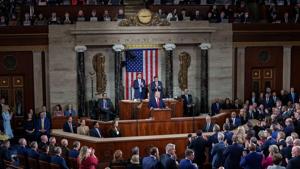
Pro-life organization Susan B. Anthony Pro-Life America is disappointed that mention of what it considers a dangerous mail-order abortion pill was absent from Tuesday evening’s State of the Union, after earlier in the day releasing its own “State of the Unborn” address.
Susan B. Anthony Pro-Life America President Marjorie Dannenfelser told The Center Square that “President Trump’s State of the Union was historic in length, yet he failed to address one of the most urgent and growing crises facing our nation: the pressing issue of dangerous mail-order abortion drugs.”
“The silence was deafening, especially as the Biden-era reckless mail-order abortion policy continues to erode pro-life gains and harm women and babies nationwide,” Dannenfelser said.
Earlier on Tuesday, Marjorie Dannenfelser released a “State of the Unborn” address, in which she detailed what abortion looks like in the nation today.
Dannenfelser called on the Trump administration and GOP leaders to “stand firm on the Hyde Amendment and tackle the crisis of mail-order abortion drugs that is fueling hundreds of thousands of American deaths a year,” according to a press release on the State of the Unborn address..
Dannenfelser told The Center Square that.”tragically, abortions are up, not down, since Dobbs at 1.1 million annually, largely because more than 60% are abortions fueled by mail-order drugs that bypass state protections.”
Dobbs refers to the landmark Supreme Court case in which Roe v. Wade and Planned Parenthood v. Casey were overturned, and it was decided that abortion is not constitutionally protected, as stated by the National Constitution Center.
Dannenfelser told The Center Square that “horror stories are emerging across the country” about the mail-order abortion pill.
“Women are being poisoned and forced into abortions by abusers, traffickers, pimps, boyfriends, and exes ordering the drugs online,” Dannenfelser said.
“Just yesterday, a federal district court in Louisiana held a hearing in Louisiana v. FDA, where Attorney General Liz Murrill and abortion drug coercion survivor Rosalie Markezich highlighted the devastating harms that mail-order abortion drugs are causing,” Dannenfelser said.
Dannenfelser noted that the mail-order abortion issue “is all thanks to Biden’s COVID-era policy of abortion drugs by mail.”
“The Trump-Vance administration could reverse [the policy] today if they chose to act,” Dannenfelser said. “The GOP base is waking up to this harsh reality.”
“Recent polling revealed that 32% would be less enthusiastic about voting in the November midterm election if GOP leaders abandon pro-life policies and 34% would be less willing to volunteer – numbers that rise even higher among the most engaged GOP voters,” Dannenfelser said.
“This problem will only grow as the reality sets in,” Dannenfelser said.
International Monetary Fund says U.S. federal debt ‘too big’

A report from the International Monetary Fund warns that U.S. debt is likely to remain elevated in the coming years, a risk for the U.S. and the global economy.
“The conclusion is that the current account deficit is too big,” IMF Managing Director Kristalina Georgieva said.
The warning comes as Congress mulls a non-binding resolution to limit deficits to 3% of gross domestic product, or GDP, a measure of total economic activity.
The IMF said that the U.S. government deficit is expected to remain in the 7% to 8% of GDP range annually. That would cause government debt to hit 140% of GDP by 2031, IMF officials wrote in their first Article IV review of the Trump administration’s policies.
“While the risk of sovereign stress in the U.S. is low, the upward path for the public debt-GDP ratio and increasing levels of short-term debt-GDP represent a growing stability risk to the U.S. and global economy,” the Article IV report noted.
U.S. debt stands at about $38 trillion, according to the U.S. Treasury Department, highlighting the scale of the financial challenges discussed in the IMF report.
The IMF report also said some of President Donald Trump’s tariffs are working against his pro-growth policies.
“The reduced taxation of tips and overtime pay, combined with increases in the child tax credit, should boost household incomes,” according to the report. “However, staff models suggest that reductions in Medicaid and food assistance, combined with higher tariffs, will act in the opposite direction, resulting in materially lower real disposable incomes for the bottom third of the income distribution and an increase in the poverty rate.”
IMF officials said the U.S. needs a plan to address its financial challenges.
“A clear, frontloaded fiscal consolidation plan is needed to put debt-GDP on a downward trajectory,” the report said.
“Achieving this needed realignment of the fiscal position will require going beyond the ongoing efforts to identify efficiencies in discretionary, non-defense federal spending (which makes up only 15% of total federal outlays),” according to the report. “Rather, the bulk of this adjustment will need to be borne by increases in federal revenues and a rebalancing of entitlement programs (notably social security and Medicare).”
Bipartisan support continues for House Resolution 981, which would limit yearly deficits to 3% of GDP by 2030 or sooner. Last year’s budget deficit was about double that at 6% of GDP.
The resolution sets a target of reducing the deficit to 3% of GDP or less. After reaching that goal, Congress will then aim for a balanced budget. Congress has not achieved this in more than two decades.
House Resolution 981 directs the House Budget Committee to recommend enforcement options within 180 days. These options include procedures for when the target is unmet. The Rules Committee must suggest rule changes to help meet the target. These changes could make it harder to waive budget rules and require the Congressional Budget Office to analyze major bills. The resolution also urges Congress to avoid budget gimmicks.
The last budget surplus was in 2001. Since then, spending has outpaced revenues, and annual deficits grew sharply during the COVID-19 pandemic. The fiscal year 2025 deficit was $1.7 trillion, or about 6% of GDP.
Congress last passed a budget below the 3% target in 2015.
The growing national debt, which is nearing $39 trillion, is largely the result of Congress spending more money than it collects, along with rising costs for Medicare and Social Security as the U.S. population ages and healthcare costs continue to increase.
WATCH: Whitmer touts progress, urges unity in last State of the State
In Michigan Gov. Gretchen Whitmer’s final State of the State address, she touted increased wages, crime reduction and “fixing the roads” over the past seven years.
In the final year of her term, Whitmer promised to focus on improving literacy, closing the housing gap and passing the state budget on time.
Whitmer, a Democrat, said there is a lot she’s proud of from her time as governor.
“Over the last seven years, we’ve delivered on the kitchen table issues together. We’re building a Michigan for all,” Whitmer said. “Wages and GDP are up, crime and overdose deaths are down. Pre K, school meals and community colleges are all free. Taxes on retirement, tips, overtime and Social Security gone. We fixed more roads, built more homes and replaced more lead pipes than ever.”
While Whitmer called out President Donald Trump for tariffs, the speech remained largely conciliatory to the Republicans across the aisle.
“We’re all exhausted by the endless division. Too many people are quick to judge and eager to spin everything they read, watch or hear. It’s stoked by irresponsible leaders and organizations who get more power or make more money when we’re all angry at each other or sad about ourselves,” she said. “Despite these national challenges, Michiganders can show the way forward. We can show the rest of the country how we work together to get things done.”
That will include on the coming fiscal year’s budget, as state Republicans and Democrats joined on Wednesday night to cheer for passing it by July 1. This comes after the budget fiasco of this past year, when the state budget wasn’t finalized until mid-October.
In a surprising olive branch, Whitmer even thanked Trump for his role in Selfridge Air National Guard Base in Macomb County receiving millions in infrastructure upgrades.
Whitmer also laid out her priorities for the coming year.
“In 2026, I’m focused on issues that will help us build a Michigan for all,” she said. “First, our kids’ education, and second, more money in your pocket for housing and healthcare.”
Whitmer added that mitigating the effects of medical debt, protecting Medicaid funding, and ensuring record investments in education will be the focus of her recommendations for the upcoming budget negotiations.
State Republicans put out a number of responses to the speech, but Sen. Aric Nesbitt, R-Porter Township, gave the official response.
In a video filmed on his six-generation dairy and grape farm, Nesbitt called out Whitmer and her time as governor.
“For eight years, Gov. Whitmer has had a bad habit of saying all of the right things, and then doing all of the wrong things, and she’s hoping you’ll forget,” Nesbitt said. “But we haven’t forgotten because we’re living with the consequences. It’s harder and harder than ever to make it in Michigan.”
Nesbitt said Republicans, who control the state House, are focused on cleaning up Whitmer’s “mess.”
“By nearly every metric, Michigan is worse off today than when Gov. Whitmer first took office,” Nesbitt said. “You deserve leaders who share your values and understand your struggles. That’s why Republicans in the House and Senate are fighting every day so you and your family can make it in Michigan once again.”
These are the military heroes awarded the Medal of Honor, Purple Heart, Legion of Merit
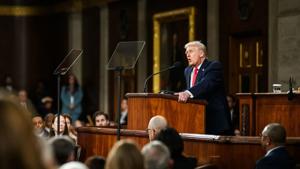
Several members of the U.S. military and Coast Guard received the highest honors for acts of courage and bravery.
Two received the Medal of Honor, two received Purple Hearts and one received the Legion of Merit.
Retired Navy Capt. Royce Williams received the Medal of Honor on Tuesday and on Wednesday, he was inducted into the Pentagon’s Hall of Heroes.
Williams was recognized for his heroic actions during the Korean War. He also served in World War II and Vietnam. A South Dakota native, he joined the Naval Aviation Cadet Program when he was 17. He began flight training in 1943 and retired from the Navy as a captain in 1980.
His renowned solo dogfight with seven Soviet pilots in 1952 has been described by military experts as “one of the greatest feats in aviation history.” He was awarded the Silver Star in 1953, which was upgraded to the Navy Cross in 2023.
“In the skies over Korea in 1952, Royce was in the dog fight of a lifetime, a legendary dog fight,” President Donald Trump said during his State of the Union address. “Flying through blizzard conditions, his squadron was ambushed by seven Soviet fighter planes. It was his first aerial combat of the war. And despite being massively outnumbered and outgunned, Royce led the takedown of four enemy jets and almost destroyed the others — vanquishing his adversaries while taking 263 bullets to his own plane and being seriously hurt.”
For more than 50 years, his mission had been kept a secret and Williams didn’t even tell his wife, Trump said. “But the legend grew and grew,” and now at 100 years old, “this brave Navy captain is finally getting the recognition he deserves.”
Williams described what happened as “God reaching in and dipping His hand in to pick somebody up for the most unusual reasons and displaying him in front of his fellow citizens,’ at a ceremony on Wednesday.
Army Chief Warrant Officer 5 Eric Slover also received the Medal of Honor for an act of bravery causing him to sustain severe injuries.
He was recognized for his role in the capture of Venezuela’s former president Nicolás Maduro during an overnight joint U.S. military mission in Caracas, Venezuela on Jan. 2. The former president and his wife, Cilia Flores de Maduro, were indicted in 2020 on multiple federal charges, including narco-terrorism and drug trafficking.
“Slover planned a mission and was the flight lead in the cockpit of the first helicopter,” Trump said. “Eric steered the Chinook under the cover of night and descended swiftly upon Maduro’s heavily protected military fortress.
“While preparing to land, enemy machine guns fired from every angle, and Eric was hit very badly in the leg and hip — one bullet after another. He absorbed four agonizing shots, shredding his leg into numerous pieces.”
Despite his severe injuries, Slover delivered military operatives to the drop zone. Ensuring they “would capture and detain Maduro was the only thing Eric was thinking about then,” Trump said. “The success of the entire mission and the lives of his fellow warriors hinged on Eric’s ability to take searing pain.
“Even as he was gushing blood … Eric maneuvered his helicopter with all of those lives and souls to face the enemy and let his gunners eliminate the threat — turn the helicopter around so the gunners could take care of business — saving the lives of his fellow warriors from what could have been a catastrophic crash, deep in enemy territory.”
Coast Guard Petty Officer 2nd Class Scott Ruskan has been awarded the Legion of Merit “for extraordinary heroism” after he saved 165 people during the Texas Hill Country flash flood disaster on July 4, 2025. It was the first mission of his career, The Center Square reported.
“People watched Scott from a distance, and they couldn’t believe what they were seeing. The winds were blowing, the rain was pouring, everything was going and that rapid water, nobody had ever seen anything like it. Coast Guard rescue swimmer Scott Ruskan descended from a helicopter above. Nobody knew where he came from,” Trump said.
Two National Guardsmen have also been awarded the Purple Heart after they were shot while patrolling the nation’s capital on Nov. 26. Army Spc. Sarah Beckstrom died from her injuries and received the award posthumously. Air Force Staff Sgt. Andrew Wolfe was also awarded the honor after recovering from life threatening injuries.
The Medal of Honor is only presented by the president to U.S. service members who distinguish themselves “through conspicuous gallantry and intrepidity at the risk of life above and beyond the call of duty.”
The Purple Heart is awarded to military members who are injured or killed in combat, from acts of terrorism or friendly fire.
The Legion of Merit is awarded by the departments of the Army, Navy, Air Force and Homeland Security “for exceptionally meritorious conduct and outstanding service.”
California lawmakers talk about impacts of H.R. 1 for food aid

Members of a California Assembly budget subcommittee heard from state officials who are often the first point of contact for residents who rely on state-run food assistance programs.
The federally-funded Supplemental Nutrition Assistance Program, known as CalFresh in California, provided food assistance to more than 3.2 million residents of the state in 2025, according to data from the California Department of Social Services. Those who work in positions helping CalFresh recipients are seeing the impact cuts from H.R. 1, the federal budget bill passed in July 2025 and known as the One Big Beautiful Bill Act. The budget cuts are expected to eliminate $187 billion in federal funding for SNAP benefits nationwide through 2034, according to the Congressional Budget Office.
“It is often said that a budget is a reflection of our values, and nothing could be truer,” said Assemblymember Corey Jackson, D-Moreno Valley and chair of the Assembly Budget Subcommittee for Human Services.
“The conversations that shape those values begin right here within these walls, within this room, at this historic time for our social safety net,” Jackson said during the committee’s meeting on Wednesday afternoon at the Capitol in Sacramento.
CalFresh currently serves more than 5.3 million individuals in 3.1 million households with an average monthly benefit of $333 a month, Troia testified during the hearing.
“The federal changes under H.R. 1 will have very major impacts on these households,” Jennifer Troia, director of the California Department of Social Services, testified. “We estimate $2.3 [billion] to 4.3 billion in annual federal funding reductions, and the governor’s budget assumes that as many as 578,000 people could lose benefits as a result of H.R. 1.”
Troia also testified that CalFresh workers are attempting to offset the worst effects of H.R. 1 by maximizing allowable exemptions, using data to help CalFresh recipients keep their benefits, reducing administrative burdens and connecting people who rely on CalFresh to organizations that can help them satisfy work and activity requirements.
“Even with these efforts, it is critical to acknowledge again that we expect that many Californians may lose access to CalFresh,” Troia testified. “They would face increased food insecurity and greater difficulty meeting basic needs, with corresponding impacts on their health and well-being.”
State officials who testified on Wednesday also acknowledged that many immigrants who reside in California illegally will lose their access to CalFresh, as well as foster youth and veterans, among other CalFresh recipients. Problems with funding that existed before the H.R. 1 cuts also impact the workers who provide services to those who need food assistance, officials said.
“We must acknowledge the historic moment we find ourselves in,” Jackson said during the meeting. “Those who are worried about their services being cut or reduced, we are doing everything that we can to make sure that we keep you stable, that we keep you safe and that you have an opportunity to be on a path to thrive here in the state of California.”
Surgeon general appointee advocates for a new vision for American health care

Surgeon General appointee Casey Means fielded pointed questions from both parties during her confirmation hearing Wednesday, while outlining a vision for American health that emphasizes prevention and addresses the root causes of disease.
While eventually, senators asked Means’ about her qualifications for the role – Means completed medical school at Stanford University and later left a surgical residency to pursue work in metabolic health – for the first rounds of questioning, senators largely focused on Means’ alignment with the “Make America Healthy Again” agenda and the ethical promotion of health programs or products.
Multiple senators, including Republican Sen. Bill Cassidy of Louisiana – who is himself is a medical doctor – probed Means on her view of vaccines.
In the leadup to his question, Cassidy spoke of the situation in South Carolina, where a measles outbreak that started in October has racked up nearly 1,000 cases. Most of those cases have been people under the age of 18, with about a third occurring in children under five. The state’s Department of Health has reported that 913 cases have occurred in people who are unvaccinated and a handful in those who are partially vaccinated. Twenty-six have received both doses of the MMR vaccine. There have been no reported deaths from the outbreak.
“You’re a mom. We’re on the verge of losing our measles elimination status. Would you encourage other mothers to have their children vaccinated against measles with the MMR vaccine?” Cassidy asked.
Means affirmed that she believes “vaccines save lives” and are a “key part of any infectious disease public health strategy,” but she did not say that she would issue statements as surgeon general broadly encouraging parents to vaccinate their children against measles.
Instead, she emphasized the importance of “informed consent,” something she mentioned many times, saying it was important to “[rebuilding] trust in public health.”
“I’m not an individual’s doctor, and every individual needs to talk to their doctor before putting a medication in their body,” she said.
Cassidy also asked Means about the scientific basis for linking vaccines to autism. He and others were adamant that there’s “a lot of evidence” showing there’s no connection.
“Some have been scared to vaccinate their children because they’ve been told incorrectly that vaccines cause autism. Do you believe that vaccines, whether individually or collectively, contribute to autism?” Cassidy asked.
“The reality is that we have an autism crisis that’s increasing, and this is devastating to many families, and we do not know as a medical community what causes autism,” Means replied. “The administration has just committed a huge amount of funding to look at the exposore of all environmental factors that could be contributing to autism, and until we have a clear understanding of why kids are developing this at higher rates, I think we should not leave any stones unturned.”
Others questioned Means’ promotion of various health and wellness products and programs, saying that she has repeatedly not followed Federal Trade Commission rules requiring promoters to disclose their financial relationship to the brand they’re endorsing.
Democratic Sen. Chris Murphy of Connecticut said that his staff found that Means had been paid by brands like Function Health, Genova Diagnostics, Daily Harvest and Zen Basil Seeds and more often than not, recommended them multiple times without making that clear.
“This seems systemic. It seems that in the majority of instances in which you were as a medical professional recommending a product, you were hiding the fact that you had a financial partnership. You seem to be in regular willful violation of the FTC rules. That is concerning,” Murphy said.
Means contested Murphy’s staff’s findings as a “false representation.”
Means said that her focus as surgeon general would be to affect a “paradigm shift” in the U.S. on how its health care system should function and the problems it seeks to address. Means described shifting from “reactive sick care” to a proactive health care system, one that is incentivized to treat root causes and help patients achieve robust health rather than treat the symptoms of chronic disease.
“Mental and physical health are unraveling from shared root causes that we can fix,” Means said, listing heart disease, diabetes, dementia and depression as some prevalent diseases that are often preventable through diet and lifestyle. “As surgeon general, I would call on every American and the Public Health Service to join in a great national healing, one that halts preventable chronic disease, makes healthy living the easiest choice, honors the body’s connection to the environment and puts America back on the road towards wholeness and health.”
FBI searches Los Angeles schools superintendent’s home

FBI agents on Wednesday searched the home and office of Los Angeles Unified School District Superintendent Alberto Carvalho.
The reason hasn’t been revealed.
An LAUSD spokesperson told The Center Square that the district has been informed of law enforcement activity at district headquarters and the superintendent’s home in Los Angeles.“The District is cooperating with the investigation,” the spokesperson said in an email. “We do not have further information at this time.”A public affairs specialist at the FBI Los Angeles office confirmed by phone that a “court-authorized warrant” had been served.“However, the affidavit is sealed by the court,” the specialist told The Center Square. “I’m not in a position to comment further.”The U.S. Attorney’s Office for Los Angeles made a similar comment when called by The Center Square.Los Angeles Mayor Karen Bass’ communications office told The Center Square that LAUSD is an independent body not governed by the city.“The Mayor’s Office has no information about this,” the office said.LAUSD is the nation’s second-largest school district. Only the New York City school system is bigger.LAUSD serves more than 500,000 students in an area covering 710 square miles.Carvalho has served as LAUSD’s superintendent since February 2022 and has been the district’s longest-serving superintendent in over 20 years. Prior to his job at LAUSD, Carvalho was superintendent of Miami-Dade County Public Schools for 14 years.Carvalho’s latest post on X is from Feb. 24, when the superintendent posted a TV station’s report on an increase in advanced placement enrollment in the district.
Trump administration halts $259M in Medicaid funds to Minnesota

The Trump administration will halt approximately $259 million in federal funds from Medicaid in Minnesota, Vice President JD Vance said Wednesday.
Vance, alongside Administrator for the Centers of Medicare and Medicaid Services Mehmet Oz, cited concerns of fraud for the pause in payments. Oz said the exact figure is based on an audit in Minnesota over the last three months of 2025.
“Far too many people have gotten rich by taking what is the best of the American spirit and getting rich off of it, instead of providing services to kids who need it,” Vance said. “That is stopping today.”
Oz cited examples in Minnesota where health care providers for children with autism made false claims to the government in order to receive federal payments. In one example, a health care provider billed the federal government for eight patients who were dead, according to Oz.
He said the fraud schemes tend to be insulated to immigrant communities in Minnesota and involve reported services that were never delivered.
Vance and Oz gave Minnesota Gov. Tim Walz a 60-day deadline to propose a plan addressing the fraud in order for the government to release withheld funds. Oz clarified that the state government already has funds to cover the costs of necessary services but will simply not be reimbursed by the federal government until a solution is announced.
“This is not a problem with the people of Minnesota,” Oz said. “It’s a problem with the leadership of Minnesota and other states who do not take Medicaid preservation seriously, any delay in services is going to be and should be laid at the seat of Governor Walz.”
Vance said he is looking for proof from leadership in Minnesota that Medicaid payments are being verified and provided for accordingly.
“The fact that there are so many people handing out millions and billions of dollars of federal Medicaid money without even confirming that they’re doing the thing that they say that they’re doing, it’s a disgrace,” Vance said. “It’s a defrauding of the American taxpayer, and we’re stopping it.”
Oz estimated fraud, waste and abuse payments in healthcare across the country total about $500 billion.
Vance and Oz also announced a six month moratorium on durable medical equipment enrollment. This includes orthotics equipment and other medically necessary devices. Oz said the issue with medical equipment is becoming a large problem across the country.
“This unfortunate necessity is going to allow us to get on top of what we believe is billions of dollars of DME frauds,” Oz said. “We already stopped a billion and a half dollars of billing, but we need more time to shut down these bad guys.”
Oz and Vance said there will be more announcements “soon” to tackle fraud in other states. They mentioned California and New York as particular examples but did not make any official announcements on efforts in either states.
“Our social safety net will disappear unless we take fraud more seriously,” Vance said. “What I’m most worried about is that unless we preserve these programs for the next generation, they’re going to disappear, and all the money is going to go to fraudsters.”
State of Union criticized by Southwest Dems, praised by GOP

Members of Congress from the Southwest reacted along party lines to this year’s State of the Union.
President Donald Trump spent much of his Tuesday night speech talking about the economy, immigration, Iran, voter ID and crime. According to the president, America is safer today than it was when Joe Biden was in office.
U.S. Sen. Michael Bennet, D-Colorado, disagreed with Trump’s comments on various issues before the joint session of Congress.
“At the State of the Union, President Trump once again tried to convince us that what we have seen with our own eyes is not the truth,” Bennet told The Center Square Wednesday. “Coloradans have witnessed the reality: American citizens shot and killed in U.S. cities, families living in fear and struggling to afford health care and groceries, and small businesses fighting for survival under the weight of Trump’s tariffs.”
As a result, Bennet said that he will continue to fight for truth and protect Colorado communities suffering under Trump’s “lawlessness.”
U.S. Rep Judy Chu, D-California, said on X that the State of the Union is meant to be unifying, not divisive.
“His speech was a disgraceful partisan spectacle, full of lies and non-stop attacks on his political enemies,” said Chu, whose district includes Pasadena.
U.S. Sen. Jacky Rosen, D-Nevada, disagreed with Trump’s statements that Americans are better off today than before he re-entered office. In a post on X, Rosen said life got more expensive for Nevada families during Trump’s first year back.
“Trump has weakened the state of our Union, and Nevadans need to hear him outline a real plan to actually address the affordability crisis,” said Rosen.
Some Democrats skipped the event, including U.S. Sen. Ruben Gallego, D-Arizona.
Gallego instead went to an alternate event known as The People’s State Of The Union.
“Trump has made us sicker, poorer and less secure,” said Gallego in a speech at the alternate event.
Arizona’s other U.S. senator – Mark Kelly – attended the president’s State of the Union. While the Democrat said in a press release that “Donald Trump mentioned a few things I agreed with, banning stock trading in Congress and stopping hedge funds from buying single-family homes,” Kelly criticized Trump for “handing a giant tax cut to rich people.”
U.S. Rep. Abe Hamadeh, R-Arizona, liked the address, especially the moments where Trump recognized military service members.
“As a member of the Armed Services committee in the U.S. House, I fought for E. Royce Williams to receive the Medal of Honor, so that was a particular highlight for me,” Hamadeh told The Center Square Wednesday.
Williams, a 100-year-old South Dakota native who lives today in San Diego, was honored for his actions as a Korean War fighter pilot.
As Hamadeh described it, the president’s speech focused on America’s victories and celebrated greatness and true heroism.
“From a mom waiting tables to some of the greatest athletes on earth, to warriors recovering from service to our country, American greatness was on full display and celebrated,” said Hamadeh.
Trump asked lawmakers to stand if they agreed government should protect Americans before illegal aliens. Democrats didn’t stand, and Hamadeh said it will be long time, if ever, that Democrats will recover from that fact.
“I make every effort to work in a bipartisan way, but last night the Democrats made it very clear why that is almost impossible,” said Hamadeh. “I have to agree with President Trump. Most of them are crazy.”
U.S. Rep. Andy Biggs, R-Arizona, considered the State of the Union to be an incredible speech.
“The best ever,” said Biggs while shaking hands with Trump after the address ended.
Trump’s tariffs set to rise to 15% for some countries, Greer says
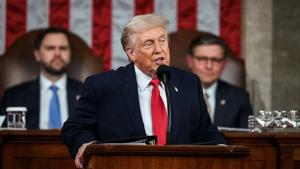
The Trump administration signaled a possible climb in some U.S. tariffs above 10%, but provided few specifics.
Jamieson Greer, the U.S. trade representative, said Wednesday that the 10% tariff on imported goods was likely to increase.
“Right now, we have the 10% tariff. It’ll go up to 15% for some and then it may go higher for others, and I think it will be in line with the types of tariffs we’ve been seeing,” Greer said on Fox Business’ “Mornings with Maria.”
Trump first announced a 10% global tariff hours after the Supreme Court struck down his tariffs under a 1977 law last week. The next day, he said he would raise that global rate to 15%.
The 10% global tariff Trump signed on Friday went into effect at 12:01 a.m. Tuesday. A bulletin from U.S. Customs and Border Protection said that Trump’s executive order imposed an additional 10% ad valorem duty. The duty applies to imported articles of every country for 150 days under Section 122 of the Trade Act of 1974, with exceptions.
Before the Supreme Court’s ruling on Friday, the United Kingdom paid the lowest import duties at 10%. Most other nations faced higher rates, including the European Union, Japan, Indonesia and others.
Greer told Bloomberg TV that the White House was preparing to raise the temporary tariffs to 15% “where appropriate.”
Kevin Hassett, director of the National Economic Council of the United States, told reporters that tariffs would remain a key part of Trump’s economic agenda, even after the ruling.
“The tariffs are not going back to zero,” he said. “That’s not going to happen.”
The Yale Budget Lab found that consumers faced an overall average effective tariff rate of 16% before the Supreme Court ruling. After the ruling, it fell to 9.1%, then climbed back to 13.7% when Trump imposed Section 122 tariffs. The Yale Budget Lab also estimated that the Section 122 tariffs would mean a loss of between $600 and $800 for the average U.S. household.
The Supreme Court, split 6-3, ruled that the International Emergency Economic Powers Act didn’t give Trump expansive tariff powers. Justices Clarence Thomas, Brett Kavanaugh and Samuel Alito dissented.
“The Framers gave ‘Congress alone’ the power to impose tariffs during peacetime,” Chief Justice John Roberts wrote for the majority.