Center Square
U.S. cut 92,000 jobs in ‘dismal’ February report, unemployment 4.4%

The U.S. economy lost 92,000 jobs in February, a significant cut after January saw a better-than-expected report, according to the Bureau of Labor Statistics.
The unemployment rate remained steady at 4.4%. The rate only marginally increased from its 4.3% rate in January. Interestingly, health care employment decreased in February, reflecting a rare instance that the BLS attributed to strike activity. Over the past several weeks in California, thousands of nurses went on strike to protest pay, working conditions and staffing.
Additionally, a nurses strike in New York City may have had additional effects on the health care sector, which typically drives most job growth in the report. Overall, the health-care sector lost 28,000 in February after adding 77,000 in January.
Over the past 12 months, the health care industry has added roughly 36,000 jobs per month.
Employment in the information and federal government sectors trended down in February as well. Jobs in the information sector decreased by 11,000 in February.
Federal government jobs continued to decrease in February with a loss of 10,000. Since October 2024, federal government employment has decreased by 330,000.
Heather Long, chief economist at Navy Federal, described February’s report as “dismal.” She said, overall, the U.S. economy has lost jobs since April 2025 based on the February report.
She estimated jobs from May 2025 to February 2026 decreased by 19,000.
“Companies are not hiring in the face of all these headwinds and uncertainty,” Long wrote on social media. “Even healthcare is starting to slow down.”
Social assistance employment was one of the few sectors to see an increase during the month of February. The sector saw an increase of 9,000 jobs, largely driven by a 12,000 job increase from the individual and family services sector.
Nearly all major employment sectors lost jobs in February. The hospitality sector lost 27,000 jobs; manufacturing lost 12,000 jobs; and the construction sector lost 11,000 jobs.
Turmoil in Texas: Concerns for Paxton to drop out, Gonzales drops reelection bid
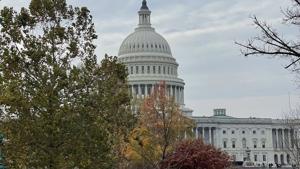
Within two days of the March primary election, two high-profile races are already in turmoil. Republican leaders are taking actions to keep the seats red, expressing support for one incumbent and calling for another to end his reelection campaign.
On Tuesday, U.S. Sen. John Cornyn led the primary results heading into a runoff with Attorney General Ken Paxton. By Wednesday, President Donald Trump said he’d soon issue an endorsement. Paxton has issued conflicting statements, saying he won’t drop out regardless of who Trump endorses and he’d consider dropping out if the Senate passes the SAVE Act.
Meanwhile, House leadership called on disgraced U.S. Rep. Tony Gonzales, a Republican representing a west Texas border district, to end his reelection campaign after he admitted this week to having an affair with his staffer who then killed herself. Gonzales was forced into a runoff election by Second Amendment advocate Brandon Herrerra, who political analysts believe could keep the seat red in November. Late Thursday night, Gonzales acquiesced after months of denying the affair and saying he wouldn’t drop out or resign.
Trump said in a social media post the divisive U.S. Senate race in Texas “cannot, for the good of the Party, and our Country, itself, be allowed to go on any longer. IT MUST STOP NOW! I will be making my Endorsement soon, and will be asking the candidate that I don’t Endorse to immediately DROP OUT OF THE RACE! Is that fair? We must win in November!!!”
Polls show Cornyn defeating Democratic nominee state Rep. James Talarico, D-Austin, in November but a matchup with Paxton shows Republicans likely losing the seat for the first time in more than 30 years. The Texas U.S. Senate seat has been considered a safe Republican seat, but with Paxton challenging Cornyn an estimated $100 million or more would need to be spent to defend the seat instead of on other senate races to keep a Republican majority in the Senate, political analysts argue.
On Thursday, Paxton said he’d consider dropping out of the race if the Senate passes the SAVE Act, which includes additional requirements to ensure only U.S. citizens are voting.
“I would consider dropping out of this race if Senate Leadership agrees to lift the filibuster and passes the SAVE America Act,” Paxton said. He also attacked Cornyn for not abolishing the filibuster and “Fake News reporters and the establishment are trying to destroy me with misinformation,” claiming “No one has been more loyal to Donald Trump than me.”
Within 24 hours of making that statement, he’d also told online websites and podcasters he would not drop out of the race regardless of who Trump endorses.
U.S. Senate Majority Leader John Thune said he’s spoken with Trump on several occasions asking him to endorse Cornyn. He says Cornyn “is an incredibly effective senator for the state of Texas, a strong conservative voice here in the United States Senate. He represents by far our very best hope of making sure that Texas stays red in November. I’ve certainly weighed in many, many times in support of Senator Cornyn.”
On Thursday, in a joint statement, House Speaker Mike Johnson, Leader Steve Scalise, Whip Tom Emmer and Chairwoman Lisa McClain called on Gonzales to end his reelection campaign.
“The Ethics Committee has announced an investigation into Congressman Tony Gonzales’s conduct, and we urge them to act expeditiously. Congressman Gonzales has said he will fully cooperate with the investigation. We have encouraged him to address these very serious allegations directly with his constituents and his colleagues. In the meantime, Leadership has asked Congressman Gonzales to withdraw from his race for re-election,” they said in a joint statement.
Several hours later, Gonzales agreed, stating, “After deep reflection and with the support of my loving family, I have decided not to seek reelection while serving out the rest” of his term. He did not apologize to the former staffer’s family or husband or his constituents.
Herrerra thanked the House leaders “for holding Congressman Tony Gonzales accountable for actions that have tarnished the office. I’m looking forward to representing the district the way the people of West Texas have always deserved.”
The runoff election is May 26.
HHS and DOC announce nutrition education initiative for medical schools
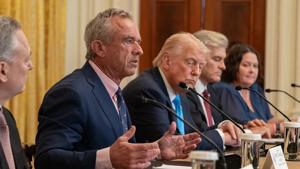
Nutrition education for medical students will become more prominent in curriculum beginning this upcoming fall.
U.S. Department of Health and Human Services Secretary Robert F. Kennedy Jr. and U.S. Department of Education Secretary Linda E. McMahon announced the advancement of nutrition education for medical students on Thursday.
According to Kennedy, chronic disease is overwhelming America and is accelerating.
“Today, we spend $4.5 trillion a year on health care, and 90% of it goes to managing chronic disease,” Kennedy said.
According to McMahon, diet-related chronic diseases contribute to roughly 1 million deaths each year, impose enormous economic and emotional costs on the American population, and 14.7 million school-aged children currently suffer from obesity.
“Today’s announcement puts nutrition and prevention front and center in how we train tomorrow’s doctors and healthcare leaders,” McMahon said.
To improve the health of American citizens, the Health and Human Services and Education departments have created a taxpayer-funded initiative that 53 universities across 31 states will use to guarantee medical students learn more about nutritional health.
“The Department of Education will never mandate curriculum, that is not our job, but we can and will spotlight promising evidence-based models, convene leaders who are improving health outcomes, and celebrate institution-driven curriculum reforms that are reforming medical education,” McMahon said.
The HHS will invest $5 million taxpayer dollars through a multi-phase National Institues of Health nutrition education challenge, to support curriculum development and fund clinical training in gold standard science. The effort will expand beyond medical schools to residency programs, nursing dietitian and nutrition science programs nationwide.
“It has always been the goal of healthcare professionals to not just treat but to prevent disease,” Jeffry P. Gold, M.D., president of University of Nebraska System, said.
The Advancing Nutrition Education Across the Medical Continuum initiative readjusts curricumlum for health and nutrition benefit, ensuring medical students will be required 40 hours of comprehensive nutrition training prior to graduation. Prior to this initiative, less than two hours were required in some schools and 75% of schools did not require any hours.
“Nutrition has been treated as an elective in medical education,” Bobby Mukkamala, MD, president of the American Medical Association said. “It should be a basic foundational training, because it impacts every one of our patients.”
According to Kennedy, more than 30,000 physicians each year will now graduate equipped with nutrition education to help prevent, treat and reverse chronic disease.
“This is how we make America healthy again,” Kennedy said.
More information, including the schools that now follow the initiative, can be found at hhs.gov/nutrition-education.
Farm bill, with changes, heads to U.S. House for vote

After more than 22 hours of debate, the Agriculture Committee in the House of Representatives voted early Thursday morning to advance the Farm, Food, and National Security Act of 2026.
Seven Democrats – despite voicing objections to measures limiting federal investments into farmland solar projects and loosening restrictions on PFAS chemicals and pesticides – ultimately supported the bill.
Those included Democratic Reps. Adam Gray and Jim Costa of California, Josh Riley from New York, Sharice Davids of Kansas, Don Davis of North Carolina, Gabe Vasquez of New Mexico, and Kristen McDonald Rivet of Michigan.
The five-year bipartisan farm bill renews and enhances crop insurance, disaster assistance, risk management programs, loans for farmers, and federal agricultural research.
It also invests in rural broadband connectivity, forestry management, rural water infrastructure and hospital assistance, and the Rural Energy for America Program.
Additionally, it transfers authority over the Food for Peace initiative from USAID to the U.S. Department of Agriculture, requiring at least 50% of food distributed to be sourced from the U.S.
Committee Chairman Glenn Thompson, R-Pa., said the bill totals roughly $1.3 trillion and “reflects the will of the committee, and it is filled with bipartisan provisions that will move the needle for farmers, ranchers, and rural Americans across the country.”
Out of the dozens of amendments put forward during the markup, lawmakers adopted less than 10 into the bill. The proposal heads to the House floor for a vote as soon as next week.
Key amendments include increasing research on food waste, broadening eligibility for grants to volunteer fire departments, creating a reserve fund for REAP, and requiring a report on the effects of proposed changes to the United States-Mexico-Canada Agreement.
Democratic amendments rolling back the cost-cutting reforms to the Supplemental Nutrition Assistance Program in Republicans’ One Big Beautiful Bill Act all failed.
House Agriculture Committee Ranking Member Angie Craig, D-Minn., called the legislation “a shell of a farm bill” and refused to support it Thursday.
“Have we made some bipartisan improvements to the bill during the amendment process? Sure,” Craig said. “But despite that, this remains a lackluster, disappointing farm bill that does not meet the moment. And it is going to have challenges getting broad bipartisan support on the floor.”
Stakeholders held mixed reactions to the bill. Some sided with Democrats, condemning the bill for its lack of SNAP support.
In a Thursday statement, the Food Research & Action Center said the bill “blatantly ignores the robust impact of SNAP in supporting families, farmers, food retailers, and America’s overall economy.”
Other organizations, however, rejoiced that Congress finally made progress on a farm bill after eight years. The American Farm Bureau Federation said the legislation is “critical as farmers face headwinds not seen in a generation.”
“The farm bill has a ripple effect across the country by supporting the farmers who grow the food that stocks every kitchen pantry in America,” President Zippy Duvall of the federation said. “We urge House leaders to continue the momentum and bring this important legislation to a vote on the floor.”
These are the members of Congress who voted against disclosing sexual harassment claims

Nearly all members of Congress, 357 Republicans and Democrats, don’t want taxpayers to know which members have used taxpayer funds to pay sexual harassment claims.
An untold number of members of Congress have spent a combined roughly $17 million of taxpayer money to settle sexual harassment claims made against them, according to House records, U.S. Rep. Thomas Massie, R-KY, says.
U.S. Rep. Nancy Mace, R-SC, this week proposed forcing a vote on a resolution she filed directing the U.S. House Committee on Ethics to “preserve and publicly release all records related to investigations into Members of Congress for sexual harassment, unwelcome sexual advances, and sexual assault under House rules.”
“Congress has been sweeping this under the rug for far too long. Tony Gonzales may be the latest example, but he’s not the only one,” Mace said, referring to U.S. Rep. Tony Gonzales, R-TX, who is refusing to resign after months of denying he had an affair with his former staffer, Regina Ann Santos-Aviles, who later killed herself.
Gonzales, who is running for reelection, received roughly 42% of the vote and heads to a runoff. As constituents continue to call for him to resign, he admitted to the affair on Wednesday on a podcast saying he “made a mistake, had a lapse in judgment and a lack of faith.”
The admission, critics argue, is too late. The Office of Congressional Conduct had been investigating Gonzales for months, the San Antonio Express-News reported. The news outlet also published text messages sent between Gonzales and Santos-Aviles in which she said he’d “gone too far,” provided by her husband. Now the House Ethics Committee has opened an investigation.
“Staff deserve to come to work without being harassed by their bosses. Women deserve to be safe,” Mace said. “And the American people deserve to know when their so-called ‘representative’ is abusing power instead of serving their constituents. No more hiding. No more excuses. It’s time to end the cover-up and drag the truth into the light.”
The majority of Congress on Wednesday, 357, disagreed. Nearly all Republicans, 175, and nearly all Democrats, 182, voted to refer the resolution to the committee, essentially killing it. One member voted present not voting, nine didn’t vote, according to the roll call vote.
Those who voted to “refer it to committee” did so knowing the “resolution ain’t ever making it out of committee,” U.S. Rep. Thomas Massie, R-KY, said. Massie has been calling for the release of names for years.
Only 65: 38 Republicans and 27 Democrats, voted in support of the resolution by voting against the motion to refer it to the committee.
U.S. Rep. Lauren Boebert, R-Colorado, said she was “disgusted,” saying, “Don’t we all campaign on transparency? Millions of dollars have been used in this slush fund as hush money to silence victims who have been sexually harassed, sexually abused by members of Congress. Now Congress is going to do exactly what it does best: investigate itself. And we know that none of that ever goes anywhere. The American people demand transparency.”
To all the members of Congress that voted today to continue to conceal Congress’s sexual harassment slush fund, go home and tell your daughters what you’ve done. pic.twitter.com/3K84hYOJNs— Rep. Lauren Boebert (@RepBoebert) March 4, 2026
U.S. Rep. Anna Paulina Luna, R-FL, also chastised members for “protecting” Gonzales, arguing they care more about winning elections and keeping a majority in Congress than about victims.
The 357 who voted to send the resolution to the committee “know it’s going to die. We know that members of Congress are using taxpayer dollars to pay off sexual harassment. We just had a member of Congress literally sexually harass someone who lit herself on fire and you guys all protected him. … It’s wrong that we cover up … and won’t censure our own side,” she said.
.@RepLuna: “I think it’s really disgusting how this institution protects itself…we just had a Member of Congress literally sexually harass a woman that then lit herself on fire and you all protected him! You guys all protected him! My own side, your side.” pic.twitter.com/b7M8RaQ4Ru— CSPAN (@cspan) March 4, 2026
After the 357 members voted to keep congressional sexual harassment records buried, Mace said, “Both parties colluded to protect predators. They voted to keep sexual harassment records buried, and they did it together.
“Every Member who voted against this resolution voted to protect the cover-up instead of the victims.”
She warned the American people: “This is the establishment in action, always protecting itself, never the victims. Ask yourself why. Remember their names when they ask for your vote.”
House Republicans re-pass DHS funding bill in symbolic vote
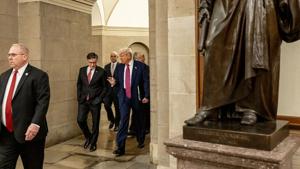
The U.S. House re-passed the 2026 Homeland Security funding bill in a symbolic vote Thursday, amping up pressure on Democrats as DHS remains shuttered while the U.S. engages in military hostilities with Iran.
Four Democrats joined Republicans in the 221-209 vote, only hours after Senate Democrats again voted to keep DHS closed. They say they will oppose any funding bill that fails to adopt their proposed restrictions on immigration enforcement activities.
The successful House vote accomplished nothing except providing Republicans with another opportunity to point out the risks of keeping DHS agencies closed. House Speaker Mike Johnson, R-La., told reporters that “everybody in America better watch that board.”
This is the second time in less than six months that Democrats have forced a shutdown over policy demands, with the most recent lasting a record-long 43 days.
With no federal funding, DHS employees deemed “essential” – including TSA agents and most members of FEMA, the Coast Guard, and the Secret Service – must work without pay during a shutdown, while the rest are furloughed. While those agencies haven’t closed, they have ceased nonessential operations.
“Democrats continue to refuse to fund the Department of Homeland Security. Their message is clear: the safety of our homeland is not their priority,” Rep. Mark Harris, R-N.C., posted on social media. “Democrats are willing to risk the security of America to play politics.”
Calls for greater accountability in DHS erupted after an ICE agent fatally shot 37-year-old Alex Pretti in January, the second killing during that month of a U.S. citizen protesting in Minneapolis.
Democrats’ policy demands include prohibiting DHS agents from wearing masks, racially profiling, indiscriminately arresting people, tracking protestors, or entering private property without a judicial warrant in addition to an immigration court warrant.
Other changes Democrats want to see include requiring agents to display ID, wear body cameras, and obtain the consent of states and localities to conduct large-scale operations, among other things.
The Trump administration threw cold water on most of the proposals, arguing that personal ID requirements would endanger agents and that requiring judicial warrants or making “sensitive” locations off-limits would handicap the agency’s ability to do its job.
But the White House has also taken some conciliatory steps as well, such as implementing body-worn cameras and ending roving patrols. President Donald Trump also ousted DHS Secretary Kristi Noem on Thursday ahead of both DHS votes.
The changes, however, remain insufficient for most Democrats.
“I’ve been saying for months that Kristi Noem has got to go. But changing the name on the door doesn’t change the fact that this Administration’s DHS has caused chaos in our communities for months, ripped families apart, and killed American citizens,” Rep. Grace Meng, D-N.Y., stated. “I won’t support any funding for DHS until this rogue agency is held accountable from top to bottom.”
Trump’s newest tariff program won’t raise nearly as much money
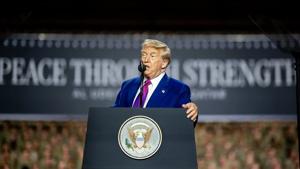
President Donald Trump’s newest tariffs, which already face a legal challenge in court, could increase deficits by $1.6 billion over the next decade, if they survive court scrutiny.
The latest developments mark a pivotal moment for Trump’s trade agenda, as his administration’s use of tariffs faces mounting challenges. With the Supreme Court limiting presidential authority on tariffs and new measures under alternative laws already sparking controversy, the outcome will have ramifications for the U.S. economy, federal budget, and global trade relations.
The Congressional Budget Office, which provides budgetary analysis to federal policymakers, projected that the reduction in tariff rates after the Supreme Court decision would bring in roughly half the revenue from Trump’s reciprocal tariffs.
Last month, the Supreme Court delivered a setback to one of Trump’s signature initiatives, dismissing his administration’s claim that the 1977 International Emergency Economic Powers Act granted the president broad authority to levy duties on foreign imports. After the ruling, the president introduced a new global tariff under Section 122 of the Trade Act of 1974, which, according to the administration, permits the president to impose tariffs of up to 15% for up to 150 days to address major international payments issues.
The Congressional Budget Office estimated that the reduction in tariffs following the Supreme Court decision will increase primary deficits by $1.6 trillion over the next decade. The CBO also noted that some previously collected tariff revenue could be refunded.
“We estimate that about $150 billion in customs duties were collected as a result of the IEEPA tariffs before they were removed. Some importers have made claims for refunds of those duties as well as for interest,” according to the report. “The extent and timing of payments to those importers are uncertain. Because of that uncertainty, the estimated change in deficits reported above does not reflect refunds of previously collected duties.”
Trump’s tariff policy could hamper the U.S. economy, according to the CBO report.
“We projected that changes in trade policy since January 2025 would temporarily raise the rate of inflation, reduce real investment, lower the level of real gross domestic product, and reduce employment,” CBO Director Phillip Swagel wrote. “The termination of IEEPA tariffs dampens those effects.”
Gross domestic product is a measure of the nation’s total economic activity.
Much about Trump’s tariffs remains unclear.
“Our tariff projections continue to be uncertain, in part because the Administration may change how tariff policies are administered. For example, if mechanisms for additional exemptions were implemented, the tariff duties collected could decline substantially,” Swagel said. “Moreover, the United States has not implemented changes in tariffs of this size in many decades, so there is little empirical evidence to guide our estimates of their long-term effects.”
Last month, the Supreme Court ruled that the International Emergency Economic Powers Act does not grant the president broad authority to impose tariffs. Since the ruling, Trump has used alternative laws to impose a 10% global tariff on imports, with some exceptions.
The president is working to salvage trade agreements with foreign nations made last year, following his April 2025 announcement of reciprocal tariffs on every U.S. trading partner. Tariffs have become a central policy focus of Trump’s second term in office.
Trump is also seeking to re-establish high tariff barriers through alternative legal avenues, including trade investigations under Section 301.
“It’s my strong belief that the tariff rates will be back to their old rate within five months,” Treasury Secretary Bessent said Wednesday on CNBC’s “Squawk Box.”
Bessent also noted that Trump’s proposed 15% global tariff could be implemented as soon as this week.
Trump has relied on tariffs to advance key campaign promises since returning to the White House in 2025, including a proposed $2,000 tariff rebate for most Americans. He has asserted that tariff revenues could fund increased military spending, replace income taxes, and help reduce the federal government’s $38.7 trillion debt. Experts caution that tariff revenues are unlikely to cover the cost of those initiatives.
Legal experts: Supreme Court should decide energy policy framework over climate lawsuits

The U.S. Supreme Court will hear arguments in the fall over a case to decide whether states can sue fossil fuel companies for damages related to global climate change.
The court agreed to hear arguments in Suncor Energy Inc. v. County Commissioners of Boulder County. The case centers on officials in Boulder County, Colorado, who claimed fossil fuel companies should be liable for damages resulting from emissions that cause climate change across the globe.
The state and local government officials argued that fossil fuel companies are liable under nuisance laws. Typically, state nuisance laws are used in disputes with neighbors where an individual may be conducting activities that lower the value of another individual’s property. Legal experts said state nuisance laws are inappropriate to address damages from climate change.
Michael Gerrard, a law professor at Columbia Law School, said there are more than two dozen lawsuits in states across the country against fossil fuel companies with similar arguments as Boulder County, Colorado.
West Virginia Solicitor General Michael Williams said this kind of litigation will cripple the energy industry in his state. He said litigation from other states attempting to regulate in West Virginia is alarming.
“This is really a debate about how those industries continue to function,” Williams said. “Especially as the science and the regulatory structure continues to evolve when it comes to issues like climate change.”
Williams said climate change activists have been attempting to use court litigation to implement a federal level energy policy that regulates emissions. He argued that the U.S. Supreme Court needed to address this before it was settled in a state court.
“Questions that touch on global energy markets and interstate commerce and foreign policy, those are decisions that really belong in the hands of Congress or at the very least at the federal level,” Williams said.
When the court agreed to take up the case, the justices asked whether it has authority under Article III of the Constitution to decide it, even though litigation has not fully proceeded in Colorado’s state courts.
Other cases have advanced across the country, albeit with slightly different arguments. In October, the Maryland Supreme Court heard arguments in a case against large oil companies that claimed companies concealed information about their products’ contributions to climate change. Justices on the court appeared skeptical of three separate cases from Baltimore, Annapolis and Anne Arundel counties against the British oil and gas company BP.
“This is throwing a bunch of legal spaghetti up on the wall and seeing what sticks,” said Phil Goldberg, special counsel for the Manufacturers’ Accountability Project. “All these different kinds of the combinations and permutations undermine the idea that there is any kind of legal theory or finding behind these allegations that they may have.”
Gerrard said it is possible the Supreme Court will only rule on the cases involving state nuisance laws, rather than the cases that focus on deception from energy companies. He said the energy companies are likely to succeed if the court primarily focuses on issues involving state nuisance laws.
“There is ample documentation already that some of the defendant companies did engage in disinformation campaigns even though their own scientists were telling them that climate change is real,” Gerard said.
Climate change litigation across the country faces a unique infection point after the Trump administration repealed the Endangerment Finding, a landmark rule that allowed the Environmental Protection Agency to regulate carbon emissions.
“That means that there’s no longer the argument that the EPA’s power gets in the way of these cases,” Gerard said.
The legal experts said they hope justices on the Supreme Court will institute a federal energy policy framework that can define climate change litigation moving forward.
“We have this partisan divide and that’s why we don’t have Congressional action and why the environmental community is trying to use every lever available to it,” Gerard said. “I’d love to see one federal approach.”
Judge orders tariff refunds, but Friday’s hearing could set course

The government must refund more than $130 billion in tariffs imposed under President Donald Trump’s unconstitutional tariff regime, even to those who did not file a refund suit.
Judge Richard Eaton at the Court of International Trade ordered the administration on Wednesday to begin refunding importers. Eaton set a hearing for Friday with questions about the refund process still unanswered.
Justin Angotti, an associate in Reed Smith’s international trade group, said he expects the government to challenge the order.
“The government is expected to seek an appeal and a stay of Judge Eaton’s order,” he said. “If a refund process comes to be, importers will still need to jump through at least some hoops, and Customs will move slowly, or at least try to.”
Angotti said the judge “won’t take well to needless delays.”
More than 2,000 companies, including major firms like Costco and FedEx, have filed lawsuits to recover the tariffs they paid.
Zack Hadzismajlovic, a partner with McCarter & English and leader of the firm’s global trade practice, said Friday’s hearing could help determine the course of the refund process.
“Tomorrow is a watershed day with regard to the path ahead,” he told The Center Square. “We will know a lot more with regard to how quick the process of refunds will be, or whether or not the government is going to try in every possible way to delay, deny and so on.”
Earlier this week, attorneys for the federal government asked a federal appeals court to delay a step toward refunds for 90 days “to allow the political branches an opportunity to consider options.” The appeals court denied that request and moved ahead.
The tariffs, initially imposed in 2025 as part of the Trump administration’s efforts to address trade imbalances and protect U.S. industries, increased costs for American importers and consumers. The Supreme Court’s decision to invalidate the tariffs left thousands of businesses seeking refunds.
On Thursday, the attorneys behind a class action suit seeking tariff refunds asked to attend Friday’s hearing. The attorneys representing importer Freestyle World Inc. said that a class-action suit is the best way forward for refunds, especially for small businesses.
“Absent a class action, most Class Members would likely find the cost of litigating their claims prohibitively high and would therefore have no effective remedy,” attorneys from Lieff Cabraser Heimann & Bernstein LLP wrote. “The cost of retaining counsel and filing and litigating complaints is likely to near or exceed the potential recoveries for most Class Members.”
The firm also said some of the companies that want tariff refunds are afraid to ask for them.
“Many small business owners … are reluctant to assert their rights in individual actions, or to participate publicly in challenges to those policies, because they reasonably fear retaliation by the Trump Administration,” attorney Daniel Hutchinson wrote in the motion to intervene.
He said businesses worry federal officials may subject them to heightened scrutiny in regulatory inspections, audits, licensing and enforcement.
Eaton’s order comes after the U.S. Supreme Court invalidated President Donald Trump’s tariffs under the 1977 International Emergency Economic Powers Act in February. After the high court’s ruling, Trump used a different law to impose a 10% global tariff on U.S. imports, with exceptions.
On Thursday, several states challenged the legality of Trump’s newest 10% global tariff under Section 122 of the Trade Act of 1974. The import duty can remain in place for up to 150 days.
The Penn Wharton Budget Model projected that the Supreme Court’s tariff ruling would generate up to $175 billion in refunds.
Recent economic research shows that U.S. businesses and consumers paid nearly all of the cost of Trump’s tariffs.
Trump used tariffs to underpin key promises he made since re-taking the White House in 2025, including a proposed $2,000 tariff rebate check for everyone but the wealthy. He has also said tariffs could cover the cost of increased military spending, replace income taxes and pay down the federal government’s $38.7 trillion in debt. Tax watchdogs have said Trump’s tariffs won’t raise enough revenue to cover the cost of those plans.
As the legal and political battles over Trump’s tariffs continue, the outcome of the refund process could have repercussions for American businesses, consumers and future trade policy. With billions of dollars at stake and uncertainty over the implementation of new tariffs, importers and policymakers are watching the high-stakes trade dispute unfold.
Iran War Powers resolution fails in House
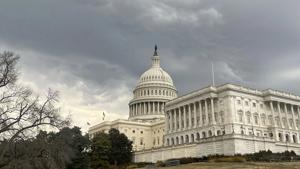
Congressional efforts to halt the U.S. military’s operations in Iran have now failed twice, with the U.S. House tanking a War Powers Resolution only a day after it was rejected in the Senate.
Only four Democrats opposed the resolution in the 212-219 vote Thursday. Reps. Thomas Massie, R-Ky., and Don Beyer, R-Va., broke ranks and supported the resolution.
“The American people do not want a war with Iran,” Beyer said. “Trump’s war in Iran is not smart, not legal, not morally right and not in our national interest.”
The U.S. military is currently following up on the joint coordinated U.S.-Israeli strikes that killed Iran’s Supreme Leader Ayatollah Ali Khamenei by attempting to control Iranian airspace and destroy its navy.
Most Republicans see Operation Epic Fury as a short-term operation against a country that poses a serious threat to the U.S. and its allies and has repeatedly resisted diplomacy.
But Democrats view the controversial activities – which have no set timeline and have led to the deaths of six U.S. service members – as equivalent to declaring war, which only Congress has the constitutional power to do.
A few key members of Congress had received advance notice of the strikes but did not vote to authorize them.
“The Islamic Republic is a barbaric, corrupt regime that has murdered, imprisoned, and terrorized its own people for decades,” Rep. Sara Jacobs, D-Calif., told lawmakers Thursday. “I want nothing more than a free Iran and safety and security for innocent Iranians. That requires more than force. It requires seriousness, accountability, and a real plan.”