Center Square
Suspect killed after ‘unauthorized entry’ at Mar-a-Lago

U.S. Secret Service shot and killed an armed suspect following an “unauthorized entry” into President Donald Trump’s Palm Beach Mar-a-Lago estate early Sunday morning.
Trump, who remained in Washington, D.C. over the weekend and attended a dinner for governors at the White House Saturday evening, was unharmed.
USSS says the suspect, a male in his 20s, appeared to be carrying a shotgun and “fuel can” when he was confronted by agents and a Palm Beach Sheriff’s deputy.
Palm Beach County Ric Bradshaw briefed reporters Sunday morning, describing the events leading up to the suspect being shot.
“At 1:30 this morning, the security detail detected that an individual had made his way into the inner perimeter of Mar-a-Lago. A deputy and two Secret Service agents on the detail went to that area to investigate. They confronted a white male that was carrying a gas can and shotgun. He was ordered to drop those two pieces of equipment that he had with him. At which time, he put down the gas can, raised the shotgun to a shooting position at the point in time, the deputy and two Secret Service agents fired their weapons and neutralized the threat,” said Bradshaw.
No deputies or Secret Service agents were injured during the confrontation. The FBI is leading the investigation.
It is unclear if the suspect was targeting the president, any members of his family, or the property itself. Earlier this month, Ryan Routh was sentenced to life in prison for attempting to assassinate the president at Trump’s Palm Beach golf course in September 2024, two months following an assassination attempt on Trump in Butler, Penn., when he was grazed in the ear by a bullet.
This is a developing story.
U.S. Supreme Court to hear Cuban land claims cases Monday

The U.S. Supreme Court will hear arguments on Monday in two cases to determine whether decades-old losses from Cuba can be obtained by two U.S. businesses.
Havana Docks Corporation v. Royal Caribbean Cruises and Exxon Mobil v. Corporacion Cimex challenged laws that allowed U.S. citizens to bring lawsuits against anyone who trafficked in property that was confiscated by the Cuban government on or after Jan. 1, 1959.
The law also gives the president power to suspend the right to bring a lawsuit when he has concerns over national interests and the transition to democracy in Cuba. President Donald Trump decided not to suspend the lawsuit in 2019.
Jordan Von Borken, senior counsel at the U.S. Chamber Litigation Center, said President Barack Obama’s loosened restrictions and Trump’s decision not to renew lawsuit suspension allowed U.S. companies to pursue legal action against Cuba.
However, in 2016, several cruise lines began using a set of docks that the Havana Docks company had interest in. The Cuban government took over operations of the docks in 1960. The cruise lines argued that, even without the government takeover, Havana Docks lost its interest in the property in 2004.
Havana Docks argued that the U.S. Congress should have focused on punishing the Cuban government for its communist takeover rather than the companies in Cuba that suffered under it.
“Havana Docks relies heavily on a purpose argument that Cuban expropriation of property was bad and Congress meant to punish not just the Cuban expropriators but also people who then economically benefited from that expropriation,” Von Borken said.
Von Borken estimated damage claims against the cruise lines could reach into the hundreds of millions of dollars, depending on how the issue is sorted by the U.S. Supreme Court.
In Exxon Mobil v. Corporacion Cimex, the argument is over the Cuban government’s 1960 seizure of oil and gas assets owned by Exxon. The Cuban government never paid Exxon after the takeover.
The case is to determine whether Exxon has to satisfy its claim against the Cuban government under the Foreign Sovereignty Immunities Act. The act determines whether a foreign state or its agencies can be sued in federal court in the United States.
Generally, foreign states are considered immune from U.S. court jurisdiction. However, a key exception to this immunity is in cases involving expropriation, similar to what the Cuban government did in 1960.
“The broader question [is] if you have a statute that seems like it creates damages claims for people who would otherwise be immune due to sovereign immunity, do you have to also satisfy the FSIA, which is what the DC Circuit said, or do you have a waiver of sovereign immunity right there in the statute, which is what Exxon says,” Von Borken said.
After justices on the court hear arguments in the case on Monday, they are expected to issue a decision by July.
Republicans, split over SCOTUS tariff ruling, seek way forward
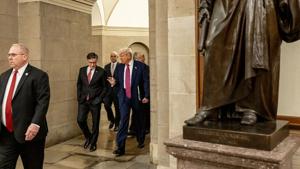
Republicans in Congress are sharply divided over whether to continue President Donald Trump’s tariff policies after the U.S. Supreme Court struck them down Friday.
The Supreme Court ruled 6-3 that the International Emergency Economic Powers Act does not enable the president to impose tariffs without congressional authorization, a decision that all Democrats – and multiple Republicans – praised.
Most Republican lawmakers who supported the ruling echoed House Financial Services Committee Chair French Hill’s, R-Ark., statement, which focused on the constitutional concerns rather than Trump’s tariff policy.
“I share in President Trump’s goal of securing fair and reciprocal trade agreements and holding bad actors accountable for their unfair trade policies,” Hill said. “While tariffs can be a useful tool when applied in a targeted way, today’s Supreme Court decision underscores the need for Congress to play a role in trade policy.”
Sen. Rand Paul, R-Ky., said the court had “defended the Constitution” by recognizing that tariffs “are taxes and the power to declare them belongs to the Congress,” while Sen. John Curtis, R-Utah, and others expressed relief that America’s “system of checks and balances remains strong nearly 250 years later.”
Other supportive Republicans, however, delivered much sterner rebukes of the Trump administration and the impact of tariffs on prices.
“As a matter of policy, the empty merits of sweeping trade wars with America’s friends were evident long before today’s decision,” Sen. Mitch McConnell, R-Ky., said in a Friday statement.
“Congress’ role in trade policy, as I have warned repeatedly, is not an inconvenience to avoid,” McConnell added. “If the executive would like to enact trade policies that impact American producers and consumers, its path forward is crystal clear: convince their representatives under Article 1.”
Yet many Republicans opposed the court’s decision and are now exploring legislative ways to codify Trump’s tariffs.
Rep. Greg Steube, R-Fla., will introduce a bill next week to make the president’s 10% global tariff permanent. He posted on social media that the “only people celebrating right now are the CCP and foreign governments that have spent decades ripping off American workers.”
Sen. Bernie Moreno, R-Ohio, who called the Friday ruling “outrageous” and a “betrayal,” called on his fellow Republicans to use another budget reconciliation bill as a vehicle to codify Trump’s trade agreements. House Budget Committee Chairman Jodey Arrington, R-Texas, agreed.
But leaders in the Republican party have responded to the ruling with caution and have made no promises as to whether Congress will take up such legislation. Regarding next steps, House Speaker Mike Johnson, R-La., said that “Congress and the Administration will determine the best path forward in the coming weeks.”
Democrats have already introduced legislation to return all tariff revenue to U.S. businesses within 90 days, which would reverse the deficit-reducing impact of the policies and likely spark extensive litigation.
Trump, however, does not believe the court’s decision constitutionally prevents him from implementing tariffs. Almost immediately after the ruling, Trump signed an Executive Order imposing a 10% global tariff under the Trade Act of 1974, rather than the emergency powers the Court ruled were illegal.
On Saturday, Trump said he would increase that to 15%.
Day after Supreme Court ruling, Trump says he will raise tariffs to 15%
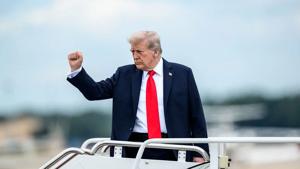
President Donald Trump on Saturday said he would raise global tariffs to 15%. The announcement on social media comes a day after the U.S. Supreme Court struck down his use of a 1977 law to impose tariffs on imports from around the world.
“Based on a thorough, detailed, and complete review of the ridiculous, poorly written, and extraordinarily anti-American decision on Tariffs issued yesterday, after MANY months of contemplation, by the United States Supreme Court, please let this statement serve to represent that I, as President of the United States of America, will be, effective immediately, raising the 10% Worldwide Tariff on Countries, many of which have been ‘ripping’ the U.S. off for decades, without retribution (until I came along!), to the fully allowed, and legally tested, 15% level,” Trump wrote Saturday on social media.
On Friday, after the Supreme Court ruled Trump did not have the authority to enact tariffs under the 1977 International Emergency Economic Powers Act, Trump said he would implement 10% tariffs using other laws. He said Saturday he was upping that to 15%.
“During the next short number of months, the Trump Administration will determine and issue the new and legally permissible Tariffs, which will continue our extraordinarily successful process of Making America Great Again,” Trump wrote.
Treasury Secretary Scott Bessent said Friday the administration will restructure the sweeping import taxes under other legal authorities.
“This administration will invoke alternative legal authorities to replace the IEEPA tariffs,” he said. “We will be leveraging Section 232 and Section 301 tariff authorities that have been validated through thousands of legal challenges.”
The Supreme Court, divided 6-3, ruled that the International Emergency Economic Powers Act didn’t give Trump expansive tariff powers to tax goods entering the country. Justices Clarence Thomas, Brett Kavanaugh and Samuel Alito dissented. The majority ruled that Trump’s tariffs violated the major questions doctrine, which holds that Congress must speak clearly when it grants significant powers.
“The Framers gave ‘Congress alone’ the power to impose tariffs during peacetime,” Chief Justice John Roberts wrote for the majority.
Many businesses are seeking refunds for the billions of dollars in tariffs they paid under the 1977 law that the Supreme Court ruled exceeded the president’s authority.
Groups file brief in support of ending post-Election Day ballot counting
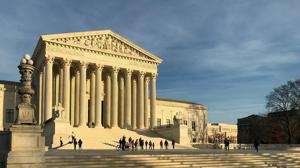
Four election integrity groups filed an amicus brief in support of a case that requests the U.S. Supreme Court not allow state laws that permit counting ballots arriving after Election Day, with experts saying that the recent normalization of late ballots negatively affects trust in and efficiency of elections.
Executive Director of Honest Elections Project Jason Snead told The Center Square that “this case is nothing more than a return to the norm and an enforcement of federal law against a novel scheme that illegally extends elections beyond Election Day.”
Late arriving ballots “[erode] confidence in the outcome,” and “mean that election results are delayed,” Snead said.
“We have seen long delays in declaring a winner and instances where late arriving ballots change the outcome,” Snead said.
Honest Elections Project was joined by the American Legislative Exchange Council (ALEC), the Center for Election Confidence (CEC), and Restoring Integrity and Trust in Elections (RITE) in filing the amicus brief in Watson v. Republican National Committee.
Snead told The Center Square that the case “is about a conflict between federal and state law.”
“Federal law sets Election Day,” Snead said. “The question for the court is whether accepting late ballots extends or alters Election Day.”
“A ruling in favor of the RNC would increase confidence in the outcome of elections,” Snead said.
Snead additionally told The Center Square that “routine, widespread mail voting only began in the last few decades, and laws accepting late ballots are even newer.”
“Thirty-six states do not allow late ballots, and historically that has been the norm,” Snead said. “Of the fourteen that allow late ballots, half only began during COVID, an emergency that has long since ended.”
President of RITE Justin Riemer told The Center Square that his organization is “pleased to stand alongside the Center for Election Confidence, Honest Elections Project, and ALEC in urging the Court to uphold the straightforward meaning of federal law.”
“The federal Election Day deadline isn’t just a legal mandate, it’s essential for maintaining order and building public trust in our elections,” Riemer said.
ALEC CEO Lisa B. Nelson told The Center Square that “federal law concerning Election Day is clear, and states have no obligation to continue to count ballots well beyond the close of polls.”
“If states want to ensure more confidence in their elections, ALEC’s model policy, the Deadline for Return and Receipt of All Ballots Act, is a good starting point,” Nelson said.
“ALEC is proud to stand with its partners on this important principle,” Nelson said.
Business groups seek quick tariff refunds after Supreme Court ruling

The U.S. businesses that paid billions in tariffs to the federal government want their money back.
After the U.S. Supreme Court found President Donald Trump exceeded his authority under a 1977 law, business groups quickly called for refunds of these tariffs.
The high court decision affects Trump’s tariffs enacted under the International Emergency Economic Powers Act. Trump had used the law to impose tariffs on nearly every imported product from every country.
Neil Bradley, executive vice president at the U.S. Chamber of Commerce, said the ruling was good news for U.S. businesses and consumers.
“Swift refunds of the impermissible tariffs will be meaningful for the more than 200,000 small business importers in this country,” he said.
The nation’s largest business lobby also asked for a full reset on tariffs.
“We encourage the administration to use this opportunity to reset overall tariff policy in a manner that will lead to greater economic growth, larger wage gains for workers, and lower costs for families,” Bradley said.
The Penn Wharton Budget Model estimated the Supreme Court ruling will generate up to $175 billion in refunds.
Getting that money won’t be easy. International Chamber of Commerce Secretary General John Denton warned that refunds could be challenging.
“Companies should not expect a simple process: the structure of U.S. import procedures means claims are likely to be administratively complex,” he said. “[The] ruling is worryingly silent on this issue and clear guidance from the Court of International Trade and the relevant U.S. authorities will be essential to minimize avoidable costs and prevent litigation risks.”
Trump sharply criticized the Supreme Court’s decision on Friday before announcing a new set of tariffs under different laws to replace the import duties invalidated by the high court. He also criticized the Supreme Court for its silence on the issue of refunds. He said that failure by the high court could mean refunds end up in court disputes for years.
Gary Shapiro, CEO of the Consumer Technology Association, a trade group, said “the government must act quickly to refund retailers and importers without red tape or delay.”
Some businesses filed for refunds even before the Supreme Court ruling.
Warehouse retailer Costco filed a lawsuit in December to hold its place in the refund line, where other companies were already waiting. Costco noted a separate lawsuit was needed because importers “are not guaranteed a refund for those unlawfully collected tariffs in the absence of their own judgment and judicial relief.”
The request hints at a complicated refund process for a share of the billions in tariffs the federal government collected in fiscal year 2025. Supreme Court Justice Amy Coney Barrett said refunds could be a “mess” during oral arguments in November.
U.S. Sen. Maria Cantwell, D-Wash., wrote a letter to Treasury Secretary Scott Bessent seeking a “detailed explanation” of how the refund process would work.
“Many American businesses, especially small and medium-sized businesses, have struggled to pay these illegal tariffs and, for some, the financial strain has placed them on the brink of bankruptcy,” she wrote in the letter. “It is essential [that the Treasury Department] implement an expeditious and transparent process to remediate the financial harm that resulted from these illegal tariffs.”
Illinois Gov. J.B. Pritzker, a Democrat with plans for higher office, demanded a refund of $8.6 billion for all families in his state.
“On behalf of the people of Illinois, I demand a refund of $1,700 for every family in Illinois,” the governor wrote, threatening further action if the White House failed to comply.
Recent economic research has found that Americans are picking up the cost of tariffs. A report from the Federal Reserve Bank of New York confirmed “U.S. firms and consumers continue to bear the bulk of the economic burden of the high tariffs imposed in 2025,” according to a report from the Federal Reserve Bank of New York. Other studies have reported similar findings on the impact of the tariffs. The Kiel Institute for the World Economy found that Americans are paying almost the entire cost of tariffs.
First lady’s style immortalized in American history

As tourists are expected to flock to the nation’s capital for spring break and America’s 250th birthday, there is a new attraction at the Smithsonian’s National Museum of American History – First Lady Melania Trump’s inaugural gown is on display.
The first lady made history Friday when she donated her Hervè Pierre-designed dress to the Smithsonian. The strapless, off-white crepe, floor-length gown is trimmed with two bands of black silk gazar in a zig-zag formation. Her ensemble was completed with a matching simple black choker, adorned with a floral diamond reproduction of a 1955 Harry Winston brooch.
While most first ladies find themselves thrust into fashion through their husband’s presidency, Melania Trump, a fashion model, brought her own passion for fashion and design to the White House. While Pierre designed her gown, she collaborated to bring the design to life.
During her remarks at the presentation ceremony, Trump briefly described her love for the process and the complexity involved in creating the garment.
“Personally, I relish the entire design process, from start to finish. It takes time, it’s slow, but the end result is always magical,” said the first lady. “It is no easy feat to construct such a complex garment. Behind every true couture piece stands a superior team of patternmakers, seamstresses, and artisans who transform a creative idea into reality.”
Trump argues that the dress’s design reflects the American spirit, while crediting the country’s fashion as a potential leader in the industry.
“This black and white masterpiece showcases America’s pure spirit of originality, superior engineering, and boundless creativity. It’s a testament as to why America’s fashion industry can lead the rest of the world,” said the first lady.
Trump is only the second first lady to have both inaugural gowns from the 2017 and 2025 inaugurations displayed at the Washington, D.C., museum as part of a popular exhibit on first ladies.
She joins Ida McKinley, the wife of former President William McKinley, from the inaugurations of 1897 and 1901.
Traditionally, the Smithsonian only collects inaugural gowns of first ladies worn during their husband’s first inauguration, but since President Donald Trump didn’t serve two consecutive terms, they broke the tradition for the first lady.
The tradition of displaying first ladies’ inaugural gowns began with Helen Taft in 1909, the wife of former President William Taft. Trump’s second gown marks 26 dresses on display in the First Ladies exhibit. The exhibit was established in 1912 and includes artifacts from first ladies dating back to America’s first First Lady, Martha Washington.
The Smithsonian Institution comprises 21 museums with a current federal appropriation of over $1 billion, providing 62% of its funding, allowing patrons to visit without paying admission.
Bill would add restrictions to importing guns to California
Those bringing guns into California would have to jump through more hoops if the Legislature passes a new bill.
Senate Bill 948, introduced by state Sen. Jesse Arreguin, D-Oakland, would require more paperwork for gun importers.
A personal firearm importer trying to import a gun into the state would have to get a firearm safety certificate, which would have to be accompanied by a report on the gun owner and the firearm itself. The report is already required by law.
Under the new legislation, anyone trying to bring a gun into the state would have to acquire the certificate within 60 days of coming into California.
The bill would also require an applicant for a firearm safety certificate to take an eight-hour training course that covers firearm safety and handling. The course includes live-fire shooting exercises at a range. This would apply to anyone bringing a gun into California after July 1, 2028.
Antique firearms would not be included in the new regulations as proposed by SB 948.
“With the constitutionality issues that this bill brings up, it is definitely one we are opposing,” Adam Wilson, director of legislative affairs at Gun Owners of California, told The Center Square on Wednesday. “We take the position that any additional restrictions are onerous and burdensome, especially ones that put regulations on what is a constitutional right.”
Other organizations that advocate for Second Amendment rights said they oppose the bill.
“FPC opposes all unconstitutional and immoral restrictions and burdens on the right to keep and bear arms,” said a spokesperson from the Firearms Policy Coalition, a pro-Second Amendment organization, in a written response emailed to The Center Square.
Arreguin was not available this week to talk to The Center Square about his bill. Other Democratic lawmakers in California also did not respond to The Center Square’s request for comments.
According to reports from Everytown for Gun Safety and the gun safety organization Giffords, California has the strongest gun laws in the country. A report published earlier this year by Everytown for Gun Safety states that California has some of the lowest rates of gun ownership and gun-related deaths in the country and that California was the first state to enact firearm consumer safety standards.
Giffords, which was founded after former U.S. Rep. Gabby Giffords, D-Arizona, was shot in the head in a 2011 Tucson shooting, issued its own report in 2023 crediting California with enacting the country’s first assault weapons ban in 1989. The organization also points to California being one of the first states to pass laws instituting protections for victims of gun violence, mandating waiting periods to cut down on rates of suicide and violence against others and passing other laws to increase gun safety.
After the shooting that killed six other people and wounded 12, Giffords survived, ultimately stepping down from her seat in the U.S. House of Representatives to focus on recovery and start her namesake organization, according to the Giffords website.
Gun safety organizations like Project Child Safe, Moms Demand Action, Giffords and Alliance for Gun Responsibility did not respond to The Center Square this week.
WATCH: Newsom, others praise $239M learning center at San Quentin
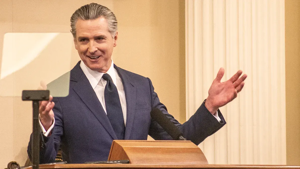
Gov. Gavin Newsom and others, including a survivor of a crime, gathered Friday morning at the San Quentin Rehabilitation Center to praise the opening of a $239 million learning center designed to prepare inmates to re-enter society.
The 81,000-square-foot facility consists of three buildings, including a technology and media center with podcast and TV production facilities and reentry center, a hub of classrooms that are operated with universities and a college and features an expanded library, and a community and workforce area that includes a gathering hall, cafe and store. There will be outdoor classrooms with views of the San Francisco Bay, according to the Governor’s Office.
The center was funded through a lease revenue bond, and Newsom said it made more sense to spend the money at San Quentin than to spread it out thinly among many prisons. But he said the San Quentin learning center could be a model for other prisons.
“You can be smart as well as tough on crime,” the Democratic governor told reporters as he stood in front of a fence outside the new complex at the state’s oldest prison. “It’s about pragmatism. It’s about dealing with the fundamental fact that 95% of the people in the system will go back to your neighborhoods, and what kind of neighbors do you want them to be?”
“Three years ago, I stood here and promised to turn this symbol of the old system into the crown jewel of a new one,” Newsom said. “Today, with the opening of this learning center, we are proving that rehabilitation and public safety go hand in hand — and that hope is a powerful tool for safer communities.”
San Quentin was built in 1852, and the San Francisco Bay prison in Marin County is known for its history of inmates such as cult leader Charles Manson, whose followers killed nine people including pregnant movie actress Sharon Tate and coffee heiress Abigail Folger. Other inmates included convicted killer Scott Petersen. It has been part of the storylines in a long list of movies, including two starring Humphrey Bogart, “San Quentin” (1937) and “Dark Passage” (1947).
Newsom, who put a moratorium on the death penalty in 2019 in California, noted San Quentin once had the biggest death row in the western hemisphere with 737 people. In 2022, Newsom ordered the building that contained death row be dismantled.
San Quentin State Prison was renamed the San Quentin Rehabilitation Center in 2023 after the passage of Assembly Bill 134. The goal has been to transform the facility into a Norwegian-style facility with vocational training, and officials mentioned visits to Norway during Friday’s press conference.
“If you go in our classrooms, you will see signs that say, ‘Believe in the process,’ ” said Chris Redlitz, cofounder of The Last Mile, a nonprofit launched at San Quentin to provide business and technology training.
Construction of the learning center began 18 months ago on a site near the former death row.
Newsom said the new center shows California can both tackle crime and work to rehabilitate criminals and prepare them for post-prison careers and life.
He pointed to statistics showing that homicides are down 18% in California in 2025 from 2024.
Robberies have fallen 19%, and violent crime is down 12%, Newsom said.
But minutes before Newsom spoke to reporters, a Republican legislator questioned the governor’s priorities in spending $239 million on a prison learning center.
“A prison is supposed to be a prison,” state Sen. Tony Strickland, R-Huntington Beach, said during a phone interview with The Center Square. “He’s putting money, from my understanding, into grocery stores to ‘normalize the environment.’ His words, not mine. A prison should be a prison. People go to a prison because they committed a crime. When you commit a crime, you have to pay the consequence for that action.”
Too often, Newsom has been more considerate of criminals than victims and victims’ rights, Strickland said. He noted the state government’s No. 1 priority is to keep people safe.
Instead of spending $239 million on a learning center, Newsom should be funding enforcement of Proposition 36, the anti-crime measure that voters overwhelmingly passed in 2024, Strickland said.
The measure increases penalties for certain theft and drug charges and includes options for treatments for drug offenders. Strickland has been a critic of what he calls Newsom’s failure to fund enforcement and said he will introduce a bill next week to fund Prop. 36.
At San Quentin on Friday, a survivor of crime praised the opening of the learning center.
“This is a smart investment. It’s an investment that will pay off in the future, in perpetuity,” said Tinisch Hollins, executive director of Californians for Safety and Justice.
Hollins said giving inmates access to education is how public safety is improved over time. “And they shouldn’t have to come to state prison to get it, but I’m glad that it’s here.”
San Francisco District Attorney Brooke Jenkins told reporters she has spent the last two-and-a-half years in discussions on reforming the criminal justice system.
It’s important to give inmates the resources they lacked in their communities as they “work on themselves,” Jenkins said.
“The new learning center will scale the work that has begun here and provide residents with more tools to advance their individual journeys as they work to become better than when they came in, making us all safer in turn,” Jenkins said.
WATCH: WA lawmaker, trade and business groups react to SCOTUS tariff ruling
A Washington lawmaker, trade and business group are reacting to Friday’s ruling from the U.S. Supreme Court against President Trump’s tariffs.
In an historic 6-3 decision today, the high court said the tariff tax increases unilaterally imposed by the executive branch under emergency powers are unconstitutional. The ruling reaffirms that the power to tax is exclusively reserved to the legislative branch.
“The ruling from the U.S. Supreme Court on the tariffs was not a complete surprise,” said GOP Chairman Jim Walsh, R-Aberdeen, in a Friday interview with The Center Square. “Tariffs, when they’re used properly, are a scalpel. They’re not sledgehammers. And when you use tariff policy correctly, it should be used precisely in a narrow and focused way.
Walsh said as a free market person, and a fiscal conservative he’s “not crazy about tariffs as a trade policy tool.”
The Washington Council on International Trade emailed a statement to The Center Square calling the ruling “an important step forward for the Northwest’s businesses, workers, and consumers.”
WCIT President Lori Otto Punke further noted in the statement that the tariffs caused “serious harm.”
“For more than a year, these tariffs have caused serious harm triggering retaliatory duties on key agricultural exports, eroding markets for goods and services, increasing construction and production costs, disrupting cross-border supply chains, and reducing price competitiveness,” she was quoted in the statement. “From apples to wine, from advanced manufacturing to wood products to technology and innovation, the Supreme Court has now affirmed that trade policy of this magnitude must rest on proper legal authority, wrote Otto Punke.
The National Federation of Independent Business Washington State Director Patrick Connor said the ruling will help with affordability.
“Main Street small-business owners paying attention to the tariff controversy may feel some relief and optimism that as more goods start flowing through our state’s ports, supply chain problems will ease, and prices will start to drop,” Connor wrote in a statement to The Center Square. “They are more likely to worry though that Olympia’s push for a new Millionaire Tax will hit their bottom lines as an income tax on business earnings, not take-home pay.”Walsh told The Center Square said the mostly favorable response to the decision from Washington business and trade groups was not a surprise. “It is likely to be applauded by the major players in Washington state with industrial groups, software companies, tech companies, things like this,” Walsh said. “But the administration still can apply more narrowly tailored tariffs to specific circumstances and may do that right quick. I think in general, this will be perceived as something that the Washington business community likes, both the tech industry and the transportation trade organizations that operate out of our ports and other places.”The Association of Washington Business emailed a statement to The Center Square applauding the SCOTUS decision against Trump’s tariffs.“As one of the most trade-driven states in the country, the tariffs imposed last year have significantly impacted Washington employers,” wrote AWB President Kris Johnson. “Although some Washington businesses have benefited from tariffs, the majority have experienced negative impacts in the form of higher costs on business inputs, supply chain disruption, lost or reduced export markets and canceled orders.“In the most recent Association of Washington Business employer survey, more than half of all respondents (54%) reported that tariffs have hurt their business, with the largest percentage (60%) reporting higher costs….In many cases, employers have been unable to absorb the higher costs without passing them on to their customers,” the statement said.The Center Square Washington State Editor Brett Davis contributed to this story.