Center Square
Virginia Democrats appeal ruling, legislatively pass 10-1 congressional map
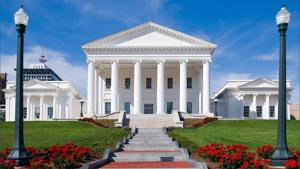
Democrats in Virginia need an appeal to their favor within two weeks to keep alive hopes of redrawing congressional districts that could potentially give them four more seats in the U.S. House of Representatives.
On Friday, the new congressional map proceeded through the Legislature in Richmond. A day earlier, Tazewell County Circuit Judge Jack Hurley Jr. granted an emergency injunction sought by the Republican National Committee effectively blocking voters from choosing on April 21.
March 6 is the start of early voting, and Hurley’s action doesn’t allow preparation for the referendum through March 18.
Democrats appealed. The state Supreme Court has an earlier appeal where Hurley ruled the planned voter referendum was rushed. The high court has allowed it to move forward while litigation also proceeds.
Success on the referendum by Democrats would allow a redraw of maps that have sent six Democrats and five Republicans to a U.S. House divided 218-214 in favor of Republicans with three vacancies. With the 2030 census, the process would return to decennial census redraws.
The U.S. House of Representatives was a 220-215 Republican majority following the 2024 election.
The state is one of 20 that doesn’t require voters to affiliate with a party when registering. In the 2024 presidential race, Democrat Kamala Harris won 51.8% of the more than 4.5 million votes and Republican Donald Trump 46.1% – a difference similar to today’s representation.
Trump announces new tariffs with ‘certainty’ after Supreme Court ruling
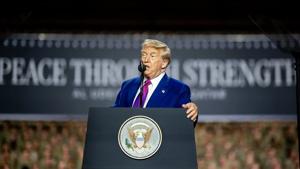
President Donald Trump announced a new round of tariffs on Friday after the U.S. Supreme Court invalidated most of the tariffs underpinning his economic agenda.
Hours after the Supreme Court reined in Trump’s use of a 1977 law to impose tariffs on imports from around the world, the president said he would use other laws to impose a 10% global tariff. He also said the ruling could allow for even higher tariffs under those other laws.
“Their decision is incorrect,” he said. “But it doesn’t matter because we have very powerful alternatives.”
The 10% levy on imported goods would be significantly lower for many countries that negotiated deals with Trump. The only country that got a 10% tariff was the United Kingdom. All other nations negotiated deals for 15% or higher. In return, those nations promised to invest in U.S. projects.
The president spent months warning that an adverse ruling would have sharp economic consequences. He changed course on Friday and said the new round of tariffs would keep most of his trade deals in place through other laws that allow more limited tariffs.
Treasury Secretary Scott Bessent said the administration will restructure the sweeping import taxes under other legal authorities.
“This administration will invoke alternative legal authorities to replace the IEEPA tariffs,” he said. “We will be leveraging Section 232 and Section 301 tariff authorities that have been validated through thousands of legal challenges.”
Trump also said he wasn’t looking for help from Congress. Instead, he will lean on executive authority to issue the next round of tariffs. He said several times that those tariffs would be certain. Asked whether the new tariffs would be limited to 150 days by law, Trump didn’t directly answer the question.
The high court decision effects Trump’s tariffs enacted under the 1977 International Emergency Economic Powers Act. Trump had used the law to impose tariffs on nearly every imported product from every country.
Americans ended up paying billions of dollars in taxes on those imports, according to recent research.
The Supreme Court, divided 6-3, held that the law didn’t give Trump expansive tariff powers to tax goods entering the country. Justices Clarence Thomas, Brett Kavanaugh and Samuel Alito dissented. The majority ruled that Trump’s tariffs violated the major questions doctrine, which holds that Congress must speak clearly when it grants significant powers.
“The Framers gave ‘Congress alone’ the power to impose tariffs during peacetime,” Roberts wrote for the majority.
Trump admin throws cold water on ICE masks ban as shutdown talks stall
Nearly a week into the partial government shutdown, the Trump administration continues to oppose certain immigration enforcement reforms that Democratic lawmakers are demanding in exchange for their votes to reopen the Homeland Security department.
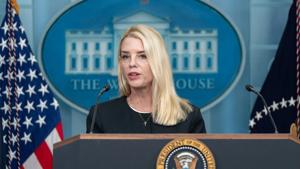
In a social media post Thursday, U.S. Attorney General Pam Bondi lauded a court-ordered pause of California’s mask ban on Immigration and Customs Enforcement agents, part of the state’s No Secret Police Act.
The 9th U.S. Circuit Court of Appeals also granted Thursday a temporary injunction on California’s requirement that every ICE agent display ID, a stipulation in the state’s No Vigilante Act.
“Law enforcement officers risk their lives for us, only to be doxxed by radical anti-police activists. Unacceptable,” Bondi said on X. “This crucial ruling protects our brave men and women in the field. We will not stop fighting bad laws like these in California and across the country.”
The administration’s praise underscores the unlikelihood of Democrats ending the partial shutdown on their own terms.
Democratic leaders in Congress have unrelentingly pushed for any DHS funding deal to incorporate their all-or-nothing list of demands — including a face mask ban and ID requirement mirroring California’s policies.
Demands for greater accountability in DHS erupted after an ICE agent fatally shot 37-year-old Alex Pretti in January, the second killing that month of a U.S. citizen protesting in Minneapolis.
Republicans previously expressed openness to some of the proposed reforms, such as mandating ICE agents wear body cameras, but have labeled most as “ridiculous.”
They have also pointed out that however long the shutdown lasts, ICE operations will feel no impact, unlike other critical DHS services such as disaster support and transportation security.
“Here’s why Democrats’ logic in forcing this partial government shutdown doesn’t hold up,” Rep. Steve Womack, R-Ark., posted on social media Friday. “If last year taught us anything, it is that shutdowns don’t work and only hurt the American people.”
This is the second time in less than six months that Democrats have forced a shutdown over policy demands, with the most recent centering around health care subsidies.
The record 43-day, full government shutdown from October to November 2025 caused food stamp insecurity, mass flight delays and cancellations, millions of dollars in GDP lost, and withheld paychecks for millions of federal workers.
Supreme Court’s tariff ruling could alter 2026 election
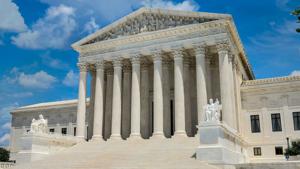
The 2026 midterm elections could now be shaped around candidates’ response to the U.S. Supreme Court striking down the bulk of President Donald Trump’s tariff authority. The ruling could have a significant effect on the makeup of Congress heading toward the midterms.
On Friday, justices of the high court said a 1977 law doesn’t give the president broad authority to issue tariffs. Across the country, Democratic candidates have campaigned on affordability and railed against Trump’s tariff policies.
“In [the International Emergency Economic Powers Act’s] half century of existence, no President has invoked the statute to impose any tariffs, let alone tariffs of this magnitude and scope,” Chief Justice John Roberts wrote. “That ‘lack of historical precedent,’ coupled with the breadth of authority that the President now claims, suggests that the tariffs extend beyond the President’s ‘legitimate reach.’ ”
U.S. Sen. Chuck Schumer, D-New York, who is up for reelection in 2028, praised the Supreme Court’s decision and called it “a victory for for the wallets of every American consumer.”
House Majority PAC, a political action committee supporting House Democrats’ campaigns, said it will continue to pursue Trump’s tariffs as a focal point in the 2026 midterms.
“Vulnerable House Republicans repeatedly voted to enable Trump’s tariffs, which raised prices and wreaked economic havoc on American families and businesses,” the organization said in a statement.
Several outspoken Republican critics of Trump’s tariff policies have also praised the Supreme Court’s decision.
“The Supreme Court makes plain what should have been obvious,” said Sen. Rand Paul, R-Kentucky. “This ruling will also prevent a future President such as AOC from using emergency powers to enact socialism.”
On Feb. 11, six Republicans joined Democrats in a vote to overturn Trump’s tariffs on Canada, a sign that the economic policy left some in the GOP weak with upcoming competitive elections.
U.S. Reps. Kevin Kiley, R-California; Thomas Massie, R-Kentucky; Don Bacon, R-Nebraska; Brian Fitzpatrick, R-Pennsylvania, and Jeff Hurd, R-Colorado, voted for overturning the tariffs on Canada, alongside most House Democrats.
Bacon praised the Supreme Court’s decision on Friday. Bacon plans to retire from Congress after the 2026 midterm elections. The Cook Political Report favors a Democratic challenger to take over Bacon’s seat after his retirement.
“I feel vindicated,” Bacon said. “Besides the Constitutional concerns I have on the administration’s broad-based tariffs, I also do not think tariffs are a smart economic policy.”
Hurd also praised the court’s decision. His race in Colorado is considered to be likely Republican in favor of his reelection. However, his vote last week is a crucial indicator of divisions among the GOP about tariff authority.
“Today’s decision underscores the need for Congress to play its proper role in trade policy,” Hurd said. “Major trade decisions should rest on clear statutory authority, not expansive emergency interpretations.”
Supreme Court reins in Trump on tariffs in split decision

The Supreme Court ruled Friday that President Donald Trump exceeded his authority by imposing billions of dollars in worldwide tariffs.
The high court decision affects Trump’s tariffs enacted under the 1977 International Emergency Economic Powers Act. Trump had used the law to impose tariffs on nearly every imported product from every country.
Americans ended up paying billions of dollars in taxes on those imports, according to recent research.
The Supreme Court, divided 6-3, held that the law didn’t give Trump expansive tariff powers to tax goods entering the country.
Conservative Justices Amy Coney Barrett and Neil Gorsuch and the court’s liberal wing – Sonia Sotomayor, Elena Kagan and Ketanji Brown Jackson – joined Chief Justice John Roberts’ majority opinion.
Justices Clarence Thomas, Brett Kavanaugh and Samuel Alito dissented.
The majority ruled that Trump’s tariffs violated the major questions doctrine, which holds that Congress must speak clearly when it grants significant powers.
“The Framers gave ‘Congress alone’ the power to impose tariffs during peacetime,” Roberts wrote for the majority.
Alan Morrison, a constitutional law scholar at George Washington University Law School, said the ruling didn’t authorize refunds for U.S. businesses that paid billions to the federal government to import products since April 2025.
“Today’s decision did not order any refunds of the illegally collected tariffs because the plaintiffs only asked the Court to stop tariffs that had not yet been collected,” he said. “Litigation is underway to seek refunds of some of these tariffs, with other cases certain to follow.”
Gary Shapiro, executive chair and CEO of Consumer Technology Association, a trade group, said the decision could eliminate some uncertainty for businesses.
“The Court affirmed what our Founding Fathers were so careful to write into our Constitution: the power to tax Americans rests with Congress, not the president,” he said. “Innovation thrives on predictability, and this common-sense decision brings much-needed clarity for American businesses and consumers.”
He also called for the government to promptly refund the tariffs already paid and not issue new tariffs to replace the unlawful ones.
“The government must act quickly to refund retailers and importers without red tape or delay,” he said. “Our leaders should resist the urge to compound the error by turning to new tariff authorities that add more burden and uncertainty for America’s innovators, especially small businesses and startups.”
Before Friday’s ruling, Trump had repeatedly said an adverse ruling from the Supreme Court could trigger economic collapse.
The Penn Wharton Budget Model projected that reversing the tariffs would generate up to $175 billion in refunds. It further projected that future tariff revenue would fall by half unless replaced through another source.
The Committee for a Responsible Federal Budget said the high court decision could increase projected deficits by about $2 trillion over the next decade.
“The country will now be about $2 trillion deeper in the hole,” said Maya MacGuineas, president of the Committee for a Responsible Federal Budget. “With the national debt already the size of the entire U.S. economy and interest on the debt costing more than $1 trillion this year, this is very bad news.”
She called on Congress to “fill that hole” with new revenue and use all the money to reduce deficits.
Trump’s legal team had argued that the tariffs were regulatory, not designed to raise revenue, contradicting Trump’s public claims that the import duties would raise enough money to cover the cost of his spending priorities at home.
The White House did not immediately respond to questions about the Supreme Court decision. Trump has yet to comment publicly on the ruling, but plans to hold a news conference Friday afternoon.
Federal judge: Masked ICE agents violate Fourth Amendment
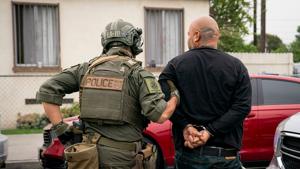
A federal judge has ruled Immigration and Customs Enforcement’s practice of conducting arrests with masked, unidentifiable agents violates the Fourth Amendment’s prohibition on unreasonable seizures.
In a Feb. 19 opinion, U.S. District Judge Joseph E. Goodwin ordered the immediate release of petitioner Anderson Jesus Urquilla-Ramos, who was “arrested abruptly and without warning by a group of masked men purporting to be” ICE officers.
“Antiseptic judicial rhetoric cannot do justice to what is happening,” Goodwin wrote to begin his 34-page ruling. “Across the interior of the United States, agents of the federal government — masked, anonymous, armed with military weapons, operating from unmarked vehicles, acting without warrants of any kind — are seizing persons for civil immigration violations and imprisoning them without any semblance of due process.
“The systematic character of this practice and its deliberate elimination of every structural feature that distinguishes constitutional authority from raw force place it beyond the reach of ordinary legal description. It is an assault on the constitutional order. It is what the Fourth Amendment was written to prevent. It is what the Due Process Clause of the Fifth Amendment forbids.”
Goodwin has issued similar rulings in recent weeks, as have other federal judges in the district and across the country.
Urquilla-Ramos, a 21-year-old national of El Salvador, said he hadn’t broken any traffic laws, but an officer pulled him over because of a plastic cover on the license plate of the vehicle. He was detained at South Central Regional Jail in Charleston, but he never was cited or charged for a traffic violation.
“I will not pretend, through careful procedural language, that what is at issue here is a technical question of statutory interpretation,” Goodwin wrote. “The overarching issue is whether the federal government may deploy anonymous agents to seize persons on American streets and highways for civil violations, without warrants, without identification, and without any process before or after.
“The Constitution does not permit that. … In our constitutional republic, governmental force derives its authority from the Constitution. But that authority is not unlimited. The Government’s power is legitimate only because it is derived from the people and exercised through law by identifiable public officers answerable to the public and to the courts. The structure of the Constitution guarantees visibility.”
In his petition, Urquilla-Ramos says the group of masked men got out of an unmarked black Ford Explorer “without even a license plate” and arrested him. He said the stop, arrest and detention violated multiple constitutional, statutory and regulatory protections, including the Fourth and Fifth Amendments, the Immigration and Nationality Act and the Administrative Procedure Act.
At Thursday’s hearing, the government did not dispute the allegations in the petition.
Goodwin agreed Urquilla-Ramos’ rights under both the Fourth and Fifth Amendments were violated.
“Petitioner was arrested by unidentifiable, masked officers acting without a warrant, without articulable justification for concealing their identities, and with no mechanism by which he could identify those seizing him or meaningfully test the legality of their asserted authority,” he wrote. “In the absence of a warrant, individualized justification, or any means of contemporaneous attribution of the seizure to particular officers, the deployment of masked and anonymous agents to execute a civil arrest strips the seizure of the accountability the Fourth Amendment presupposes and renders it unreasonable. …
“The government’s mandatory detention of him is unlawful under the Fifth Amendment’s Due Process Clause and applicable statutory provisions.”
Goodwin wrote that the use of masked agents to affect a civil immigration detention under these circumstances is unreasonable and unconstitutional.
“In reaching this conclusion, I consider the court’s responsibility to interpret the Constitution, the philosophical foundation of our system of self-governance, the historical context of immigration enforcement, the historical context of the Fourth Amendment, the personal security the Amendment guarantees, the meaning of a “reasonable” search and seizure, and the government’s asserted interests in permitting masked law enforcement,” he wrote, adding the court has a responsibility to the Constitution.
“Our legal culture has developed a strange timidity about constitutional interpretation,” Goodwin wrote. “We often act as if constitutional meaning emerges only from the Supreme Court, as if district courts merely wait for appellate instruction before interpreting constitutional text.
“That approach inverts the Constitution. In arguments everywhere, lawyers reach for perfect case analogies and factual alignment as if the Constitution itself were somehow inaccessible. But the Constitution is not a compilation of case holdings. It is a text with meaning that existed before any court construed it, and it continues to bind government conduct whether or not a prior case has addressed the specific facts at hand.
“To be sure, precedent matters profoundly. When the Supreme Court or the Fourth Circuit has resolved a question, this court follows that resolution. When prior cases illuminate related questions, the court learns from them carefully. Precedent provides predictability, constrains arbitrary interpretation, reflects accumulated judgment, and promotes equal treatment. But it cannot replace the Constitution. When precedent directly resolves the question before me, that ends the inquiry. When prior cases provide clear guidance, I follow it.
“But when existing cases address different facts, different contexts, and different questions, the Constitution still applies. And the court must determine what it means through disciplined interpretation, not serial citation. This is especially true when the government employs practices so recent that doctrine has not yet addressed them. The absence of a case holding that warrantless, non-exigent, anonymous civil seizures in the interior of the United States violate the Fourth Amendment does not mean the Constitution permits them. It means the practice is new enough, and brazen enough, that no court has yet been required to state the obvious. This court is now required to say it.”
Goodwin says anonymous police stops must remain a rare exception and “must not be premised on anonymity for the mere sake of officer protection.”
“If that were so, all officers across America might take to the streets in masks, but that would run contrary to the transparency and accountability our democracy demands,” he wrote. “In a system of checks and balances, the policy of officer anonymity violates the Constitution by evading accountability and judicial review.”
Goodwin says today’s ICE’s operational practices “raise new constitutional concerns.”
“While undercover operations in organized crime or anti-terrorism units may justify limited identity concealment, routine immigration enforcement lacks such extraordinary circumstances,” he wrote. “When the public cannot readily determine who is acting under government authority, it is difficult to regard the actions as legitimate exercises of law enforcement power.
“The use of masks and other tactics that obscure official identity carries historical and semiotic weight. Authoritarian regimes have used masked security forces to intimidate and control populations. In this nation’s history, the Ku Klux Klan relied on masks to terrorize victims while concealing accountability.
“With this background in mind, the ICE tactics of anonymous enforcement in this case contravene the history, purpose and modern interpretation of the Fourth Amendment.”
Goodwin says there is no doubt Urquilla-Ramos enjoys Fourth Amendment rights. He entered the country as an unaccompanied minor and was placed under the care of the United States Department of Health and Human Services, through its Office of Refugee Resettlement. He was released from custody into the United States, where he maintains a pending asylum application, lawful work authorization, and a valid driver’s license. He has lived her for the past four years.
“Noncitizens may hesitate to assert their rights out of fear of government retaliation,” Goodwin wrote. “In practice, undocumented immigrants may endure unreasonable searches and seizures rather than risk asserting Fourth Amendment protections that may or may not apply.
In this way, the Fourth Amendment, intended by the Founders as a shield for individual liberty, is turned into a sword.”
Goodwin says the actions by masked ICE agents doesn’t just corrode the protections envisioned by the Founders. Instead, he says those protections have been “eviscerated.”
“The Founders recognized that freedom is imperiled not only when government actions lack legal justification, but also when those actions are carried out by agents whose authority is unchecked and whose actions cannot be traced. In this light, a warrantless, anonymous civil seizure like the one at issue here is merely a general warrant in modern dress.
“Masking and anonymization of officers, therefore, are fundamentally inconsistent with the historical understanding of the Fourth Amendment.”
He says allowing officers to conceal their identity effectively collapses the system.
“Officers are thereby emboldened to exercise their power in an arbitrary and oppressive manner,” Goodwin wrote. “And public trust is decimated.”
He said there is a practical danger to the practice as well, including documented cases of people posing as ICE agents to accost immigrants and even commit sexual assault.
“These incidents have generated widespread fear within immigrant communities, affecting routine activities such as sending children to school, grocery shopping and attending recreational events,” Goodwin noted. “Validating law enforcement conduct that invites impersonation and undermines public trust would contaminate Fourth Amendment principles.
“As we have seen, when officers are faceless and nameless, others can exploit that anonymity for personal gain or criminal acts. This approach poses a serious public safety risk, endangers personal security, and increases the danger of law enforcement work — because the public cannot distinguish officials from imposters.
“Individuals understandably refuse to cooperate when they cannot tell the difference between a government agent and a criminal actor. This is precisely the kind of insecurity the Framers sought to prevent when they enshrined personal security in the Fourth Amendment.”
Goodwin also says there are times when anonymity is necessary, such as an undercover officer infiltrating a criminal organization. But he says those cases are temporary and subject to later scrutiny.
“Accountability is deferred in those cases, not abandoned,” he wrote. “That is the critical distinction. What justifies concealment in genuine exigencies is that it is exceptional.
“Stops without identification must remain rare exceptions, not routine practice. …
“What is happening here bears no resemblance to those recognized exceptions. This is not an undercover operation. No specific danger has been identified that required these agents to be masked for this arrest. This is a deliberate choice to conduct routine civil immigration enforcement through masked anonymous agents operating without warrants across the interior of the United States.
“When concealment becomes policy rather than exception, the government has not invoked an exigency. It has abolished the rule that exigency was meant to qualify.”
The government’s justification for ICE officer masking is safety, but Goodwin finds that claim insufficient.
“A mask does not stop a bullet,” he wrote. “It does not deflect a blow. It provides no physical protection that the tactical equipment these officers already carry does not provide. A mask does one thing: it hides the face of the officer wearing it.
“On a public highway, in a civil arrest of a person suspected of no crime, the only purpose served by hiding an officer’s face is to prevent his identification. And preventing identification serves only to eliminate accountability. A law enforcement practice whose sole operational effect is the elimination of accountability is not a safety measure. It is a constitutional deficiency wearing the name of one.”
Goodwin says every public official who exercises power assumes some personal exposure as the price of legitimate authority.
“Judges sentence,” he wrote. “Prosecutors accuse. Officers seize. None is entitled to anonymity as a default condition of exercising state force. The officer who arrests a person stands in no different constitutional position than the judge who sentences him or the prosecutor who sought the conviction. All exercise delegated authority.
“All do so under their own names and in their own persons, because accountability is not a burden imposed on public officials as a matter of grace. It is the structural condition of their authority. Remove it and what remains is not law enforcement. It is force without a face, which is another name for the thing the Fourth Amendment was written to prevent.”
When someone cannot identify the agents who seized him, Goodwin says the seizure is “functionally unanswerable.”
“That is not a procedural gap,” he wrote. “It is the elimination of constitutional accountability itself. Masking during arrests is therefore not a neutral safety measure; it is a deliberate choice that transforms the nature of the seizure from lawful authority into anonymous coercion.”
He also says Urquilla-Ramos was not given due process.
“He was seized without warrant, given no notice of the basis for his detention and transported to a regional jail without any opportunity to be heard before a neutral decisionmaker,” Goodwin wrote. “What the government offered instead was a fait accompli: seizure, transport, imprisonment and the suggestion that review could be sought of a deprivation already complete, through mechanisms controlled by the detaining authority. That is not due process. It is the absence of it. …
“Treating the immigration process as ‘a game of detention roulette’ is inconsistent with the constitutional guarantee of due process.”
In closing, Goodwin says an “anonymous government is no government at all.”
“It cannot be held accountable,” he wrote. “A masked agent freely uses force without justifying his actions, and the public cannot name him to challenge his conduct.
“A regime of secret policing has no place in our society. Here, the government’s power is derived by the people, and the people must be able to identify the government when it acts to infringe on their liberty. Masks obscure government action and deprive the public of its Fourth Amendment protections.”
Urquilla-Ramos was represented by Omar Baloch of Raleigh, N.C., and by William Shane Wilson of Wilson Legal Group in Charleston. The federal respondents – President Donald Trump, Philadelphia ICE Field Office Director Brian McShane, U.S. ICE Acting Director Todd Lyons, Department of Homeland Security Secretary Kristi Noem and U.S. Attorney General Pam Bondi – were represented by Christopher R. Arthur and Matthew C. Lindsay of the U.S. Attorney’s Office in Charleston, and SCRJ Superintendent Christopher Mason was represented by Anthony D. Eates II and Holly J. Wilson of the West Virginia Attorney General’s office.
U.S. District Court for the Southern District of West Virginia case number 2:26-cv-00066
DOJ probes three Michigan schools over gender instruction, bathroom policies

Federal civil rights investigators have opened inquiries into three Michigan public school districts over classroom content and student facility policies.
The probes target Detroit Public Schools Community District, Godfrey-Lee Public Schools and Lansing School District, the U.S. Department of Justice announced Wednesday.
Federal officials said investigators will examine whether the districts include sexual orientation and gender identity content in pre-K-12 classes and, if so, whether parents are notified of their right to opt their children out of that instruction.
The investigations will also assess whether the districts limit access to “single-sex intimate spaces,” such as bathrooms and locker rooms, based on biological sex. The Trump administration’s position emphasizes that Title IX protections are rooted in biological sex.
Assistant Attorney General Harmeet K. Dhillon of the Civil Rights Division said the department is responding to what they see as a growing trend.
“Supreme Court precedent is clear: parents have the right to direct the religious upbringing of their children, which includes exempting them from ideological instruction which conflicts with their families’ sincerely held religious beliefs,” Dhillon said. “And Title IX demands that we guard the safety, dignity, and innocence of our youngest citizens—our children—by ensuring that they have unfettered access to bathrooms and locker rooms of their biological sex.”
The investigations follow the Michigan State Board of Education’s adoption in November of a revised Michigan Health Education Standards Framework, which drew sharp debate across the state.
The updated standards include recommendations that students be taught about topics such as gender expression, sexual orientation and broader sexual health practices. The board approved the framework in a 6-2 vote despite opposition from Republican lawmakers, candidates, advocacy groups and some parents.
“I am proud of what we just did,” board President Pamela Pugh said following the vote. “We made safer spaces for students, all students.”
Many of the guidelines are new and were not found in the last Michigan Health Education Standards Framework, which was last updated in 2007.
The state argued in a statement following the approval that local districts still maintain control.
“As in previous versions, local control remains in place and parents retain the right to decide whether their children should participate in sex education instruction,” it said. “The standards remain consistent with Michigan law by providing for local school districts to notify parents in advance of any sex ed instruction.”
Critics argued that while the standards serve as guidance rather than requirements, they establish a concerning precedent for classroom instruction.
“Calling these standards ‘just guidelines’ doesn’t change the practical reality,” State Rep. Rachelle Smit, R-Shelbyville and Speaker Pro Tempore, told The Center Square in an exclusive interview in November. “Once Lansing sets a benchmark, local districts face strong pressure to adopt it, even when it clashes with the beliefs and needs of the communities they serve.”
Many opponents of the new framework have been particularly concerned with the inclusion of LGBTQ+ education guidelines. The guidelines were adopted for students as young as sixth grade, who are usually aged 11-12.
Now, the state recommends that schools for students in grades 6-8:
• “Define gender identity, gender expression, and sexual orientation, and explain that they are distinct components of every individual’s identity.”
• “Explain how biological sex, gender identity, and gender expression are distinct concepts.”
• “Explain that romantic, emotional, and/or sexual attractions can be toward an individual of the same and/or different gender(s).”
The Civil Rights Division said their review will focus on whether the districts—which receive hundreds of thousands of dollars of federal taxpayer funding—are complying with Title IX and recent Supreme Court precedent. Dhillon said the department is committed to enforcing civil rights protections while ensuring schools respect parental rights and student privacy.
“This Department of Justice is fiercely committed to ending the growing trend of local school authorities embedding sexuality and gender ideology in every aspect of public education,” she said.
The Civil Rights Division emphasized the investigations are in their early stages and no findings have been made. In letters to the districts, officials said failure to comply could result in loss of federal funding. The districts have until April 6 to respond to the department’s request for information.
Supreme Court strikes down bulk of Trump’s tariffs
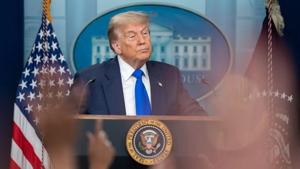
The U.S. Supreme Court on Friday said a 1977 law doesn’t give the president broad authority to issue tariffs, dealing a significant setback to President Donald Trump’s economic agenda.
Chief Justice John Roberts wrote in the majority opinion that “the Framers did not vest any part of the taxing power in the Executive Branch.”
Roberts said the tariffs violated the major questions doctrine. Trump’s interpretation of the 1977 International Emergency Economic Powers Act would be an “expansion of the President’s authority over tariff policy” that Congress didn’t intend.
“There is no exception to the major questions doctrine for emergency statutes,” the majority wrote. “Nor does the fact that tariffs implicate foreign affairs render he doctrine inapplicable. The Framers gave ‘Congress alone’ the power to impose tariffs during peacetime.”
Twelve states, five small businesses and two Illinois-based toymakers have challenged Trump’s authority to impose tariffs under the 1977 law without Congressional approval.That law, the International Emergency Economic Powers Act, does not mention the word “tariff” and, as the challengers stress, has never been used to impose tariffs.s.
The Supreme Court noted that in Friday’s decision.
“It is also telling that in IEEPA’s half century of existence, no President has invoked the statute to impose any tariffs, let alone tariffs of this magnitude and scope,” the high court wrote.
In November, Trump’s legal team had argued that the law is a clear delegation of emergency power, granting the president broad authority to act in times of crisis.
In August, the U.S. Court of Appeals for the Federal Circuit affirmed a lower court’s ruling that Trump did not have the authority, but said Trump’s tariffs could remain in place while the administration appeals to the U.S. Supreme Court. In the 7-4 decision, the Federal Circuit majority held that tariff authority rests with Congress.
Newsom OKs $590M loan for Bay Area public transportation
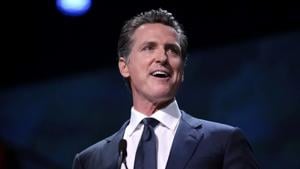
California Gov. Gavin Newsom on Thursday afternoon signed legislation that involves a $590 million loan for Bay Area public transportation.
Speaking before reporters in San Mateo County, Newsom said the loan will be paid back in 12 years. The first two years will be interest-free.
“This is not just about transportation. It’s about economic development. And it’s also about our inheritance, and we have been frankly living off our inheritance,” the Democratic governor said at the news conference and signing ceremony, which featured other elected officials. “We’ve taken a lot of these systems for granted. We haven’t invested in them over the course of many decades, and I say this knowingly as a former representative of the Parking and Traffic Commission, a county supervisor, and mayor of the city and county of San Francisco.”
The governor said people need public transportation. In some cases, Newsom said there are folks in one part of San Francisco whose property values are attached to the success of these transit systems.
“So this is about all of us; this is our identity. It’s not just about moving people. It’s about goods movement, it’s about regional vitality, and it’s about the energy that is our great export here in the Bay Area,” said Newsom.
State Sen. Scott Wiener was also at the bill signing.
He said the funding challenges that public transportation systems in the Bay Area face now are not new.
“They’ve been with us a long time,” said Wiener, a Democrat whose district includes San Francisco and portions of San Mateo County.
“The pandemic did not cause them. The pandemic made it worse and more obvious. But for far too long, we have not adequately funded our public transportation systems, and we are step by step changing that,” said Wiener, who’s running for the U.S. House seat held by former Speaker Nancy Pelosi. Pelosi, D-San Francisco, decided against seeking reelection this year.
Assemblymember Lori Wilson, D-Suisun City, said the measure signed by Newsom authorizes a temporary loan, which will serve as a bridge funding. Wilson said it aligns with the 2025 Budget Act.
“Public transit is not optional for many Californians,” said Wilson. “It connects workers to jobs, students to schools and families to essential services. And transit is also critical to achieving our climate goals and to reducing congestion on our roads.”
Wilson added that the bill provides flexibility while local leaders consider long-term solutions and engage stakeholders and constituencies.
Federal government issues guidance on prayer in schools

The U.S. Department of Education has issued guidance on prayer in public schools, outlining requirements that are tied to federal education funding.
The guidance states that no public school, teacher or school official “should ever coerce or pressure a student to engage in speech or affirm a viewpoint that would violate the student’s sincere religious beliefs.”
In a statement, U.S. Secretary of Education Linda McMahon said the guidance reaffirms constitutional protections for religious liberty.
“Our Constitution safeguards the free exercise of religion as one of the guiding principles of our republic, and we will vigorously protect that right in America’s public schools,” McMahon said.
According to the department, the updated guidance addresses three key First Amendment protections: the right of parents and students to freedom of speech, the right to practice religion freely, and the obligation of public schools to avoid establishing or endorsing religion.
The guidance follows President Donald Trump’s remarks in September at the Museum of the Bible in Washington, D.C., where he said the department would issue new direction on prayer in public schools.
After Trump announced the guidance, the Freethought Caucus issued a statement expressing concern that the federal government could appear to favor one religion.
“This guidance helps erode the Establishment Clause, blurring the lines between private and school-sponsored prayer, and create a less inclusive environment for students of diverse faiths or no faith,” the caucus said in a statement. The group added that other actions by the Trump administration “may appear to endorse one religion over others.”
Those in support of the guidance say it clarifies existing law and protects constitutional rights.
In an exclusive interview with The Center Square, Jeremy Dys, senior counsel and chair of First Liberty Institute’s Education Practice Group, said the updated direction reflects longstanding constitutional principles.
First Liberty represented former high school football coach Joseph Kennedy in Kennedy v. Bremerton School District, a 2022 U.S. Supreme Court decision that held a public school district violated the First Amendment when it disciplined Kennedy for praying on the Washington state field after games.
“What the guidance has done well is point back at the 250 years of American history that point to welcoming religion even inside our public schools and allowing students to freely exercise their faith on campus, but to have their consciences protected when they do,” Dys said.
Dys added the prayer-in-school guidance by the Biden administration claimed to call for neutrality, but rather restricted religious freedom in public schools.
“Neutrality does not mean that you can silence religious speech and somehow create a neutral sphere,” he added. “That’s actually hostility towards religion.”
Dys said school officials should ensure that students and teachers can exercise their constitutional rights while on campus.
“The job of school officials everywhere, and every professional educator, is to maximize the freedom for its students and teachers to be able to walk through the schoolhouse gates without shedding a single part of their constitutional rights,” he said.
Under Section 8524(b) of the Elementary and Secondary Education Act, local educational agencies must certify in writing to their state educational agency that they do not have policies preventing constitutionally protected prayer in public elementary and secondary schools as a condition of receiving federal funds.
ESEA funds are federal grants provided to state and local educational agencies to supplement K-12 education, particularly for high-poverty and at-risk students.
The Center Square previously reported that in Arizona, public schools could risk losing federal funds if they fail to comply with requirements to protect constitutionally protected prayer and religious expression.
State departments of education are required to submit annual reports to the U.S. Department of Education detailing how school districts are complying with the updated guidance.
The Center Square reached out to the American Civil Liberties Union and Interfaith Alliance for comment, but did not receive a response.