Center Square
Taxpayer-backed teacher unions receive $390M in dues
National teacher unions continue to collect hundreds of millions of dollars annually in membership dues, according to new federal filings with the U.S. Department of Labor.
The National Education Association, which reported 2,846,104 members from September 2024 through August 2025, reported approximately $454 million in total receipts during the fiscal year, according to its LM-2 filing. Of that amount, about $390 million came from dues and agency fees. (According to the Department of Labor, LM-2 filings are annual financial reports from labor organizations with $250,000 or more in receipts.)
NEA President Becky Pringle received $514,755 in salary during the reporting period. Since becoming president in 2021, her salary has increased by more than $80,000, according to federal filings.
Other top officers also received six-figure compensation. Vice President Princess Moss received total compensation of $416,514, while Secretary-Treasurer Noel Candelaria received $417,186.
The NEA reported $529.5 million in revenue for the 2022–23 fiscal year, including $374.2 million from membership dues, according to Americans for Fair Treatment. The average full-time teacher pays between $200 and $220 annually for national NEA membership, typically deducted directly from paychecks.
A majority of public school districts do not reimburse union dues. They are paid by members via payroll deduction of taxpayer-funded salaries.
Union officials argue the spending supports advocacy for educators and students. In a recent statement emailed to The Center Square, Pringle said test scores “reflect the consequences of disinvestment in public education,” adding that schools need funding to pay teachers competitive wages, reduce class sizes and invest in updated materials.
But critics question whether unions calling for increased taxpayer funding are also expanding their own operations and executive pay.
“The labor unions are an absolute cancer on our education system,” Rusty Brown, director of special projects at the Freedom Foundation, which advocates against public-sector unions, told The Center Square. Brown argued that unions function like cartels and contribute to declining academic standards.
According to its 2025 LM-2 filing, the NEA reported $51,747,025 in disbursements for political activities and lobbying.
Since 2022, the NEA and the American Federation of Teachers have together contributed $43.5 million to political organizations, including The Trevor Project, according to a report by the nonprofit Defending Education.
At the state level, union dues can be far higher. For example, in California, individual teacher dues exceed $1,000 annually for state and national unions. Public education unions in California are estimated to collect more than $800 million per year, according to the California Policy Center.
Trump to lead Board of Peace inaugural meeting

The worldwide Board of Peace is set to meet Thursday in Washington for its inaugural meeting, bringing together representatives from nearly 50 nations with a focus on rebuilding Gaza.
President Donald Trump has announced a $5 billion pledge from partner nations for Gaza reconstruction. However, it is unclear how much each partner nation will be contributing, including America.
Trump has indicated that part of the reconstruction effort will include thousands of personnel who will be committed as part of an international stabilization force.
The president will be serving as the board’s chairman, which was announced last fall. Israel, along with several Arab nations, has agreed to join the board.
Hamas attacked Israel on Oct. 7, 2023, and the death toll through Wednesday’s published reports are at more than 75,000. Since a ceasefire in October, the Gaza Ministry of Health – considered credible by the United Nations – says 600 Palestinians have been killed.
Daily strikes and fights, according to published reports, are still happening five months since the ceasefire announcement.
Last month, while visiting Davos, Switzerland, the president formally ratified the Charter of the Board of Peace.
The president touted the board, saying it would bring about lasting peace in the region, which has been plagued by multiple wars since the end of World War II.
“This board has the chance to be one of the most consequential bodies ever created,” Trump said in Davos. “Today, the first steps toward a brighter day for the Middle East and a much safer future for the world are unfolding right before your very eyes. Together, we are in a position to have any credible chance to end decades of suffering, stop generations of hatred and bloodshed, and forge a beautiful, everlasting, and glorious peace for that region.”
The board has been endorsed by the United Nations Security Council through a resolution as part of the president’s peace plan for Gaza.
Despite an ongoing war between Ukraine and Russia, Russia has agreed to join the board.
The Vatican was invited to join the board, but declined. White House Press Secretary Karoline Leavitt, in a Wednesday briefing, said it was an “unfortunate decision.”
California, Colorado, others sue Trump over energy funding
Editor’s note: This story has been updated since its original publication to include a comment from the White House.
Democratic attorneys general from 13 states on Wednesday sued the U.S. Department of Energy over its decision to terminate $2.7 billion in federal money for energy and infrastructure programs.
The suit, which was filed in the U.S. District Court for Northern California, says the programs were mandated by bipartisan majorities in Congress and that the Trump administration violated the Constitution’s separation of powers, which gives Congress the power of the purse.
The lawsuit is being co-led by attorneys general from California, Colorado and Washington state. Other plaintiffs are attorneys general from Connecticut, Illinois, Maryland, Massachusetts, New Jersey, New York, Oregon, Rhode Island, Vermont and Wisconsin. Besides the U.S. Department of Energy, defendants include Secretary of Energy Chris Wright, the Office of Management and Budget, and OMB Director Russell Vought.
In California, $1.2 billion in federal funding for the Alliance for Renewable Clean Hydrogen Energy Systems and $4 million under the Resilient and Efficient Codes Implementation program were terminated.
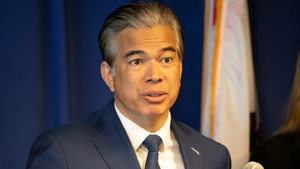
“The president doesn’t just get to cancel them because he disagrees with them,” California Attorney General Rob Bonta told reporters during a virtual news conference Wednesday afternoon with Colorado Attorney General Phil Weiser.
The Democratic attorneys general’s lawsuit refers to Republican President Donald trump’s executive order, called “Unleashing American Energy” and issued on Inauguration Day – Jan. 20, 2025.
Trump’s order says “burdensome and ideologically motivated regulations” have impeded development of energy and natural resources and caused higher costs for energy, transportation, heating, utilities, farming and manufacturing. The order calls on all agencies to pause the distribution of funds appropriated through the Inflation Reduction Act of 2022 or the Infrastructure Investment and Jobs Act. The latter is also known as the Bipartisan Infrastructure Law.
The suit accuses the Trump administration, including the Department of Energy and the Office of Management and Budget, of eliminating programs created under the two laws. The lawsuit said the Department of Energy followed up with a list in March of DOE-funded energy and infrastructure projects it would end and expanded that list in October.
“In our constitutional system, only Congress has the power to appropriate funding, and to define if and how federal programs are administered,” the lawsuit says.
After the suit was filed, The Center Square reached out to the White House for comment.
“The Trump Administration is confident that we will defeat this frivolous lawsuit,” White House spokeswoman Taylor Rogers said late Wednesday afternoon, answering The Center Square’s questions by email. “Left-wing politicians in Blue states are still doubling down on Joe Biden’s failed and costly Green New Scam policies, which have driven up energy prices, hurting families and businesses.
“Meanwhile, President Trump has canceled unpopular green energy subsidies that wasted Americans’ hard-earned tax dollars and is unleashing American energy,” Rogers said. “The American people want reliable and affordable energy, but Democrats refuse to abandon their failed approach and embrace the President’s energy dominance agenda.”
But Weiser, the Colorado attorney general, accused the Trump administration of creating its own scam by blocking money Congress allocated for states.
“Federal funding can’t be terminated to punish states or score political points,” Bonta said. The California attorney general added the termination of federal money threatens more than 200,000 union jobs in the state and contributes to higher energy prices.
“California believes in innovation and clean energy,” Bonta said. “We won’t stand by while lawful funding is stripped away.”
Weiser accused the Trump administration of canceling the same grants in blue states that it is allowing for red states.
“We don’t live in the Blue States of America or the Red States of America. We live in the United States of America,” Weiser said.
The Center Square Wednesday asked Weiser and Bonta several questions about their current and previous lawsuits against the Trump administration. Weiser replied by accusing the Trump administration of making arbitrary and capricious decisions that violate the federal Administrative Procedure Act. He said the federal government didn’t give a reason for blocking funding such as approximately $300 million to Colorado State University to study ways to reduce methane emissions.
“If we’re going to have gas and oil development, it’s valuable to make sure methane emissions aren’t happening,” Weiser told The Center Square. “In Colorado, we have these methane-producing wells, and we’re seeking to address it.”
Bonta said the hydrogen project in California, which gets most of the federal energy funding cited on Wednesday, involves hydrogen plants and distribution.
Bonta and Weiser agreed they’re getting a high rate of return on their lawsuits against the Trump administration.
For every dollar spent suing Trump, California gets a return of nearly $10,000, Bonta said, answering The Center Square’s questions. He said that after spending $19 million so far, the state has protected $200 billion in federal funding.
“Some things are priceless,” Bonta said, citing the rights to vote and birthright citizenship and court rulings that resulted in the removal of federalized deployed National Guard and Marines from Los Angeles.
Weiser said his office received an additional $600,000 to spend on litigation against Trump and has secured $1 billion in federal funding.
Wednesday’s lawsuit is the 58th one California has filed since President Donald Trump started his second term in January 2025. For Colorado during the same period, it’s the 54th suit.
Bonta said California filed 120 lawsuits against Trump during his first term and, at the state’s current pace, is on the way to doubling that during the president’s second term. Weiser, who became the Colorado attorney general in 2019, said he filed 19 lawsuits against the first Trump administration and three times that since January 2025.
During other administrations, California has filed few, if any, lawsuits against the federal government, Bonta said.
EXCLUSIVE: U.S. Rep. Kiley launches CalPERS ESG probe after The Center Square investigation
In an exclusive interview with The Center Square, Congressman Kevin Kiley, R-Calif., questioned California state retirement fund objectives, saying they have an “entirely different agenda” that appears to potentially breach fiduciary duties — and puts retirees’ futures at risk in favor of progressive political objectives.
The interview came days after Kiley and two other congressmen announced a probe of CalPERS’ ESG practices in response to an investigation by The Center Square that revealed CalPERS lost 71% of its $468 million investment into its Clean Energy and Technology Fund.
“What we seem to be seeing is an entirely different agenda driving some of those decisions, potentially in violation of the law and to the detriment of Californians,” said Kiley, who chairs the Early Childhood, Elementary, and Secondary Education Subcommittee on the House Committee on Education and Workforce. “Our inquiry here is designed to see exactly what’s going on with that particular investment, and there’s a host of other related policies CalPERS has implemented that do not seem to be driven towards maximizing returns.”
He said the committee will obtain records that are not publicly available under state law and determine whether CalPERS is meeting its fiduciary duty to operate for the exclusive benefit of retirees — or if other, ideological factors are at play.
“This is about protecting the investments and retirement of California’s public employees,” Kiley told The Center Square. “CalPERS has a massive amount of money that is under its investment decisions and it has a legal obligation under both state and federal law to manage those assets for the benefit of the affected employees who rely on those funds for their retirement.”
As of February 17, CalPERS managed assets worth $611 billion. In early December, the libertarian Reason Foundation estimated CalPERS’ pension deficit, or shortfall between its assets and pension obligations, was $166 billion.
Kiley said CalPERS doesn’t seem to be focused on getting the best returns for retirees and the taxpayers who fund the pension.
“When you see these sorts of ESG policies … it is axiomatic that when you’re making investment decisions in order to advance those causes for ideological reasons, then by definition you are not doing it in a way that is singularly driven towards getting healthy returns,” Kiley said.
On February 12, 2026, the House Committee on Education and Workforce sent a letter to CalPERS President and Vice Chair of Investment Theresa Taylor demanding detailed documentation on the CETF investments.
CalPERS had denied a similar request for information by The Center Square was denied, citing public records request inclusions enshrined in California law for certain financial records. No such exemption exists for congressional inquiries.
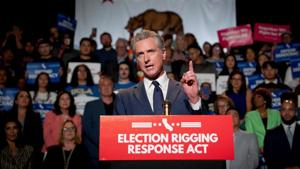
Kiley, whose district was fragmented by Gov. Newsom’s Prop 50, which suspended the state’s independently drawn Congressional districts until 2030, placed the inquiry in the context of his efforts to change state policy through federal legislation.
“We have been holding Gavin Newsom accountable and have had many victories over him, and so it’s no secret that I was the number one target of his redistricting sham,” Kiley said. “We cut off his federal funding for high speed rail, we reversed — through legislation that I introduced — his ban on gas-powered vehicles, we got him to end his policy of free healthcare for illegal immigrants, and in a whole host of other ways, we have been systematically been counteracting the destructive policies that he’s inflicted on the people of California.
Turning to California’s fiscal challenges, Kiley warned of unsustainable pension obligations and unchecked spending.
“It’s California taxpayers” who will cover the costs,” he said, noting Newsom has expanded the state budget to over $330 billion — a more than 50% increase during his tenure.
Kiley said Newsom’s failure to pay down the state’s $20 billion federal unemployment loan from the COVID era — making California the only state not to do so — as a stark example of the state’s fiscal mismanagement.
Under federal law, this failure has triggered automatic taxes on California small businesses to repay the debt.
“Here you have a very clear example of Newsom taking our state into debt, failing to pay off those debts, and directly impacting our taxpayers here and now,” Kiley said.
The Center Square also recently uncovered that CalPERS’ new Chief DEI Officer, whose listed duties include integrating DEI principles into investment practices, and recruiting staff for DEI-informed proxy voting and ESG investing, has no financial experience.
Another recent investigation by The Center Square highlighted CalPERS’ ties to financing Chinese military technology.
CalPERS officials told The Center Square Tuesday that they will not be commenting on the congressional inquiry.
“We received and are reviewing the U.S. House Committee letter regarding the nearly 20-year-old investment,” wrote CalPERS spokesperson Abram Arredondo in a statement to The Center Square Tuesday. “As their investigation is ongoing, we have nothing further to add.”
‘Just the beginning of enormous growth’: White House heralds strong jobs report

The White House is heralding a better-than-expected jobs report as one of the first signs of what it says will be a “record successful year” in 2026, after a year of stalled jobs growth.
“The January jobs report shattered expectations, highlighting how the president’s pro-growth economic agenda is fueling American prosperity,” White House Press Secretary Karoline Leavitt said Wednesday.
The labor market added 130,000 jobs in January, with 172,000 new jobs in the private sector – “more than two and a half times economists’ predictions,” Leavitt underscored.
That’s better than any month in 2025. Last year saw a net gain of 181,000 jobs, which many economists have described as a stagnant labor market.
Under the second Trump administration, the job market has lagged while some other economic indicators have been strong. GDP growth was robust in quarters two and three – generally stronger than it has been the last several years. Inflation dropped from 2.7% to 2.4% from December to January – the lowest since May and closer to the Federal Reserve’s target rate of 2%.
Analysts’ interpretations of the latest jobs report vary from overwhelmingly positive to more critical.
The director of the Sound Money Project at the American Institute for Economic Research largely agreed with the administration’s read on the data.
“The labor market appears to be in great shape at the moment,” William Luther said in a statement to The Center Square.
He noted, as Leavitt did, that 80.9% of those between the ages of 25 and 54 were employed in January, the highest prime-age labor force participation rate since 2001.
“At the same time, the composition of jobs has improved,” Luther added, explaining that the president’s policies have stopped the trend of federal government job growth outpacing private sector growth, as it did at times under the Biden administration.
“That shift in employment, from the unproductive public sector to the productive private sector, will bolster economic growth going forward,” Luther said.
Others gave a more cautious analysis.
“The January job numbers were certainly stronger than expected,” said Desmond Lachmann, senior fellow at the American Enterprise Institute. “However, I would not make too much of one month’s numbers, which oftentimes are revised downward.”
Lachmann said he would still characterize the current job market as a “no-hire, no-fire kind of pattern,” though unemployment has remained low.
Senior Economist with the Competitive Enterprise Institute Ryan Young also interpreted the siloed job growth in health care as concerning.
“People are flocking to safer jobs where they are less likely to be laid off, instead of taking chances by starting their own businesses, or working for riskier startups instead,” Young told The Center Square.
Advocates call on Trump to cut taxpayer funds for minor transgender care

Advocates across the country are calling on medical groups and the Trump administration to end the practice of gender-altering operations for minors.
The increased calls come after Fox Varian, a 22-year-old woman who identified as a boy as a teen, won a $2 million settlement on Jan. 30 from doctors in New York who gave her a double mastectomy when she was 16 years old. The New York jury found a doctor and psychiatrist liable for medical malpractice by providing Varian the approvals for surgery.
The “detransition” case was the first of its kind to win after going to trial in a United States courtroom. The jury awarded Varian $1.6 million for past and future pain and suffering and $400,000 for future medical expenses.
Mark Trammell, general counsel at the Center for American Liberty, applauded the $2 million award but called for more in damages. He said some of the operations could cause a woman to lose the ability to have children.
“I do wish the court would have awarded a little bit more money,” Trammell said. “How do you put a price tag on a woman’s ability to have children later in life?”
On Feb. 3, the American Society of Plastic Surgeons recommended delaying gender-related surgery for individuals 19 and younger as concerns emerged surrounding surgical interventions for minors, The Center Square reported.
The U.S. Supreme Court also allowed Tennessee to uphold a ban on doctors prescribing puberty blockers and hormone therapy for minors with the express purpose of undergoing gender transition.
“More are waking up to the reality that this is abuse that’s happening to children,” Trammell said. “I think it’s absolutely within the state’s power to protect vulnerable kids from being abused by adults.”
Erin Hawley, vice president at Alliance Defending Freedom, said some doctors have used their platforms to frighten parents with children who want to transition genders. She pointed to the threat of a child committing suicide if they are not allowed to transition.
“You do have some parents supporting this because they think it’s their only option,” Hawley said.
Trammell pointed to an apparent targeting of children who may be suffering with mental illness and are recommended to transition by medical professionals. He mentioned Chiles v. Salazar, a U.S. Supreme Court case set to determine whether Colorado’s conversion therapy ban can apply to a therapist who provides services to a child dealing with gender dysphoria.
“I think there’s a growing fear among practitioners that if they counsel their patients in any direction, that is not immediate affirmation that they can lose their medical license,” Trammell said.
Hawley and Trammell said more cases like Varian’s should proceed through courts. Hawley said some sex-change operations can bring in as much as $100,000 for a hospital or medical entity.
Hawley called on state and federal leaders to block taxpayer funds from supporting sex change operations in minors. She said funds from Medicaid should not be allowed to support these procedures.
The Trump administration has proposed rules that would prevent hospitals enrolled in Medicare and Medicaid services from providing sex change surgeries for minors. The administration also extended the proposal for those covered under the Children’s Health Insurance Program, or CHIP.
“States who want to continue doing this could continue to theoretically do so through state-only funding, but it presents a barrier going forward,” said Sarah Parshall-Perry, vice president of Defending Education.
Hawley said she anticipates legal challenges to the Trump administration’s proposed rule but is optimistic about federal funding withdrawals. NYU Langone Health announced it would end its transgender program for minors on Tuesday, citing the “current regulatory environment.”
“Congress gets to do with your money what they want,” Hawley said. “If it’s executive policy for the [U.S. Department of Health and Human Services] to not fund these sorts of things, I think that’s on pretty strong ground.”
Trump: Japan to invest $36B in U.S. energy, mineral projects

Japanese companies will finance investments valued at $36 billion in energy and minerals projects in Ohio, Texas and Georgia as part of a trade agreement that will cut U.S. tariffs on Japanese imports to 15%, according to the Trump administration.
The announcement is part of Japan’s 2025 agreement to invest $550 billion over the next four years at the direction of the U.S., with the funds aimed at rebuilding and expanding core American industries. In October, the Trump administration provided details on Japanese investments of up to $332 billion to develop critical energy infrastructure in the U.S.
The investments announced by the administration on Tuesday include $33 billion for construction of a massive natural gas power plant in Portsmouth, Ohio, that would generate up to 9.2 gigawatts of electricity, enough to supply the needs of approximately 7.4 million homes, making it the largest gas-fired power generation facility in the world, according to a statement released by the U.S. Department of Commerce.
The Portsmouth Powered Land Project will cost $33 billion to build and be operated by SB Energy, a subsidiary of Japanese technology conglomerate SoftBank, while two of Japan’s largest industrial firms, Hitachi and Toshiba, are to provide the natural gas turbines and grid technologies, the Commerce Department said.
Japanese investors have also agreed to commit $2.1 billion for a partnership stake in the Texas GulfLink crude oil export terminal, located about 30 miles offshore in the Gulf, which received a final regulatory approval earlier this month from the U.S. Maritime Administration.
The GulfLink terminal is expected to generate annual U.S. crude oil exports of $20 billion to $30 billion and promote American energy dominance, Commerce Secretary Howard Lutnick said in a statement.
In a third investment, with capital for the project coming from the Japan Bank for International Cooperation and Nippon Export and Investment Insurance, Element 6, a subsidiary of South African mining company De Beers, will build a synthetic industrial diamond manufacturing plant in Georgia capable of supplying 100% of U.S. demand for synthetic diamond grit, a critical input in advanced industrial manufacturing.
“Japan is providing the capital,” said Lutnick. “The infrastructure is being built in the United States. The proceeds are structured so Japan earns its return, and America gains strategic assets, expanded industrial capacity, and strengthened energy dominance,” he said.
The natural gas-fired plant in Ohio would supply baseload power needed in central part of the state to supply fast-growing demand from data centers built to power artificial intelligence applications. The Portsmouth plant would interconnect with the nation’s largest power grid, run by PJM, with a ground-breaking scheduled for late 2026 and first electricity generation expected by 2028.
In addition to its investment in the Portsmouth power plant, SoftBank recently purchased a former electric vehicle plant in Ohio to support its “Stargate” project, a $500 billion joint venture that will own and operate AI infrastructure with partners that include OpenAI and Oracle.
Noritake, a Japanese manufacturer of industrial grinding wheels and advanced ceramics, was identified by Japanese officials as a primary buyer of diamond grit produced at the Georgia plant.
“The scale of these projects are so large, and could not be done without one very special word, tariffs,” Trump posted on Truth Social.
The U.S. Supreme Court is expected to rule in the coming months on questions about whether Trump exceeded his authority in invoking a 1970s law known as the International Emergency Economic Powers Act to impose tariffs on America’s trade partners.
Hassett says Fed researchers should be punished for tariff analysis

Kevin Hassett, director of the National Economic Council of the United States, said Wednesday that Federal Reserve researchers who found that President Donald Trump’s tariffs hit Americans hardest should face discipline over the analysis.
“It’s, I think, the worst paper I’ve ever seen in the history of the Federal Reserve system,” Hassett told CNBC.
Federal Reserve Bank of New York’s researchers Mary Amiti, Christopher Flanagan, Sebastian Heise and David Weinstein, an economics professor at Columbia University, wrote the paper.
“U.S. firms and consumers continue to bear the bulk of the economic burden of the high tariffs imposed in 2025,” according to the report from the Federal Reserve Bank of New York.
Hassett said the paper failed to make the grade.
“The people associated with this paper should presumably be disciplined, because what they’ve done is they’ve put out a conclusion, which has created a lot of news that’s highly partisan based on analysis that wouldn’t be accepted in a first-semester econ class,” Hassett said.
Phillip Magness, a senior fellow at the Independent Institute, said the Federal Reserve analysis was in line with similar studies.
“The New York Fed analysis is consistent with multiple other empirical studies into the effects of Trump’s tariff policies,” he told The Center Square. “The Fed report found that about 90% of tariff incidence is passed through onto American consumers and businesses. This finding is in line with several other independent studies.”
The Kiel Institute for the World Economy found that Americans are paying almost the entire cost of tariffs. A National Bureau of Economic Research paper found that nearly the entire tariff burden is passed on in the form of higher prices, directly impacting American businesses and consumers.
Similarly, a December 2025 study from Duke’s Department of Economics found that during the 2019–21 trade dispute, consumers ultimately paid more than the tariff cost on European wines. Goldman Sachs economists projected in October that American consumers will pay 55% of the tariff costs, U.S. businesses will pay 22% and foreign exporters will pay 18%.
Magness said no research has surfaced showing that foreign businesses are significantly cutting prices.
“I have not seen any credible study that supports the White House’s claims about foreign firms incurring the bulk of tariff incidence,” he said.
However, in November, the Congressional Budget Office changed some of its tariff projections after noting that foreign businesses were picking up about 5% of the cost of the tariffs through lower prices.
Magness said Hassett’s comments could have a chilling effect on research that doesn’t match White House talking points.
“Hassett’s comments about […] the New York Fed researchers are a serious breach of professional and scholarly ethics,” he said. “[Hassett] is sending a signal that the White House will attempt to punish professional economists who publish empirical findings that contradict the administration’s unsubstantiated claims about the benefits of tariffs.”
Peter Navarro, a top trade adviser to Trump, has said it is about bargaining power: “In real markets, the burden falls on whoever can’t afford to lose access to the U.S. consumer.” The White House has said foreign exporters who depend on access to the American economy will ultimately pay the cost of the tariffs.
Trump has made tariffs a central part of his economic agenda during his second term. In April 2025, Trump imposed import taxes of at least 10% on every U.S. trading partner. Since then, the president has suspended, changed, increased, decreased, and reimposed tariffs under the 1977 International Emergency Economic Powers Act.
A group of states and small businesses challenged Trump’s tariffs under the 1977 law, winning in two lower courts before the administration appealed to the U.S. Supreme Court. The high court agreed to hear the case on an expedited basis.
Jeffries says no progress made in DHS shutdown negotiations
The U.S. Department of Homeland Security has remained underfunded for five days, but Democrats and Republicans are no closer to reaching a deal on the annual DHS appropriations bill.
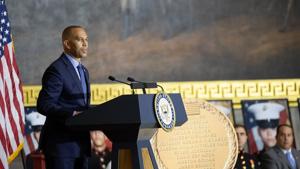
House Minority Leader Hakeem Jeffries, D-N.Y., told reporters Wednesday that Democrats will continue to ensure the DHS funding bill “will not move forward” unless it contains measures reforming Immigration and Customs Enforcement “in a dramatic, bold, meaningful, and transformational manner.”
“In terms of the state of play on the current proposal, we’ve responded, we’ve reiterated our perspective on the types of things that are absolutely necessary in order for a DHS funding bill to move forward, all anchored in this principal that ICE needs to conduct itself like every other law enforcement agency in the country, and stop using taxpayer dollars to brutalize the American people,” Jeffries said.
The Homeland Security bill is the only appropriations bill for fiscal year 2026 – which began four months ago – that remains unpassed.
This is the second time in less than six months that Democrats have forced a shutdown over policy demands, with the holdup this time centered around demands for immigration enforcement changes.
Demands for greater accountability in DHS erupted after an ICE agent fatally shot 37-year-old Alex Pretti in January, the second killing that month of a U.S. citizen protesting in Minneapolis.
While Republicans are open to some of the policy demands Democrats have made, they remain staunchly opposed to some measures that Jeffries said “remain lines in the sand” for Democrats.
Those proposed changes include mandating that immigration enforcement agents obtain a judicial warrant on top of an immigration court warrant before entering private property, as well as making some locations completely off-limits, such as churches, hospitals, schools, and polling sites.
Democrats also want to require immigration enforcement agents to display identification and prohibit agents from wearing face masks.
Republicans argue that such changes will cripple efforts to combat illegal immigration and put DHS agents at risk, but Jeffries said Democrats “remain steadfast in our views as to the type of things that have to happen in order for ICE to be dramatically reformed.”
While ICE is suffering no impact from the lapse in DHS appropriations – having received a $75 billion boost from Republicans’ budget reconciliation bill – other agencies like FEMA, the U.S. Coast Guard, the Secret Service, and the Transportation Security Administration are not so fortunate.
Those agencies have scaled all but the most necessary operations, but more than 90% of their employees are considered “essential” and must therefore show up to work. If the shutdown persists until their next payday, the hundreds of thousands of DHS employees in those and other agencies will miss their paychecks.
Wexner denies knowing anything of Epstein’s crimes; Oversight Dems unconvinced
Democrats on the House Oversight Committee remain unconvinced of 88-year old billionaire Les Wexner’s claim that he was “duped” by sex trafficker Jeffrey Epstein throughout their entire roughly 20-year relationship.
The founder of Limited Brands retailer and former CEO of Victoria’s Secret was deposed by the committee in his Ohio residence Wednesday, where he denied any knowledge of Epstein’s sex trafficking activities.
“I was naïve, foolish, and gullible to put any trust in Jeffrey Epstein,” Wexner said in his statement to Congress. “He was a con man. And while I was conned, I have done nothing wrong and have nothing to hide. I completely and irrevocably cut ties with Epstein nearly twenty years ago when I learned that he was an abuser, a crook, and a liar. And, let me be crystal clear: I never witnessed nor had any knowledge of Epstein’s criminal activity. I was never a participant nor coconspirator in any of Epstein’s illegal activities.”
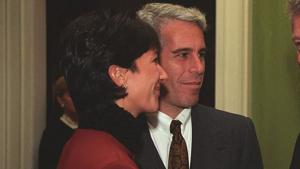
Epstein, who died in prison in 2019, had acted as Wexner’s finances manager and advisor beginning in the mid-1980s. The two reportedly became close, with Wexner calling Epstein a “loyal friend” in the past.
Epstein received power of attorney over Wexner’s finances by 1991. While it is unclear how long Epstein held that power, he and Wexner remained associates until 2007.
Wexner claimed Epstein “carefully and fully hid” from him all criminal behavior during that time by “curat[ing] an aura of legitimacy” through his connections with respected high-ranking individuals.
“He was clever, diabolical, and a master manipulator. He was meticulous in revealing to me only glimpses into the life in which he was a sophisticated financial guru,” Wexner said. “He knew that I never would have tolerated his horrible behavior. Not any of it. At no time did I ever witness the side of Epstein’s life for which he is now infamous.”
More than two hours into the deposition, however, committee Democrats remained unconvinced of Wexner’s innocence. They accused Wexner of downplaying his financial support of Epstein and giving Epstein “license and ability” to traffic women and girls.
“There is no single person that was more involved in providing Jeffrey Epstein with the financial support to commit his crimes than Les Wexner,” committee Ranking Member Robert Garcia, D-Calif., told reporters during a break in the deposition.
“Mr. Wexner admitted that he traveled both to Epstein’s island as well as his other properties. Mr. Wexner also admitted that Jeffrey Epstein had a lot of access to Mr. Wexner’s wealth. And when asked even simple questions, even as it relates to Mr. Epstein being the co-president of the foundation that established the area that we’re in today, Mr. Wexner had little to say,” Garcia added. “Mr. Epstein would not be the wealthy man he was without the support of Les Wexner.”
Wexner told lawmakers that he never “witness[ed], condone[d], or enable[d] his crimes in any way.” He said he had only visited Epstein’s island, located in the U.S. Virgin Islands, once with his wife and children.
He also said that after learning that Epstein had “stolen vast sums of money from our family,” he “never spoke with Epstein again,” and in 2007 severed all business ties with Epstein after revelations of his sexual misconduct.
Wexner’s deposition follows the release of unredacted documents from the Department of Justice naming him and others as potential co-conspirators to Epstein and Ghislaine Maxwell.
Being named in the files does not necessarily implicate an individual in a crime, and Wexner had not been charged for any crime.