Center Square
WATCH: Gov. Ferguson signaling income tax bill may be dead for session
Nine days remain in the 2026 legislative session in Olympia, and the proposed income tax has yet to reach the House floor and reports circulating late Tuesday suggest it may not reach the floor this session.
There are media reports that Gov. Bob Ferguson has told supporters and donors that getting it just right could mean “coming back next year to finish the bill in a longer session,” he wrote in an email to political donors and supporters.
Ferguson told the Washington State Standard he is “hopeful” an agreement can be reached by the end of the session March 12.
Senate Bill 6346, a 9.9% tax on income above $1 million, already cleared the Senate, but when it passed a House committee last week, amendments that were attached changed the legislation, stripping out a key tax break for large corporations.
Since then, several big tech companies have publicly blasted the bill, releasing a letter Monday warning that the proposed income tax on people making $1 million or more a year could undermine their industry’s development and progression.
As reported by The Center Square, the letter to Ferguson was signed by a variety of tech sector company leaders, including Allen Institute founding CEO Oren Etzioni, Read AI CEO and Co-founder David Shim, and founder and former vice president for AI at Microsoft Luis Vargas, among others.
On late day news that Ferguson may be backing off the income tax for this year, Washington State Republican Party Chair Jim Walsh, who also serves in the House, texted The Center Square.
“The fatal flaw in the current governor’s unconstitutional income tax scheme is that it doesn’t include a constitutional amendment. He and his supporters can spin that as much as they like but, without amending Article VII, they’ve got a dead fish in their bowl,” Walsh wrote.
Senate Minority Leader John Braun stepped off the Senate floor to call The Center Square upon hearing news that the bill may be dead for this year.
He said he met with Ferguson on Tuesday and discussed the income tax in length, but said the governor did not mention his hesitation with the bill at this point, nor did he mention sending a letter out to supporters and donors about potentially waiting until next year to try again.
“Language that gave a preferable B&O tax status and some other preferable tax statuses to certain industry groups, primarily big tech, were stripped out,” Walsh told The Center Square in an earlier Tuesday interview, referencing the House version that passed a committee last week.
“Those groups who might have been neutral or even slightly positive on the state income tax scheme now are against it,” he said, “as they should be, and they should have been all along, frankly.”
Walsh said he’s convinced Democrats are fighting among themselves at this point, with moderate members urging support for alternate legislation that would allow voters to weigh in before passage of an income tax.
“Right now, all the negotiation, all the panic, all the neurosis, is amongst the Democrats,” he said. “They’re all trying to figure out how to put some more lipstick on this pig and make it less horrible.”
Also late day Tuesday, Tennessee Gov. Bill Lee announced that Seattle based Starbucks is “expanding its North American presence with plans to locate a corporate operations office in Davidson County later this year,” noted the news release.
“Companies across the nation recognize that Tennessee’s strong values and fiscally-conservative approach are good for business, and we are proud to welcome another Fortune 500 company like Starbucks to our state,” said Gov. Bill Lee.
During a Tuesday media availability, Republican legislative leaders said the pushback from the business community on the income tax should not be ignored.
“The AWB [Association of Washington Business] poll said one in two businesses are considering leaving Washington, and when those businesses leave the state, jobs for everyday people leave too and that means taxpayer dollars are going to be leaving,” said Rep. April Connors, R-Kennewick.
A communications contact in Ferguson’s office said she did not have the letter referenced in media reports that Ferguson sent to his supporters about the potential pullback on the income tax.
This story will be updated as more information becomes available.
Lawmakers consider SNAP, other amendments to 2026 farm bill

Lawmakers on the U.S. House Agriculture Committee debated dozens of amendments to the long-overdue 2026 farm bill during the Tuesday night markup.
The Farm, Food, and National Security Act of 2026 is a more than 800-page package authorizing various nutrition, rural development, farm support, and agricultural trade programs.
Among hundreds of other measures, the legislation would make investments into broadband connectivity, childcare, forest management, water infrastructure, and hospital assistance in rural areas, as well as crop insurance programs and the Rural Energy for America Program.
Though bipartisan, the legislation received vehement pushback from some Democrats over some provisions, such as a loosening of restrictions on chemical environmental contaminants and limiting federal investments into farmland-based solar projects.
Besides introducing amendments to undo those portions, Democrats advocated using the bill to reverse both the food stamp reforms in Republicans’ “One Big Beautiful Bill” and President Donald Trump’s tariff policies.
Other proposed changes included providing financial relief for farmers dealing with PFAS contamination, restoring $1 billion to the Environmental Quality Incentives Program, redirecting the $20 billion in aid to Argentina to American farmers impacted by tariffs, and exempting veterans from SNAP work requirements.
Committee Republicans are highly unlikely to adopt those amendments.
“Throughout the creation of this farm bill, it was an open and honest process. My door was open to anyone who had practical, actionable items for improving ag policy,” committee Chairman Glenn Thompson, R-Pa., told lawmakers.
“If you are disappointed that a priority is not addressed in this text, please know that I understand, as the bill is missing many of my priorities as well,” Thompson added. “But we must not let perfect be the enemy of good.”
A few Republican lawmakers have brought forward amendments as well, including one striking any benefits specifically allocated for “socially disadvantaged” individuals and another that would create a grant program to help bring more organic products to the market.
Ranking member Angie Craig, D-Minn., said the bill “represents a missed opportunity to address the most pressing challenges facing farmers and families right now.”
“My sincere hope is that the Senate will provide us a product that better meets the needs of the American farmer and rural communities,” Craig told the committee. “I cannot vote for this bill today, but I remain hopeful that in the end, we get the product that America’s farmers and working people deserve.”
Although Congress is supposed to pass a new farm bill every five years, the most recent farm bill passed in 2018. If passed, the newly introduced farm bill would last through fiscal year 2031.
More than 230 stakeholder organizations have publicly supported the bill.
Los Angeles school board borrows $250M for settlements

The Los Angeles Unified School District recently borrowed $250 million to settle claims of sexual abuse.
That’s in addition to the $500 million that the LAUSD Board of Education approved for borrowing in 2025.
Neither the United Teachers Los Angeles, a union, nor State Superintendent of Public Instruction Tony Thurmond, a Democratic gubernatorial candidate, responded to The Center Square’s request for comment. LAUSD acknowledged The Center Square’s request for comment, but did not say anything by press time.
Sonja Shaw, a Republican candidate this year for Thurmond’s job, said the actions by the nation’s second-largest school district are beyond incompetence.
“It is systemic failure,” Shaw told The Center Square Tuesday. “Another $250 million in borrowed money on top of an earlier half-billion and hundreds of millions already paid out to settle sexual misconduct claims. That is not bad luck. That is a pattern. …
“Children have been speaking up for years,” Shaw said, noting families have been sounding alarms. Even so, Shaw said, the system repeatedly protects the adults first.
“When a district pays out massive settlements tied to employee sexual misconduct, it reveals a structure that failed to protect children,” said Shaw, currently the president of the Chino Valley Unified School District Board of Education. “Why are taxpayers now financing bonds to clean up abuse that should have been prevented in the first place?”
Maria Luisa Palma of Oleada Parents made similar comments to the Los Angeles school board in late February. During her time at the podium, Palma questioned what the district was doing to prevent sexual abuse of students and said the board continues to “protect sex abuses through the bargaining agreement with UTLA and other unions.”
Meanwhile, Palma said, children’s lives have been damaged.
“Any amount of money is never going to fix those children’s lives,” Palma told the board. “Even one case is too many, so if you continue to agree to the same protections for teachers in those bargaining agreements, sex abuse is on your heads going forward. How do you sleep at night?”
Palma told The Center Square on Tuesday that only three of the seven board members were in the room for public comment.
“Some of them, like Karla Griego, appear to leave intentionally when I and others from our Oleada parent group speak,” Palma said.
Los Angeles resident Adam Carolla also blasted the teachers’ union, saying on his podcast that “horrible teachers and ones that get caught in pedophilia” are moved to neighborhoods where people don’t complain.
“People speak Spanish mostly, and mom and dad work all day,” said Carolla on his podcast. “They continue, except for now with people that can’t lawyer up.”
WATCH/EXCLUSIVE INTERVIEWS: California Voter ID measure gets over 1 million signatures
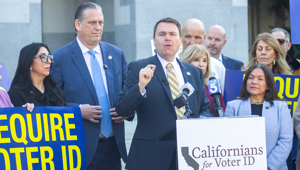
An initiative imposing new voter identification requirements in California is one step closer to getting on the ballot.
Roughly 1.35 million signatures were collected during the effort to get the California Voter ID initiative on the Nov. 3 general election ballot. That’s well over the 800,000 signatures that were required. The initiative petitions will now go to the secretary of state to verify the signatures later this week.
The new initiative would require voters to show one of several forms of identification, according to supporters during a press conference on Tuesday morning.
Those who vote by mail would have to write the last four digits of their identification number on their ballot for it to be counted. The numbers would be from a form of identification of the voter’s choice.
State lawmakers who advocated for the measure said the effort has drawn bipartisan support.
“Voter ID is one of those rare opportunities, one of those rare issues, where Democrats, Republicans and everyone in between all agree,” Assemblymember Carl DeMaio, R-San Diego, said during the press conference outside the Capitol in Sacramento. “There are a lot of concerning discrepancies in our election practices.”
California Secretary of State Shirley Weber and county election officials would also be required to verify voter registration using government data, according to the group backing the initiative. Under current state law, voters don’t have to show identification at the polls when they vote.
“All this does is it says that you need to be a U.S. citizen in order to register to vote and that you need to show a form of ID,” Sen. Tony Strickland, R-Huntington Beach, told The Center Square in an exclusive interview before the press conference. “This is very simplistic. Thirty-six states have it. Every state that has implemented this has actually had higher voter participation.”
According to the organization Californians for Voter ID, there is widespread support for voter identification measures in the state. A poll conducted by Public Opinion Strategies in January 2025 shows that 68% of Californians support voter identification requirements, and 51% said they strongly supported such measures.
Despite the data that shows deep public support for instituting voter identification requirements, some oppose the measure, telling The Center Square on Tuesday they anticipate such restrictions could unfairly disadvantage voters of color.
“We know it’s not about election integrity. It’s about voter suppression,” Brittany Stonesifer, senior program manager for voting rights and redistricting at Common Cause California, told The Center Square in an exclusive interview after the press conference.
“The number of people who don’t have current ID goes significantly up for voters of color,” she said outside the Capitol. “The studies consistently show that states with strict voter ID requirements have much lower turnout, and the gap between white voters and non-white voters goes up significantly.”
However, lawmakers of color said during the press conference on Tuesday that the effort to institute new voter identification laws is a common-sense measure that would improve the quality of California’s elections.
“When people begin to question the integrity of our elections, trust in the government starts to erode,” Assemblymember Leticia Castillo, R-Corona, told reporters. “That’s exactly why we need voter ID in California.”
Castillo, who worked at the polls during elections in her district, said she saw voters who showed up to the ballot box show her their IDs, even if they weren’t required to do so.
“They’d tell me, ‘You have to check IDs. How do you know it’s really me?’ ” Castillo said.
In response to a question from The Center Square during the press conference, DeMaio said the measure ultimately helps all Californians, not just Republicans.
“It should not help one political party or another,” DeMaio said. “Who is going to benefit from this? California voters – the people.”
As fighting intensifies overseas, Republicans push harder to get DHS funded

As fighting continues overseas, Republicans have ramped up calls to Democrats to pass funding for the Department of Homeland Security, which not only regulates immigration but contributes to national and international security efforts.
“Democrats: Where is your patriotism?” House Republicans wrote on X.
The department includes Customs and Border Protection and Immigration and Customs Enforcement – for which Democrats are demanding reforms– but also the Transportation Security Administration, the Coast Guard, the Secret Service and the Cybersecurity and Infrastructure Security Agency.
Congress has been locked in a stalemate over DHS funding for weeks, with a partial government shutdown going into effect 18 days ago.
Since the U.S. began air strikes on Iran over the weekend, six American service members have been killed, a potential terrorist attack was carried out in Austin, Texas, and several U.S. embassies and consulates in the Middle East have been attacked. President Donald Trump has said more American casualties are “likely” in what was planned as a four-to-five-week campaign – but could stretch beyond that.
Multiple DHS agencies work on preventing and mitigating terrorist attacks but they’re starting to miss paychecks as the shutdown continues.
As the U.S. and Israel target Iranian leadership and military weapons, Iran has fought back, striking many locations across the Middle East with ballistic missiles and drones, including American military bases. Republicans have said that some guardsmen have been caught in the fray.
“There are members of the U.S. Coast Guard based out of Bahrain right now… These service members are directly in harm’s way,” wrote Rep. Tom Emmer, R-Minn., on X Monday. “Democrats are trying to prevent these American heroes from receiving a paycheck while they risk their lives in defense of our nation. It’s disgusting.”
Democrats are holding the line on the funding, with many of them criticizing the administration for its actions overseas.
“Has President Trump learned nothing from decades of U.S. meddling in Iran and forever wars in the Middle East,” said longtime Virginia Sen. Tim Kaine in a statement. “For months, I have raised hell about the fact that the American people want lower prices, not more war – especially wars that aren’t authorized by Congress, as required by the Constitution, and don’t have a clear objective.”
The president has said he authorized military action against Iran because of their failure to stop developing their nuclear capabilities and other developing weaponry that could have soon posed a danger to the U.S.
The House of Representatives is set to vote on a slightly modified DHS funding bill on Thursday, which, if passed, would go to the Senate.
State financial officers protect, recover $28B in tax dollars in 2025

Conservative state treasurers, auditors and comptrollers protected and recovered $28 billion in taxpayer dollars from “waste, fraud, and abuse” in 2025, according to a report from the State Financial Officers Foundation.
CEO of State Financial Officers Foundation OJ Oleka told The Center Square that the “revelations” in his organization’s report “underscore the fact that accountability matters and that it does not come automatically.”
“Simply put, taxpayer dollars do not protect themselves,” Oleka said.
“In every instance where fraud was stopped, waste was exposed, and money was saved for taxpayers, it was because a principled financial officer demonstrated leadership, vigilance, and courage,” Oleka said. “They upheld their fiduciary duty and went above and beyond.’
“In the places where fraud was able to spread, proactive oversight and accountability could’ve made a difference,” Oleka said.
When asked what can be done to prevent fraud and corruption in the first place, Oleka said: “At least one thing states can do is elect a strong financial officer willing to be a relentless watchdog over public funds.”
Oleka said “the fraud crisis in Minnesota could very well have been prevented had the state not abolished its Treasurer role years ago.”
Oleka told The Center Square that the State Financial Officers Foundation’s report “underscores why, according to surveys, state financial officers are the most trusted elected officials on money matters — more than Congress, state legislators, or governors.
“Stopping fraud is an important tool to improve affordability and reduce the national debt,” Oleka said. “Eliminating fraud and wasteful spending means the government prints less money, which means a higher value for everyone’s dollar.”
According to the report, in 2025, State Financial Officers Foundation (SFOF) members “protected over $28 billion in state funds.”
SFOF is a “cohort of 40 officers from 28 states,” as explained in the report.
These SFOF members “stopped approximately $5.7 billion in waste, fraud, and abuse,” and “oversaw $22.3 billion in investment earnings and unclaimed property returned directly to citizens” in 2025.
For example, according to SFOF, Florida Chief Financial Officer Blaise Ingoglia “identified approximately $1.86 billion in excessive or wasteful local government spending.”
Meanwhile, Kentucky Auditor Allison Ball “identified approximately $1 billion in Medicaid waste and lapsed education funds.”
In a third of dozens of examples of state financial officers exposing fraud and stewarding tax dollars, SFOF revealed that Utah State Treasurer and SFOF national chairman Marlo Oaks oversaw “investment earnings of $1.5 billion and returning ~$43 million in unclaimed property.”
In a statement, Marlo Oaks told The Center Square that the report “makes one thing clear: when you remove independent financial oversight, taxpayers pay the price.”
“The massive fraud uncovered in Minnesota is a stark reminder of what happens when accountability is weakened,” Oaks said.
“Across the country, state financial officers are doing the job taxpayers expect, identifying billions in waste, fraud, and abuse, generating strong investment results, and returning billions in unclaimed property to rightful owners,” Oaks said.
“That’s not partisan; it’s fiduciary duty,” Oaks said. “America’s state financial officers will continue to expose fiscal misconduct and protect the hard-earned dollars of the American people.”
Iran war, Saudi outage to boost U.S. propane, butane exports
Chaos in global energy markets following the launch of Operation Epic Fury is expected to drive record demand for U.S. exports of propane and butane, analysts said Monday.
Following a military strike by the U.S. and Israel that killed Iran’s supreme leader Ayatollah Ali Khamenei and approximately 40 senior officials, Iran launched missile attacks on Saudi Arabia’s largest oil field and targeted civilian and energy infrastructure in at least nine countries including Saudi Arabia, Qatar, Kuwait, Bahrain, Oman and Jordan.
Propane and butane, together called liquified petroleum gas or LPG, are one of the largest U.S. export products in dollar terms. The U.S. produced more than 10 billion gallons of propane in 2025, about 70% of which was exported to foreign markets, energy department data shows.
LPG has been among the fastest growing U.S. exports in the last two decades, with total overseas shipments in 2024 valued at approximately $29 billion, about the same as soybeans, soymeal and soy oil, which together are the nation’s largest agricultural export category in dollar terms, Census Bureau data shows.
Analysts predict a sustained spike in demand for non-Middle Eastern energy, including U.S. LPG, which is typically a mix of 80% propane and 20% butane used by consumers and businesses across a number of industries that include agriculture, plastics production, petrochemicals, home heating and cooking.
Before the recent conflict with Iran began, Saudi Aramco had already shut down its 450,000-barrel-per-day Juaymah LPG export terminal, one of the world’s largest, due to an accident on Feb. 23 expected to keep the facility offline for more than a month. LPG buyers around the world were already scrambling to find supplies even before Iran shut down the Strait of Hormuz to vessel traffic.
Saudi Aramco is reportedly considering alternative export routes, including pipelines to the Red Sea that would allow shippers to bypass the Strait of Hormuz, according to Price Futures Group commodities analyst Phil Flynn.
U.S. consumers and companies will be mostly unaffected by surging global LPG prices because domestic inventories of both propane and butane are at levels well above average for this time of year, said Eric Smith, associate director at the Tulane Energy Institute in New Orleans.
In the week ended Feb. 23, the energy department reported propane inventories were at a record-high 62.6 million barrels for this time of year.
“We export massive amounts of LPG and the recent events will likely have little to no impact on our domestic propane and butane prices,” Smith said. “We can expect world LPG prices to rise, so our exporters will probably do well in this market environment. In the longer term, maintaining the Fifth Fleet at bases in Bahrain makes it very costly for the United States to police the Strait of Hormuz,” Smith said.
Since 2007 when the shale oil revolution began, the U.S. LPG export sector has seen 18 consecutive years of growth, with most of the shipments going to Asian nations where the two gases are used primarily to manufacture plastics and petrochemicals.
U.S. propane exports averaged about 1.8 million barrels per day in 2025, up slightly from the year prior, while overseas shipments of normal butane reached nearly 500,000 barrels a day in the year, with both at record highs.
“Texas, especially the Mt. Belvieu area near Houston, is the epicenter of world LPG exports,” Smith said.
LPG terminals located along the Texas coast, with daily loading capacity of 2.2 million to 2.4 million barrels per day, currently account for 85% to 90% of total U.S. LPG exports. The remaining U.S. LPG exports are shipped from Marcus Hook, Pennsylvania and Ferndale, Washington.
Although Asian demand softened in mid-2025 due to uncertainty over trade policies, U.S. LPG exports to Europe hit all-time highs during the year while shipments to Africa, primarily Egypt and Morocco, surged fourfold.
WATCH: Trump threatens to end all trade with Spain
President Donald Trump on Tuesday said he wanted to end all trade with Spain over disagreements about military spending.
The president cited Spain’s reluctance to increase defense spending to match other NATO members and its refusal to allow the U.S. to use its bases for the Iran operation.
“We’re going to cut off all trade with Spain. We don’t want anything to do with Spain,” Trump said Tuesday during a bilateral meeting with German Chancellor Friedrich Merz.
Merz agreed with Trump that Spain had failed to invest in defense with other NATO members as required.
“We have all committed to the 5% NATO target,” he said.
Trump’s latest trade threat indicates that the U.S. Supreme Court ruling has not altered his approach to using trade as leverage.
On Sunday, Spain announced it would deny the U.S. permission to use its air bases for operations connected to the war in Iran.
Spain is part of the 27-nation European Union, which recently halted plans to finalize a trade deal with the U.S. after the U.S. Supreme Court said the bulk of Trump’s tariffs were illegal.
On Tuesday, the EU said it expects the Trump administration to honor the trade agreement made with the 27-nation bloc in Scotland last year.
Merz said Spain couldn’t be singled out.
“First, Spain is a member of the European Union, and as such we conduct negotiations on a tariff agreement with the United States only together – or not at all,” the German chancellor said.
Trump previously warned other nations not to use the Supreme Court’s decision to renegotiate deals.
“Any Country that wants to ‘play games’ with the ridiculous supreme court decision, especially those that have ‘Ripped Off’ the U.S.A. for years, and even decades, will be met with a much higher Tariff, and worse, than that which they just recently agreed to. BUYER BEWARE!!!,” Trump wrote in a social media post.
The U.S. trade deal with the European Union called for 15% tariffs on goods coming to the U.S.
The EU deal was the biggest deal Trump made after announcing “Liberation Day” tariffs on April 2, 2025. U.S. total goods trade with the European Union was an estimated $975.9 billion in 2024.
The Supreme Court, divided 6-3, ruled that the International Emergency Economic Powers Act didn’t give Trump expansive tariff powers to tax goods entering the country.
“The Framers gave ‘Congress alone’ the power to impose tariffs during peacetime,” Chief Justice John Roberts wrote for the majority.
Denver City Council votes to ban masks on ICE agents

The U.S. Department of Homeland Security says it will not comply with a new Denver ordinance that bans law enforcement, including federal agents, from wearing face coverings while operating in the city limits.
The ordinance, passed unanimously on Monday by the Denver City Council, says all law enforcement personnel must have their badge or identification number displayed and bans the use of a “facial covering when performing duties.”
The ordinance makes exemptions for special weapons and tactics, tactical operations and undercover work.
According to DHS, federal agents wear face coverings to protect from being doxxed by activists. The department says the city’s ban and others like it are unconstitutional because of the Supremacy Clause.
“Sanctuary politicians attempting to ban our federal law enforcement from wearing masks is despicable and a flagrant attempt to endanger our officers. To be crystal clear: We will not abide by unconstitutional bans,” DHS Deputy Assistant Secretary Lauren Bis told The Center Square on Tuesday, answering a question by email. “The Supremacy Clause makes it clear that state politicians do not control federal law enforcement.”
A federal judge last month blocked a California law that sought to ban U.S. Immigration and Customs Enforcement agents from wearing masks.
Mayor Mike Johnston’s office told The Center Square in an email that Denver’s ordinance is different in that it applies to local, state and federal law enforcement “rather than being tailored toward the federal government.”
The Denver Police Department is working with the city attorney and council members “to determine what implementation could look like” for the ordinance, a police spokesperson told The Center Square.
“Of utmost importance is discretion and prioritizing de-escalation when encountering these situations,” the spokesperson said in an email. “Our goal is to apply this ordinance in a way that builds trust and transparency without putting officers, deputies or the public at risk.”
Johnston plans on signing the ordinance this week, his office said. The ordinance’s final passage comes after the mayor last week signed an executive order that bars federal immigration authorities from using city properties in staging for civil immigration enforcement operations.Bies added that federal law enforcement officers have seen an increase in assaults against them.“The men and women at CBP, ICE and all of our federal law enforcement agencies put their lives on the line every day to arrest violent criminal illegal aliens to protect and defend the lives of American citizens,” the Homeland Security official said. “Make no mistake, this type of demonization is contributing to the surge in assaults of law enforcement officers.”
Trump: U.S. Navy to provide escorts for tankers through Strait of Hormuz

Over concerns that Iran is blocking vital tankers from transiting the Strait of Hormuz, President Donald Trump announced that the U.S. Navy will begin escorting tankers through the area.
“Effective IMMEDIATELY, I have ordered the United States Development Finance Corporation (DFC) to provide, at a very reasonable price, political risk insurance and guarantees for the Financial Security of ALL Maritime Trade, especially Energy, traveling through the Gulf,” the president posted on his Truth Social account Tuesday afternoon. “This will be available to all Shipping Lines. If necessary, the United States Navy will begin escorting tankers through the Strait of Hormuz, as soon as possible. No matter what, the United States will ensure the FREE FLOW of ENERGY to the WORLD. The United States’ ECONOMIC and MILITARY MIGHT is the GREATEST ON EARTH — More actions to come.”
The announcement comes after the Islamic Revolutionary Guard has threatened ships attempting to transit the Strait, which connects the Persian Gulf and the Gulf of Oman.
Over the weekend, ships in the area reportedly received VHF transmissions from the IRGC instructing that no ships are allowed to pass through the Strait.
The reports come as the U.S. Department of Transportation Maritime Administration has issued an alert to vessels in the region, urging them to “keep clear of this area if possible,” citing “significant military activity.”
“Any U.S.-flagged, owned, or crewed commercial vessels that are operating these areas should maintain a standoff of 30 nautical miles from U.S. military vessels to reduce the risk of being mistaken as a threat and are strongly encouraged to maintain close contact with Naval Forces Central Command (NAVCENT) Naval Coordination and Guidance for Shipping,” according to DOT.
Iran has been targeting Arab countries along the Persian Gulf, including Bahrain, Kuwait, Qatar and the United Arab Emirates in response to U.S. strikes inside Iran early Saturday.
U.S. Central Command announced Tuesday afternoon that all IRGC naval ships in the Gulf of Oman had been destroyed.