Center Square
WATCH: WA to distribute its store of abortion pills to clinics, possibly nationwide
Washington Senators have passed a bill that would allow the state to distribute millions of abortion pills, it purchased after the U.S. Supreme Court decision to reverse Roe v. Wade, free to clinics statewide and perhaps even nationwide.
Senate Bill 5917, sponsored by Sen. Jessica Bateman, D-Olympia, would allow the Department of Corrections to redistribute an enormous supply of abortion pills to clinics in Washington and potentially other states.
Washington state built up a large stockpile of abortion pills when former Gov. Jay Inslee in 2023 ordered a huge supply amid fear that the availability of abortion pills would be restricted when the U.S. Supreme Court returned responsibility for abortion laws to the states.
Another order was placed in 2025 and, according to staff for Senate Republicans, DOC has spent a total of $2.074 million for abortion medications from March 2023 through January 2025.
On the Senate floor this week, Sen. Leonard Christian, R-Spokane Valley, urged fellow lawmaker to adopt an amendment that would require clinics or telehealth providers to educate women seeking the abortion pill that reversing their decision after the first pill is possible within a limited window of time.
Christian grew emotional sharing how deeply he regrets his part in his girlfriend’s abortion when he was 16 years old.
“It is a decision that I will always regret and never forget,” he said.
That girlfriend would later become his wife and Christian said that she still battles depression over the decision to end their first child’s life more than 40 years ago.
Backers of the legislation say the goal is to improve distribution to prevent future waste, as tens of thousands of the doses have had to be destroyed because they expired.
In a Wednesday interview with The Center Square, Christian shared his deep concerns with the legislation.
“The bill would allow the Department of Corrections Pharmacy to become the supplier of free abortion pills to the entire country,” he said. “We tried to give them some amendments that would limit it to Washington state only. We tried to get them to demand at least the cost of payment back. They would not take it.
“In my personal opinion, I think this is them trying to figure out a way to provide abortion pills to states that have stricter laws at our taxpayer’s expense,” he added. “This is the wild west of free abortion pills. Washington state would be leading it, and the Washington citizens could be paying for it.”
Current law requires DOC to recover its costs plus $5 a dose. This legislation also allows abortion pills to be provided without charge and places no limits on distribution.
A news release from Christian after the bill cleared the Senate, called 5917 “a backhanded launch for an ongoing taxpayer-supported program, as long as DOC keeps buying pills in bulk.”
Live Action pro-life correspondent Christina Bennett was concerned the abortion pill and its side-effects can lead to serious complications, infertility and even death.
Live Action recently released a video investigation that reveals insights into how chemical abortion pills are allegedly distributed with minimal oversight and without patients being notified of potentially serious complications.
“Women will suffer from this being on the market in the way that it is. And the more that happens and the more stories are exposed, I think that’ll probably wake up the American public to some extent,” Bennett told The Center Square. “We don’t want that to happen. We don’t want women to be hurt. But we know that it is happening, and unfortunately, when it does happen, sometimes that’s the only thing that wakes people up because they are believing the lies of the industry that this is just about women’s health and safety, and it’s not at all.”
TCS reached out to Planned Parenthood for response to the Live Action video but did not receive a response in time for publication.
According to plannedparenthood.org “medication abortion is very safe. In fact, it’s safer than many other medicines like penicillin, Tylenol, and Viagra.”
Christian said that rather than getting into the business of promoting abortion, the state should put its emphasis on healing women who undergo the procedure and experience regret.
“I can tell you it’s been 40-plus years, and I regret that decision today,” he said. “I should have been a man. I should have taken her out of there. But I didn’t.”
Each one of Christian’s amendments was rejected and SSB 5917 passed on a 32-17 vote, with two Republicans joining all Democrats in voting yes on final passage.
It now awaits consideration by the House.
Texas now leading in border security in the Arctic
Texas is again leading on border security, this time in the Arctic. New icebreakers are being built for the U.S. Coast Guard in Galveston and Port Arthur to support President Donald Trump’s planned border security operations in the Arctic.
The Coast Guard has been key to national security since its founding more than 235 years ago, including in the Arctic. During WWII, Cutter Storis, a legendary light icebreaker, patrolled for submarines, ran convoys and led the first American transit of the Northwest Passage. From 1948-2007, it conducted operations in Alaska.
Davie Defense America, backed by Davie Shipbuilding in Canada and Helsinki Shipyard in Finland, is expanding its shipbuilding capacity in Galveston and Port Arthur after announcing last fall its $1 billion plan to build Coast Guard icebreakers. Its Canadian parent company, Inocea Group, acquired the historic Gulf Copper shipyard in Galveston and Port Arthur last December. Gulf Copper has been constructing U.S. Navy destroyers and is restoring Battleship Texas, the legendary WWII vessel that fired the first shots on D-Day and earned 11 battle stars.
It says it’s making a $750 million capital investment and the project is expected to create more than 2,400 new jobs. It also received a $22.7 million, taxpayer-funded Texas Enterprise Fund grant.
“With the best business climate in the nation, Texas is a magnet for complex, critical manufacturing,” Gov. Greg Abbott said in a statement. “This significant capital investment by Davie Defense will expand economic opportunity in Galveston and Port Arthur and create thousands of good-paying jobs and further bolster national defense by expanding capacity for the manufacture of icebreakers and other specialized vessels for the U.S. government and commercial customers. Texas is positioned to be a national hub for critical shipbuilding and, with our strong workforce, we will be for generations to come.”
Building Coast Guard icebreakers “embodies the Trump administration’s priorities, including the Executive Order on American Maritime Dominance, the SHIPS for America Act, and the creation of the Office of shipbuilding,” Davie Defense said.
“Recapitalization of the nation’s icebreaker fleet and closing the shipbuilding gap with China are now clear national priorities,” Davie Defense CEO Kai Skvarla said when first announcing the $1 billion plan. “Our skills and capability are perfectly matched to address these imperatives and deliver the ships America needs to protect our vital interests in the polar regions.”
Of the Texas plan, Skvarla said, “Texas has one of the world’s most business-friendly environments and the scale to support complex shipbuilding — a capability we’re bringing back to Texas for the first time in generations. Our investment will serve American industry and the U.S. government for decades to come — starting with Davie’s globally recognized specialty: the polar-capable icebreakers critical to U.S. national security.”
The new projects in Galveston and Port Arthur make Texas operations “ground-zero for the revitalization of the American shipbuilding industry,” Abbott said, “advancing American economic and national security by adding much-needed capacity to the U.S. industrial base.”
It’s the second icebreaker project in the Gulf. In December, the Coast Guard announced it had signed contracts with a Finnish company and Bollinger Shipyards in Lockport, Louisiana, to build icebreakers.
“New Arctic Security Cutters will defend U.S. sovereignty, secure critical shipping lanes, protect energy and mineral resources, and counter our adversaries’ presence in the Arctic region. They will enable the Coast Guard to control, secure and defend U.S. Alaskan borders, facilitate maritime commerce vital to economic prosperity and strategic mobility, and respond to crises and contingencies in the region,” the Coast Guard said.
Under the Trump administration, the U.S. Coast Guard received an historic $25 billion to upgrade its fleet ahead of its 235th anniversary last year, The Center Square reported.
Funding is enabling the USCG to procure an estimated 17 new icebreakers, 21 new cutters, over 40 helicopters and six C-130J aircraft and modernize its shore infrastructure and maritime surveillance systems. It will also strengthen its ability to interdict maritime illegal border crossers and traffickers, strengthen search and rescue operations and enhance navigational safety and enable maritime trade, The Center Square reported.
Under the Biden administration, the Coast Guard told Congress it needed “eight to nine polar icebreakers to meet its operational requirements” but only got one. Under the Trump administration, it’s getting roughly double of what it previously requested.
Federal debt expected to climb, but how much debt can U.S. carry?
The latest projections show U.S. debt will continue to grow over the next decade, hitting 120% of gross domestic product by 2036, raising questions about how much debt the world’s largest economy can support.
The Congressional Budget Office projects the federal government will borrow $26 trillion from late 2025 to 2036, raising public debt to $56 trillion, or 120% of GDP.
“Measured in relation to the size of the economy, that amount of debt would be the greatest in the nation’s history – more than double the 50-year average of 51% of GDP,” the CBO report noted.
Those CBO projections prompted fresh warnings for Congress about the federal debt.
Maya MacGuineas, president of the Committee for a Responsible Federal Budget, urged Congress to take action “before it is too late.”
Carolyn Bourdeaux, executive director of Concord Action, said federal lawmakers’ “continued fiscal irresponsibility constrains America’s ability to invest in national priorities and shakes investor confidence in our national financial footing.”
Michael Peterson, CEO of the Peter G. Peterson Foundation, called the CBO report “an urgent warning to our leaders about America’s costly fiscal path.”
Pinpointing just how much is too much has been difficult, but some guidelines exist. The International Monetary Fund has estimated that the U.S. debt could put the nation at risk of default when it climbs above 160% of GDP. Vanguard previously suggested 225%. The Penn Wharton Budget Model has suggested a limit of 200%.
“This 200% value is computed as an outer bound using various favorable assumptions: a more plausible value is closer to 175%, and, even then, it assumes that financial markets believe that the government will eventually implement an efficient closure rule,” according to PWBM. “Once financial markets believe otherwise, financial markets can unravel at smaller debt-GDP ratios.”
Treasury Secretary Scott Bessent told Congress last year that while it’s difficult to pinpoint a point of no return, the path ahead is clear.
“A tipping point in debt sustainability is very difficult to pinpoint, but what is not difficult to pinpoint is a trajectory and the trajectory is unsustainable when and if the markets were to rebel,” Bessent told the Subcommittee on Financial Services and General Government in May.
The CBO report said that growing debt could limit lawmakers’ policy options and lead to other serious consequences. The main risk is that a larger debt increases the likelihood of fiscal problems.
“The risk of a fiscal crisis – that is, a situation in which investors lose confidence in the value of the U.S. government’s debt – would increase,” it noted.
Bill lets Arizonans vote on right to refuse medical mandates
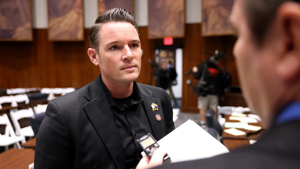
A new bill proposes giving Arizonans the chance to vote on whether the right of refusal in medical situations should be guaranteed in the state Constitution.
State Rep. Nick Kupper, R-Yuma, introduced House Concurrent Resolution 2056, which will prevent government entities from forcing people “to accept, receive or administer any medical product or treatment” as a condition for work, school or public access. Kupper proposed the amendment following his experience with being required to accept what he called an unapproved version of the COVID-19 vaccine when he was in the Air Force.
Kupper’s resolution provides exceptions for court order treatments, people in the criminal justice system, life-saving medical care, parental authority and state diagnostic requirements.
The resolution also states the constitutional amendment will not override federal legal requirements.
If the bill passes the Republican-controlled Arizona Legislature, it will be put to a vote by Arizonans in November. Under the state Constitution, Democratic Gov. Katie Hobbs doesn’t have veto power over the placement of ballot measures.
Kupper told The Center Square that the resolution comes down to whether a “government in most scenarios” should mandate that people put a medical product in their bodies or allow them to choose.
Kupper said he wants to give Arizonans “the opportunity to decide for themselves.”
“ Do they want the state to have the authority to mandate what they put in their bodies, or do they want to have that decision-making capability themselves?” Kupper asked.
“It’s a basic human right to decide what goes into your own body,” he added.
The resolution doesn’t specify any damages for a violation because a court will need to make those determinations, Kupper said.
The notion the constitutional amendment would undermine the rule of law is “completely wrong,” the legislator noted.
Whatever is in the state Constitution is the law and “overrides” state laws, he noted.
”Some people seem to think a state law can override the [state] Constitution. They clearly can’t. There’s a hierarchy here,” he said.
Furthermore, Kupper said the constitutional amendment proposal does not tell private industry what to do. He added that it also has nothing to do with abortion or the death penalty.
This issue is close to Kupper, as he almost lost his Air Force career for not taking what he called an unapproved version of the COVID-19 vaccine.
While in the Air Force, Kupper said Secretary of Defense Lloyd Austin during the Biden administration issued a lawful mandate requiring military members to take a “fully-approved [COVID-19] vaccine with approved labeling.”
However, the Air Force veteran said the problem in his case was how the mandate was implemented. Kupper explained “the lower level commanders” implemented the mandate “incorrectly” by requiring him to take an “unapproved version of the vaccine.”
Kupper said when he raised this with his commander, the commander told him the fully approved and unapproved vaccines were “the same thing.”
The military’s mandate was legal, whereas the implementation was illegal, Kupper explained.
Kupper joined a federal lawsuit challenging the COVID-19 vaccine mandate. He told The Center Square that the day after he received his discharge papers, a court issued an injunction that prevented him from being removed from the Air Force.
Kupper said he retired from the Air Force after 20 years to avoid retaliation.
Dems cheer end to Minnesota immigration operation; GOP calls it success

Democrats are applauding White House border czar Tom Homan’s Thursday announcement that immigration enforcement operation in Minnesota will end next week.
The announcement comes more than two months after the U.S. Department of Homeland Security sent thousands of federal agents to the Twin Cities as part of Operation Metro Surge. More than 4,000 illegal immigrants have been arrested as a part of it.
Democrats have called for the operation to end since it began, citing reported economic impacts, fear within the migrant community and ongoing protests and riots.
“We are cautiously optimistic . . . that this surge of untrained, aggressive federal agents is going to leave Minnesota,” said Gov. Tim Walz, a Democrat, at a press conference following the announcement. “They left us with deep damage, generational trauma. They left us with economic ruin . . . The state of Minnesota and our administration is unwaveringly focused on recovery from what they did.”
Others also expressed hesitancy about Homan’s announcement.
“I won’t believe it until they’re actually gone,” said Minnesota Lt. Gov. Peggy Flanagan, who is running for U.S. Senate this year.
Since federal agents were sent to the state, the Twin Cities have faced nearly-constant public protests. The protests were heightened by the January deaths of Alex Pretti and Renee Good, both of whom were shot by federal agents.
In his statement following the announcement, Minneapolis Mayor Jacob Frey applauded the protesters as “patriots.”
“They thought they could break us, but a love for our neighbors and a resolve to endure can outlast an occupation. These patriots of Minneapolis are showing that it’s not just about resistance — standing with our neighbors is deeply American,” he said.
He ended by calling for a “great comeback” and a renewal of the city’s “commitment to our immigrant residents.”
Homan said in his announcement that the pullback of federal forces has already begun.
“A significant drawdown has already been underway this week and will continue to the next week,” he said. “Law enforcement officers drawn down from this surge operation will either return to the duty station or be assigned elsewhere.”
Republicans and the Trump administration have applauded the operation as a necessary way to address illegal immigrants living in Minnesota—especially criminals.
Homan said agents successfully apprehended a number of targets throughout Minnesota, who included murderers, sex offenders, national security threats, and gang members.
“We have obtained an unprecedented level of coordination with law enforcement officials that is focused on promoting public safety across the entire state,” he said. “President Trump and I want to thank the men and women of ICE and CBP and partner agencies who have been assigned here during Operation Metro surge, you achieved a great success for the Minnesota communities.”
Homan added that, as part of the operation, federal agents also rescued thousands of missing illegal immigrant children.
“In addition to taking public safety threats off the street, ICE here in this state have located 3,364 missing unaccompanied alien children—children that the last administration weren’t even looking for,” Homan said.
Republicans are congratulating Homan for a job well done as the operation draws to a close, just weeks after President Donald Trump sent him to Minnesota to encourage cooperation from local and state officials.
“Job well done, Tom Homan,” said U.S. Rep. Tom Emmer, R-Minnesota. “Local law enforcement is now cooperating with federal law enforcement in Tim Walz’s Minnesota, thanks to President Trump’s leadership. We are hopeful that this partnership will continue – without local or state interference – to ensure the worst of the worst are being removed from our communities.”
GOP leader seeks federal probe into Michigan grants, Dearborn nonprofits

Michigan Senate Republican Leader Aric Nesbitt is calling on the U.S. Department of Justice to review grant oversight and administration involving several Michigan state agencies and Dearborn-based nonprofits.
In a letter sent Wednesday to U.S. Attorney General Pamela Bondi, Nesbitt asked the DOJ to examine grant processes at the Michigan Economic Development Corp., Michigan Department of Health and Human Services and Michigan Department of Labor and Economic Opportunity, as well as funding connected to ACCESS Michigan and the National Association of Yemeni Americans.
Nesbitt said he wants to ensure taxpayer-funded grants are administered with transparency and accountability.
“My mission has always been to ensure that every family, every student and every job creator has the opportunity to make it in Michigan,” said Nesbitt, R-Porter Township. “That opportunity is undermined when there are questions about how tax dollars are handled. I hope the DOJ will look into these red flags to help uphold the public’s trust.”
Nesbitt’s letter was sparked in part by reports from an independent journalist who found “massive potential fraud” in disabled adult foster care homes in the Dearborn area. First released earlier this week, those initial reports quickly went viral on social media.
“Nigerian staffer inside Dearborn’s disabled adult foster care system tells me many centers are likely committing FRAUD,” the report said on X. “No staff on site during peak hours. No patients. We knocked on several doors…No answer.”
Reminiscent of reports of widespread fraud out of Minnesota which have garnered national attention and federal investigations, Nesbitt said the seriousness of those claims of systematic fraud in Michigan warrants federal review.
He also highlighted that state and federal funds may have been approved for certain organizations despite what he characterized as “inconsistencies” and “concerning patterns” in financial reporting. Some of Nesbitt’s concerns included:
• Gaps in federal tax filings
• Misuse of grant funding, including for illegal immigrants
• A lack of clarity regarding taxpayer-funded requests for the National Network for Arab American Communities
• Little-to-no transparency or oversight of grants from Michigan agencies, which Nesbitt labeled a “pay-and-pray” approach
Nesbitt said the state must remain committed to protecting taxpayer dollars and ensuring organizations receiving state funding meet accountability standards.
“We need a government that consistently puts Michigan families first,” he said. “To truly make it in Michigan, we must ensure any potential for waste or mismanagement is addressed. With the support of our federal partners, we can seek the necessary answers to protect the integrity of our state’s financial systems.”
Trump holding out hope deal can be reached with Iran

President Donald Trump is urging diplomacy with Iran following a meeting Wednesday with Israeli Prime Minister Benjamin Netanyahu.
The allies met for a seventh time since the second-term Republican returned to the White House.
In a social media post, the president described the meeting as “very good,” while insisting that “negotiations with Iran continue” to determine whether a deal can be struck with the Islamic Republic.
“If it cannot, we will just have to see what the outcome will be,” Trump wrote. “Last time Iran decided that they were better off not making a deal, and they were hit with Midnight Hammer – that did not work well for them. Hopefully this time they will be more reasonable and responsible.”
The president is weighing an option of deploying a second aircraft carrier and strike group to the Middle East, signaling that another military strike could be on the table. He said, in an interview Tuesday, he would consider the move if the talks with the Islamic Republic fail.
Talks between the U.S. and Iran have been ongoing in Oman since late last week. Tensions are growing.
Israel is reportedly concerned with not only Iran rebuilding its nuclear program, but also ballistic missiles and support for proxy groups, such as Hamas and Hezbollah.
While Trump won’t commit to whether the U.S. will strike Iran for the second time in less than a year, he continues to hurl threats at the Iranian regime, citing a large armada of American naval ships in the region, which has been growing.
Last week, the State Department warned Americans in the Islamic Republic to leave the country. Trump said Iran’s leadership “should be very worried” amid rumors that the talks had hit a snag; that was later rebuffed.
“I’m hearing that Iran wants to restart the new program,” Trump said in a network interview. “If that’s the case, we’ll send the forces to do the job again. They tried to go back to the site, but they couldn’t access it. We discovered that they wanted to open a nuclear site in another part of the country. I said, ‘You do that – we’ll do very bad things to you,’”
The president insists Operation Midnight Hammer, when the U.S. struck Iran’s nuclear sites in June, was a necessary step in pursuing peace in the Middle East.
“If we didn’t take out that nuclear, we wouldn’t have peace in the Middle East, because the Arab countries could’ve never done that,” Trump added. “They were very afraid of Iran. They’re not afraid of Iran anymore.”
During a press conference at the State Department last week, Secretary of State Marco Rubio appeared less optimistic that the U.S. and Iran could reach a deal.
“If the Iranians want to meet, we’re ready,” Rubio said. “I’m not sure you can reach a deal with these guys, but we’re going to try to find out. This is a president that always prefers a peaceful outcome to any conflict or any challenge.”
Last week, the U.S. confirmed it had shot down two Iranian drones flying near the USS Abraham Lincoln, an aircraft carrier sailing in the region.
It is not clear which carrier and strike group would be deployed to join the Lincoln in the Fifth Fleet. The USS Gerald Ford is deployed to the Caribbean to support counter-narco operations in the region.
Norfolk-homeported USS George H.W. Bush could be among contenders. The U.S. Naval Institute reported earlier in the week that the ship was spotted underway in the Western Atlantic.
The president continues to cite the increasingly significant naval presence in the region, hoping to pressure the Islamic Republic to “make a deal.”
“It is moving quickly, with great power, enthusiasm, and purpose,” the president wrote on social media. “It is a larger fleet, headed by the great Aircraft Carrier Abraham Lincoln, than that sent to Venezuela. Like Venezuela, it is ready, willing, and able to rapidly fulfill its mission, with speed and violence, if necessary.”
The president is calling on Iran to “come to the table and negotiate a fair and equitable deal,” underscoring that the Islamic Republic cease trying to rebuild its nuclear program.
First lady charms young patients during NIH visit

Returning for her fourth visit to the National Institute for Health’s Children’s Inn, First Lady Melania Trump met with a group of patients and former patients to mark Valentine’s Day.
The visit goes hand in hand with her Be Best campaign, promoting child wellness. Trump spent time visiting with the young patients while creating Valentine’s crafts.
The first lady was asked an array of questions, including her favorite sport, taste in music and whether she is a queen, to the amusement of Melania Trump.
She previously visited the Children’s Inn in 2018, 2019 and 2020. During her visit on Wednesday, she was seated with a previous patient she had visited in a prior visit.
While Trump visited with patients and their families for nearly an hour, she didn’t make any formal remarks – keeping her conversations informal.
In a statement, she described the impact the Children’s Inn has on young patients and their families at the NIH, located in Bethesda, Md., just north of the nation’s capital.
“Love reveals itself in many forms, especially in the hardest moments of care and compassion,” said the first lady. “The Children’s Inn provides important support to children who have been diagnosed with rare and serious diseases. Returning to The Children’s Inn at NIH is a special reminder of warmth that exists here year-round thanks to the profound resilience of these young people and the dedication of those working to provide comfort, hope, and support during clinical trials.”
The Inn operates as a nonprofit, providing “free residential ‘place like home’ to reduce the burden of illness, make childhood possible, and help advance medical research,” according to a release from the first lady’s office.
WATCH: Newsom signs $90M bill to fund Planned Parenthood

California Gov. Gavin Newsom on Wednesday signed a budget bill into law that would allocate $90 million to Planned Parenthood, a reproductive health care provider.
The funding resolution was quickly voted on and passed in both chambers of the state Legislature earlier this week after a Senate budget hearing cleared the bill last week.
“Planned Parenthood is an extraordinary organization,” Newsom said during a press conference in which he signed the bill. “It’s a point of pride to be the governor and have the opportunity step into the void, and address these assault and attacks on women.”
The funding resolution, which is called Senate Bill 106, makes $90 million worth of grants available to Planned Parenthood in light of the federal budget cuts enacted in the federal budget, H.R. 1, which was enacted last summer. Otherwise known as the One Big Beautiful Bill Act, H.R. 1 restricts any federal money from going to nonprofit health care providers that specialize in reproductive health care, family planning or abortion services.
Those who opposed the passage of Senate Bill 106 said recently they don’t want to see million of dollars go to Planned Parenthood when so many of California’s rural hospitals are in danger of closing. Many have closed already or have closed their labor and maternity wards, according to California lawmakers and organizations such as the California Health Care Foundation.
“Right now, over 60 hospitals in the state of California are on the verge of shutting down, and they have to ask for a hospital stress loan,” Assemblymember David Tangipa, R-Fresno, said on the floor of the Assembly on Monday during debate on the Planned Parenthood funding bill. “In Madera County right now, women must travel outside their county just to give birth, despite a nonprofit [Planned Parenthood] operating an office there. This is not true access to care.”
Tangipa also said on Monday that he opposed the funding measure on fiscal grounds, as well.
“Under the original text of SB 106, we would be funneling millions of dollars to a nonprofit with little to no transparency at a time when it feels like every week brings another case of corruption or misuse of public funds,” Tangipa said during debate over the bill on the Assembly floor. “We should be moving to greater accountability, not away from it.”
Lawmakers also said during a Senate Budget and Fiscal Review Committee meeting last week that the funding package was the result of talks with Planned Parenthood officials specifically, not those who represented other nonprofit health care providers. According to a fact sheet published by Planned Parenthood in 2025, 115 health centers are located in California. The organization touted 1.3 million total annual visits, which resulted in 87,000 cancer screenings, 2.5 million tests for sexually-transmitted infections and 400,000 contraceptive visits.
“The fact of the matter is, they knew exactly what they were doing. They knew the chaos this would create, and they knew the communities that this would harm,” Jodi Hicks, the CEO and president of Planned Parenthood Affiliates of California, said of congressional representatives from California who voted for H.R. 1. “All nine Republican Congress members in California voted yes for that big, horrible bill that had the largest health care cut in history, including completely de-funding Planned Parenthood.”
The governor addressed other questions after the bill signing on Wednesday, including the potential passage of a “billionaire’s tax,” or a one-time tax on the wealth of Californians who have more than $1 billion in assets. The tax could pass if voters pass it as a ballot measure later this year, although those pushing the measure have not yet accumulated enough signatures to get the wealth tax on the ballot, according to news reports.
Some experts warn the measure could drive billionaires out of the state, according to previous reporting Wednesday by The Center Square.
“It’s one-time resources for an ongoing issue,” Newsom said of the billionaire’s tax. “The ongoing burden is to the general fund that will see a decline in revenue as a consequence of the tax.”
U.S. House passes national voter ID bill, sends to Senate
The U.S. House passed legislation Wednesday night that would implement comprehensive election security reforms nationwide, sending it over to the Senate for approval.
The SAVE America Act would require Americans to present proof of citizenship when registering to vote, necessitate in-person voter registration for federal elections, and require states to remove all noncitizens from their voter rolls.
Under the legislation, people would not be able to register to vote with only their driver’s license, since noncitizens can obtain that. They would instead need to present documents proving U.S. citizenship, such as a birth certificate or U.S. passport.
“We require ID for everyday activities like buying cold medicine or boarding a flight. Voting should be no different,” U.S. Rep. Scott Franklin, R-Fla., said on X. “It’s a commonsense step to protect confidence in our system.”
The bill passed 218-213, with one Democrat supporting it.
Democrats have called the legislation an act of voter suppression, given that federal law already prohibits noncitizens from voting.
“They’re trying to say this is a voter ID bill. That’s not what’s happening here,” Democratic Whip Katherine Clark, D-Mass., said Wednesday. “This is election rigging. This is voter suppression. The American people aren’t going to stand for it.”
A majority of Americans actually support the voter ID measure. In the The Center Square Voters’ Voice Poll conducted in October, 70% of voters said they either strongly support (48%) or somewhat support (22%) requiring voter ID at the polls, while 23% either somewhat oppose (10%) or strongly oppose (13%) requiring it. The poll of more than 2,500 registered voters (including 978 Republicans, 948 Democrats, and 639 Independents) is among the most comprehensive in the country.
But since some Americans might not have access to a passport or their birth certificate, Democrats argue, the bill will simply make it harder for veterans, the disabled, minorities, and women who change their last names to register to vote.
“The so-called SAVE America Act will potentially disenfranchise millions of Americans,” Rep. Brad Schneider, D-Ill., said on social media. “It is nothing more than the culmination of Republicans’ ridiculous and shameful attempts to make it harder for people to vote.”
Republicans say the changes, if implemented nationwide, will increase voter confidence in the validity of federal election results and consequently improve turnout.
The Center Square’s Voters’ Voice poll from October also found that nearly half of young adult voters surveyed had “not very much confidence” or “no confidence at all” that the 2026 midterm elections will be conducted fairly.
“Making sure that it’s easy to vote and hard to cheat is a core principle,” Rep. Bryan Steil, R-Wis., told lawmakers. “As we instill election integrity in our system, we will see more people participating because they will have faith in our elections.”
Unless GOP leadership in the Senate tweaks filibuster rules, as many Republicans have recently advocated, the SAVE America Act is unlikely to become law due to the filibuster.