Center Square
‘Very selfish’: EU sanctions on Russia fertilizer will weaken U.S., food security

Sanctions the European Union is attempting to put on Russian fertilizer to punish the country’s invasion of Ukraine will unintentionally weaken the United States, hurt American farmers and families, and harm developing countries, according to a former ambassador.
Former U.S. ambassador to the Food and Agriculture Organization (FAO) in the first Trump administration and current America First Policy Institute vice chair for rural policy Kip Tom told The Center Square that the sanctions the European Union is trying to put on Russian fertilizer are “going to weaken the US.”
“It’s going to weaken our ability to make sure that we have a reliable and affordable supply of food [going] to the American consumers,” Tom said.
This is so because such sanctions will set off a chain of negative events, as Tom explained.
If the EU sanctions “Russian companies from selling fertilizer into the EU to farmers there to produce food, fiber, and energy,” these companies will likely all of the sudden “close up,” because “Europe is their largest market,” Tom said.
“ These are mines that are some of the best mines in the world in terms of for phosphorus and potassium reserves,” Tom said. “If they close up, you’re basically taking one out of every six tons of fertilizer in the world off the market.”
Tom said “if the fertilizer prices are driven higher because of lack of supply, that means the fertilizer prices go up in the United States.”
In turn, “the farmer’s cost of production will increase,” which will eventually “make it to the consumer’s dinner table in [the] form of higher priced eggs, bread, meat,” Tom said.
Tom explained that “fertilizer is used throughout agriculture production” and “is to a crop what oxygen is to a person.”
“If we don’t have fertilizer, it’s real easy to see productivity around 50, 60 percent,” Tom said, adding that access to mines with phosphorus and potassium reserves is “really critical” to avoid high prices for consumers.
Overpriced groceries are “the last thing we want right now,” Tom said.
Beyond America, developing countries will also be negatively impacted by sanctions on Russian fertilizer.
Tom noted that there are between 850 and 900 million hungry people in the world today. “You take the fertilizer away, and you can see that number really escalates,” he said.
“When a country becomes food insecure, people are without the access to food, they migrate usually three times within their own country,” Tom said.
This migration is soon followed by moving outside their borders, which is followed by human trafficking, drug activity, and even extremist activity, Tom said.
It’s in the United States’ best interest to “advocate to Brussels to make sure that they don’t place these sanctions on the Russian fertilizer,” he added.
“It’s very selfish of the European Union to even consider something such as this,” Tom told The Center Square. “They know better.”
Tom granted that the outcome for those pushing the Russian sanctions “will be OK.”
“But for the European farmer, it’s gonna be a disaster. For the American farmer and consumers, it’s gonna be a disaster. And for those that are food insecure, it’s going to be a real problem,” Tom said.
Tom noted there may be ulterior motives behind the EU’s sanctions on fertilizer.
“The European Union has been very focused on a green initiative called the Farm to Fork Initiative,” Tom said, the initiative’s goal being to “reduce fertilizer consumption…in the EU by 50%.”
This goal could be an “ulterior [motive] that they’re trying to accomplish at the same time as…these sanctions,” Tom said.
Regardless of intentions, Tom said “it’s really important for us to encourage the EU, the policy makers in Brussels, to not sanction the Russian fertilizer.”
Tom hopes that “the delegations going over from the [U.S.] Senate” this week to Brussels will be able “to have that conversation and make sure it’s not included in the sanction package.
Tom said additionally that there is no better timing for President Donald Trump’s “Project Vault” than right now, as the project is intended to “secure minerals and the critical components” and that “fertilizer’s amongst that list.”
Neither the EU’s European Parliament or European Commission have yet responded to The Center Square’s request for comment.
Seattle’s FIFA World Cup 2026 windfall: Opportunities and risks

There is no doubt that Seattle’s hosting of six matches this summer as part of the 2026 FIFA World Cup will have a major economic impact on the city and surrounding areas.
After all, how could it not? The FIFA World Cup is the world’s premier international soccer tournament, held every four years to crown a champion. It is one of the world’s most-watched sporting events, drawing billions of viewers.
For the first time, this year’s tournament is being hosted by three countries: the United States, Mexico and Canada, with the World Cup split across 16 cities in the three host nations, accommodating 48 teams.
Some of the numbers being floated are eye-popping.
Organizers anticipate an additional 750,000 people visiting the Puget Sound region during the World Cup, with travelers staying for roughly one week.
Visit Seattle has projected a total economic impact of $929 million for King County, nearly 21,000 jobs and more than $100 million in taxes from the half-dozen matches to be held at Lumen Field.
The World Cup is expected to generate approximately $652.6 million in direct spending in the Seattle area.
“I think one of the things we’re most excited about is really being able to show our city, to show our region and state, and use this as that opportunity to showcase – you know, welcome the world – and showcase who we are,” SeattleFWC26 Chief Strategy Officer April Putney said at Seattle CityClub’s most recent Civic Cocktail event held earlier this month. “And, you know, drive those benefits that are coming from it, drive people to all around the city, to around this state, and really just try to make the most of it.”
Victor Matheson, a professor of economics at the College of the Holy Cross in Worcester, Mass., is a widely recognized expert in sports economics.
He doesn’t deny the economic impact the World Cup will have on Seattle and the surrounding region, but notes there are some caveats to the big numbers being touted.
“This is a fun and exciting event for the city,” he said, adding that Seattle’s hosting a portion of the world’s biggest sporting event is about more than money.
“Also, of course … for a hotel owner, it doesn’t matter if the city as a whole doesn’t make money. You’re definitely going to have a good month of June in Seattle,” Matheson told The Center Square during a phone interview.
He noted that the city’s relative costs – in the tens of millions – for hosting the World Cup are low, as no new infrastructure needs to be built.
“This isn’t Qatar, which spent $250 billionish hosting the event last time,” Matheson quipped.
With Lumen Field holding up to 69,000 spectators for each of its six matches, and all those people spending money at the game and in the area before and after the matches, that’s a good return on investment for Seattle, according to Matheson.
“And then if you think about money circulating through the economy again and again, you can easily double that through what’s known as the multiplier effect,” he said. “So a billion dollars is not out of the question, right?”
The multiplier effect explains how a small change in investment or spending can lead to a larger change in total income.
“The rest of the revenue forecast is most likely based upon a multiplier analysis and could contain tax revenues, too,” explained Paul Turek, a regional labor economist for the Central Puget Sound region with the state Employment Security Department, in an email to The Center Square. “The multipliers would be based upon direct spending by visitors in terms of ticket price costs (and how that gets divided), event food and concessions, as well as local travel costs, hotel accommodations, food at restaurants and other tourist activities. The direct spending to the recipients can be assumed to be re-spent or circulated, thus producing an impactful multiplier effect.”
According to Matheson, there are three “problems” to consider when evaluating economic impact numbers of major events like the World Cup.
He mentioned the substitution effect – that is, the tendency of consumers to replace more expensive items with cheaper, similar alternatives when prices rise.
“A ton of the people are just going to be locals, and they’re putting money into FIFA’s pockets rather than in the pockets of other local businesses,” Matheson said. “So that doesn’t actually increase the size of the Seattle economy; it just rearranges where the money is being spent.”
Then there’s crowding out, in which World Cup events displace other economic activities that would normally occur.
“You know, the hotels are going to be pretty full, but those hotels would be full anyway, because you’re in June in Seattle, and Seattle is a good tourist destination,” Matheson said. “To the extent that you fill up all your hotels with soccer fans and that keeps out other fans, that means that you can’t count all the benefits of the soccer fans without discounting the benefits of the people who aren’t in town in June because they’re like, ‘Oh, I’m going to skip Seattle this year because it’s too crazy. We’re going to go to Portland instead.’ ”
Finally, there are leakages, the withdrawal or outflow of money from the circular flow of income, which reduces the total spending and economic activity within an economy
“That’s money that’s spent in Seattle but doesn’t stick in Seattle,” Matheson summarized.
He pointed to local breweries to make his point. Local breweries create a significant positive impact on local economies through a high multiplier effect, where money spent on beer and services stays within the community, supporting local brewers, bartenders and suppliers.
“With the World Cup, there’s a lot less of that,” Matheson said.
One of the biggest expenses for World Cup attendees is tickets, which cost between $300 and $500, he noted.
“That money doesn’t show up in Seattle at all, right?” he said. “That money immediately leaves and ends up in the pockets of probably a bunch of corrupt FIFA officials in Switzerland and Trinidad and Tobago and Brazil …”
The big financial winner in all of this, according to Matheson, is FIFA, which will make between $9 billion and $10 billion.
“They’re going to be making all the ticket money. They’re going to be making all of the broadcast money,” he said. “A little of that will end up in the United States because it spends money putting on the TV events and spending money to make sure that players are housed and that sort of stuff.”
None of the money spent on airline tickets will end up in Seattle, Matheson added.
Hotels in Seattle are charging two and three times normal rates, “but they’re not raising the wages of their desk clerks or room cleaners by two or three times, so, you know, that’s just profit for the corporate chain. That’s not money that ends up in Seattle. It ends up in corporate headquarters back in New York and shareholders’ pockets around the world.”
Economics may be known as the dismal science, but Matheson has retained a sense of humor about the hype surrounding the economic impact of mega-events like the World Cup versus the reality.
“When all is said and done, the rule I always tell people: Take whatever number the promoter’s giving you, move the decimal point one place to the left, and that’s a pretty good idea of what you’re actually going to get,” he said. “There’s no science behind that. It just seems to be that’s the way it often works.”
WATCH: ‘Waters Edge’ tax breaks would end if California bill passes
Editor’s note: This story has been updated since its original publication to add a video.
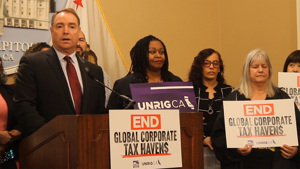
Corporations would no longer be able to get billions of dollars of tax breaks if a new bill introduced in the California Legislature makes it across the finish line.
Assemblymember Damon Connolly, D-San Rafael, together with other lawmakers and members of the SEIU of California, announced Assembly Bill 1790, which would end the “Waters Edge” corporate tax break. SEIU stands for Service Employees International Union.
“For the past 40 years, California has given multi-national corporations the opportunity to choose what tax scheme they would like to use to ensure they pay as little taxes as possible in our state,” Connolly said during a press conference Tuesday morning. “They do this through the use of the Waters Edge tax election, which allows a corporation to only pay taxes on revenue they decide is earned through the ‘waters edge’ boundaries of California.”
This choice of what a company pays in taxes, Connolly continued, gives corporations the incentive to shift as much income as they can off-shore through subsidiary companies and foreign tax aids. He noted California’s working taxpayers pick up the tab.
As much as $3 billion in new revenue would be generated to help pay for California’s schools, health care system, nutrition assistance programs, green energy generations and climate programs, Connolly said.
“We see California taxpayers and small business owners continue to subsidize the record profits of these huge, multi-national corporations,” the Assembly member said.
During the press conference, The Center Square asked Connolly how much the average California household pays to subsidize the tax liability of large corporations. Connolly said he didn’t have those numbers in front of him. But he noted corporate tax breaks, paired with the state’s budget woes, negatively impacted the average Californian.
“We’ve talked about some of the ways the budget hole is hurting real Californians,” Connolly said. “We’ll tie it more into the average household, what’s this costing now and layering it with the federal outrageous tax breaks.”
According to the California Budget & Policy Center, corporate profits in California increased to $368 billion in 2021, up 155% since 2002, adjusted for inflation. Additional data from the center shows only 0.6% of corporations made $10 million or more in California in 2021, despite accounting for more than 60% of corporate profits in the state that year.
Numbers from Connolly’s office show that some corporations have only had to pay an $800 minimum tax, less than individuals who work as janitors or nurses. Additional tax breaks from the federal government have allowed those corporations the opportunity to accumulate $900 billion over the next 10 years, according to Connolly’s staff.
“It is very important that we finally tax the rich, and we make corporations pay their fair share,” Assemblymember Alex Lee, D-Milpitas, said during the press conference. “It is a movement that is growing nationally as wealth disparity is growing untenably. We have some of the wealthiest companies in California, and yet we have record rates of people who are unhoused.”
Advocates for Connolly’s bill said the additional revenue could help backfill lost federal funds California can normally count on to help pay for taxpayer-funded programs like Medicaid, known as Medi-Cal in California; the Supplemental Nutrition Assistance Program and other services Californians rely on.
“Federal budget cuts fall hardest on communities like mine,” Assemblymember Sade Elhawary, D-Los Angeles, said during the press conference. “Losing access to these resources is not a talking point for me. We are talking about missed doctors’ visits, empty refrigerators, parents choosing between paying rent and keeping the lights on.”
Election security takes center stage as GOP lawmakers push three reform bills

Ahead of the 2026 midterm elections, Republicans in Congress are pushing forward multiple bills that would standardize election security requirements nationwide.
All three pieces of legislation being considered – the SAVE Act, the SAVE America Act, and the MEGA Act – would mandate that states require photo ID and verify the citizenship status of potential voters.
“I think we can trust the outcome of the election, but what I will tell you is that there is still a great concern that in certain pockets of the country, that there’s not strict enforcement of the laws,” U.S. House Speaker Mike Johnson, R-La., told reporters Tuesday.
He praised the SAVE America Act, a bill mirroring the House-passed SAVE Act which requires Americans to present proof of citizenship when registering to vote, necessitate in-person voter registration for federal elections, and require states to remove all noncitizens from their voter rolls.
Since the Senate still hasn’t taken up the SAVE Act after 300 days – despite Republican pressure to do so – House members will vote on the SAVE America Act on Wednesday. The bills are identical except that the latter would also require people to display a valid ID to vote in federal elections.
With valid ID necessary for everything from applying for a job to renting a hotel room, the legislation is “common sense,” Johnson argued.
“There’s only one logical reason that Democrats are opposed to this – they want the people to participate in elections who are not supposed to,” he added. “So the fact that they’re so vehemently opposing this is very telling about their agenda and their motivation.”
Rep. Bryan Steil, R-Wis., made similar arguments during a congressional hearing Tuesday centering around the MEGA Act, which he sponsored.
The bill includes the same requirements as the two others but also prohibits ranked choice voting, ends universal voting by mail, and requires mail-in ballots to be received by the close of polls on election day to be counted.
“The commonsense reforms House Republicans are proposing today will ensure it remains easy to vote, but hard to cheat,” Steil said during the hearing. “Elections should end on Election Day. You need a photo ID to cast a ballot. You must be a citizen to vote. You need an auditable paper trail. And you shouldn’t mail a ballot to people that don’t request them.”
Democrats have labeled every bill as vehicles of voter suppression, saying that federal law already prohibits noncitizens from voting and the bills would simply make it harder for veterans, the disabled, minorities, and women who change their last names to register to vote.
Under the bills, people would not be able to register to vote with only their driver’s license, since noncitizens can obtain that. They must instead present documents proving U.S. citizenship, such as a birth certificate or U.S. passport, which some Americans might not have.
“Let’s be clear up front: This is not about protecting our elections. Republicans aren’t truly afraid of non-citizens voting — which we all know is already illegal, already grounds for deportation. They’re afraid of women voting,” Democratic Whip Katherine Clark, D-Mass., said Tuesday. “They are trying to place more red tape, more paperwork, more bureaucracy between women and the ballot box.”
Johnson wants to extend rules blocking Congress from voting on Trump’s tariffs

U.S. House Speaker Mike Johnson wants to delay a congressional vote on President Donald Trump’s tariffs until July, but GOP members could join Democrats to challenge the blockade on tariff-related matters.
Johnson is moving ahead with a procedural vote on Tuesday that would prevent the House from taking up matters related to the tariffs until July 30. He aims to maintain control over the issue and avoid a direct vote that could divide the Republican caucus.
Johnson has been using the House rules committee to block members from bringing a vote on any of the emergencies that underly Trump’s tariffs to the floor. Johnson’s rules exclude tariff-related matters from “calendar days” when the House does its business, said Phillip Magness, a senior fellow at the Independent Institute.
“Johnson would likely lose a direct vote, because enough anti-tariff Republicans would join the Democratic minority to pass the resolution,” Magness told The Center Square. “For almost a year now, Johnson has been gaming the House rules to make sure that such a vote can never happen.”
Trump’s agenda at home and abroad depends on his ability to raise revenue through taxes on imports. The president has said his tariff revenue will cover the cost of $2,000 rebate checks for some Americans, offset increased military spending and reduce the nation’s $38 trillion in debt. Budget watchdogs say tariffs won’t raise enough revenue to cover any of those spending plans. The president has also frequently used tariffs as a bargaining chip with other nations to address a wide range of issues.
Johnson has renewed the rules prohibition on a tariff vote three times and is seeking a fourth extension, this time for six months until July 31, at a vote set for 8:30 p.m. Tuesday.
“He is attempting to force it through a fourth time by attaching it to a much larger rules package,” Magness said. “Rules packages are usually passed on party-line votes by the majority party, and defectors are often singled out and penalized by the speaker, who can hold up their legislation or even pursue more severe penalties that affect their committee assignments.”
Last April, Trump imposed import taxes of at least 10% on every U.S. trading partner. Since then, the president has used tariffs under the 1977 International Emergency Economic Powers Act to achieve policy goals at home and abroad. Those tariffs have pushed up prices for U.S. manufacturers and consumers, but the White House says that foreign countries will ultimately pick up the tab.
Johnson previously told Republican detractors that the prohibition would expire in January.
“The scope and duration of Johnson’s actions are unprecedented,” Magness said. “Johnson has kept these rules in place for almost a year now, thereby preventing any House oversight vote on the IEEPA tariff declarations from occurring.”
A group of states and small businesses challenged Trump’s tariffs under the 1977 law, winning in two lower courts before the administration appealed to the U.S. Supreme Court. The high court agreed to hear the case on an expedited basis. The Supreme Court heard oral arguments in the case in November, but has yet to rule on the matter.
FIGHT Act targets animal cruelty, illegal gambling, trafficking

Despite strong laws against it, animal fighting – most commonly dogfighting and cockfighting – continues to surface in Pennsylvania and across the country.
Advocates and law enforcement argue the crimes extend beyond animal cruelty, often intersecting with illegal gambling and other organized criminal activity. It’s conduct they hope to disrupt through federal legislation such as the bipartisan Fighting Inhumane Gambling and High-Risk Trafficking, or FIGHT, Act.
Law enforcement groups, including the Pennsylvania Chiefs of Police and the state Sheriffs and District Attorneys Associations, are among more than 500 organizations nationwide backing the measure. They are urging U.S. House Agriculture Committee Chairman Glenn Thompson, R-Pa., to include it in the Farm Bill, which Thompson has signaled he intends to bring to a committee markup by the end of February.
The legislation – H.R. 3946 in the House and S.1454 in the Senate – would amend the Animal Welfare Act to strengthen enforcement against animal fighting and related criminal conduct. Both bills have bipartisan co-sponsors, including many from Pennsylvania.
Recent cases in the commonwealth include a 2025 dogfighting investigation in West Hazleton, in which Pennsylvania State Police impounded 28 pit bulls found with scars and other signs consistent with fighting. In Bucks County, authorities also broke up a cockfighting ring in Plumstead Township; one of the defendants was also convicted on narcotics trafficking charges.
“Pennsylvania’s prosecutors deal with the real-world consequences of violent and organized crime, including animal fighting,” said Kelly Callihan, executive director of the Pennsylvania District Attorneys Association, in a statement released by Animal Wellness Action.
“When law enforcement and prosecutors across the Commonwealth speak with one voice, legislators should take note. The FIGHT Act reflects the on-the-ground experience of those who investigate and prosecute these crimes, and it is the common-sense step Congress should take to strengthen enforcement and protect our communities.”
Animal Wellness Action President Wayne Pacelle told The Center Square that Pennsylvania already treats dogfighting and cockfighting as felonies, but argued additional federal tools are needed to deter and disrupt these operations. He said the FIGHT Act would strengthen enforcement by prohibiting online gambling on animal fights, banning shipment of mature roosters through the U.S. Postal Service, creating a citizen-suit provision to allow private enforcement actions, and enabling forfeiture of real property used to facilitate animal fighting crimes.
There are potentially millions of birds bred and trained for fighting in the U.S. “It’s bigger than anyone has the capacity to understand,” said Pacelle.
Additionally, a significant number of birds are shipped to other countries, such as Mexico and the Philippines, where, in Manila, a multi-day event called the World Slasher Cup was recently held.
Pacelle noted that animal fighting gained national attention in 2007, when NFL quarterback Michael Vick and three others were convicted and imprisoned for their roles in operating a dogfighting ring on Vick’s property in Virginia.
After his release, Vick offered to help educate people about humane animal treatment. Pacelle, a strong critic of Vick at the time, said he agreed to work with him, but only if it involved direct, personal engagement – not just putting his name on a press release.
Pacelle said Vick accompanied him to roughly 40 communities, and together they spoke to tens of thousands of young people to raise awareness of the issue.
Animal Wellness Action also states there are concerns about cockfighting’s potential role in spreading avian disease that could threaten U.S. egg and poultry industries. More details can be found on their Fact Sheet.
“Law enforcement leaders across Pennsylvania see firsthand how animal fighting damages neighborhoods and fuels broader criminal networks – it’s far more than an issue of animal abuse,” said Natalie Ahwesh, Pennsylvania state director of Animal Wellness Action. “We’re honored to work alongside the sheriffs, chiefs of police, and district attorneys in all 67 counties to push for strong laws that equip state and federal law enforcement with the tools needed to dismantle these organized crime rings.”
White House says Trump can protect ranchers while importing more beef

The White House said it can protect U.S. ranchers while still importing additional beef from Argentina despite concerns from U.S. lawmakers in cattle states.
“Both things can happen at the same time,” White House press secretary Karoline Leavitt said Tuesday about President Donald Trump’s plans. “He wants to see prices come down.”
She called Friday’s order a “minor import” that could temporarily lower prices for consumers while ranchers rebuild herds after widespread droughts.
“Protecting our American cattle and rancher industry is a priority for the president,” she said.
Trump has been pushing for lower beef prices amid consumer frustration over higher grocery prices. On Friday, Trump signed an executive order to increase beef imports.
U.S. Sen. Deb Fischer, R-Neb., expressed concern that the imports will hurt American ranchers.
“Instead of imports that sideline American ranchers, we should be focused on solutions that cut red tape, lower production costs, and support growing our cattle herd,” she said in a statement.
The U.S. cattle inventory is at its lowest level since 1951.
Echoing these worries, U.S. Rep. Adrian Smith, R-Neb., a senior member of the House Ways and Means Committee and Chair of the Trade Subcommittee, specifically pointed to the historically low U.S. cattle inventories.
“While the United States holds historic low-inventory in cattle herds, we must focus on policies that strengthen the market and create long-term certainty for the entire supply chain,” he said in a statement.
U.S. beef prices have increased by more than 50% since 2020, according to figures from the Federal Reserve Bank of St. Louis.
In 2018-19, ground beef prices were less than $4 per pound. Prices increased during the COVID-19 pandemic and have remained above $5 a pound since mid-2023. Ground beef prices reached $6.69 a pound in December, according to the Bureau of Labor Statistics.
Agriculture Secretary Brooke Rollins recently said that Americans consume about 12 million metric tons of beef a year. About 10 million comes from domestic producers, leaving a shortfall of about 2 million, she said.
Warrants outline possible criminal probe of 2020 Georgia elections

Warrants unsealed in Georgia show an FBI investigation, possibly criminal, into the 2020 presidential election won by Joe Biden over Donald Trump.
In Fulton County, the agency said it was taking all physical ballots, including envelopes, damaged ballots, advanced voting ballots, tabulator tapes, ballot images and voter rolls, according to the warrant filed in U.S. District Court.
“These documents discuss an ongoing criminal investigation that is neither public nor known to all of the targets of the investigation,” FBI special agent Hugh Raymond Evans said in the warrant application. “Accordingly, there is good cause to seal these documents because their premature disclosure may seriously jeopardize that investigation, including by giving targets an opportunity to destroy or tamper with evidence, change patterns of behavior, notify confederates, and flee from prosecution. This warrant application is part of an FBI criminal investigation into whether any of the improprieties were intentional acts that violated federal criminal laws.”
Eleven witnesses, whose names are redacted, are listed in the warrant. One witness, listed as number 8 in the warrant, was a poll worker during the election. She told investigators that she received boxes of ballots with broken security seals.
“When she asked about the security seals, she was told by an unknown individual that they did not matter,” the warrant says.
Tabulator tapes were also questioned in the warrant. An investigation into the unsigned tabulation tapes that included 315,000 Fulton County votes came to light at a December meeting of the Georgia State Election Board.
New procedures were put in place to ensure the mistake doesn’t happen again, Ann Brumbaugh, an attorney for the Fulton County Board of Registrations and Elections, told the board after not contesting the claim. The State Election Board turned the issue over to the attorney general’s office at its January meeting.
A cybersecurity expert reviewed the tapes, telling the FBI that one tabulator was used to close out 15 tabulator machines from 12 locations, leading him to believe that the times were manipulated.
The warrant also references a January 2021 report from Seven Hills Strategies stating that Fulton County’s absentee ballot processes were “extremely sloppy and replete with chain of custody issues.”
Trump has questioned the outcome of the 2020 presidential contest in Georgia, which he lost to Biden by 11,780 votes. Biden defeated Trump 306-232 in electoral college votes; Georgia contributed 16 to the Democrats’ win, not enough of a swing (32 points) to reverse the 74-point setback.
Recounts did not find enough evidence to overturn the results.
The accusations have already been “debunked,” said Fulton County Commission Chairman Robb Pitts in a news conference broadcast shared on YouTube by WXIA Atlanta.
“Fulton County will fight his with every resource that is at our disposal, and we will not stop fighting,” Pitts said.
White House stands behind Commerce Secretary amid Epstein disclosures
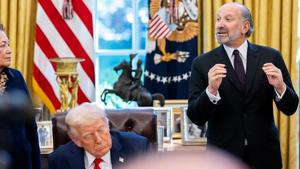
President Donald Trump continues to back Secretary of Commerce Howard Lutnick after Lutnick admitted having visited Jeffrey Epstein’s private island before a Senate committee Tuesday.
“Secretary Lutnick remains a very important member of President Trump’s team, and the President fully supports the secretary,” said White House Press Secretary Karoline Leavitt at a briefing Tuesday.
In an October podcast interview with New York Post Editor Miranda Devine, Lutnick had said that he and his wife did not pursue any kind of relationship with Epstein after moving next door and meeting him in 2005. They were, according to Lutnick, put off by some comments Epstein made about his massage table while giving them a tour of his home.
“My wife and I decided that I will never be in the room with that disgusting person ever again. So I was never in the room with him socially, for business, or even philanthropy. If that guy was there, I wasn’t going because he’s gross,” Lutnick said. “So yeah, that’s my story, a one and absolutely done.”
But recently disclosed documents from the Epstein files revealed that Lutnick did, in fact, maintain a relationship with Epstein including investing in a business together, meeting for drinks, discussing neighboring property development and invitations to dinners and galas, until 2018. Several emails also suggested that Lutnick had at least tried to visit Epstein’s island while spending some time in the Caribbean on vacation.
He confirmed Tuesday that he did visit the island while vacationing with his and another family in December 2012.
“We had lunch on the island, that is true, for an hour, and we left with all of my children, with my nannies and my wife, all together. We were on family vacation. We were not apart,” Lutnick said, during the visit.
Congress continues to look into the Epstein files, after passing a bill requiring the Department of Justice to make them public while allowing for redactions that protect victims. Leading the charge are the bill’s sponsors, Rep. Thomas Massie, R-Ky., and Rep. Ro Khanna, D-Pa., who have successfully challenged the department and gotten the names of some of Epstein’s friends unredacted.
Even before Tuesday’s admission from Lutnick, Massie and some Democrats were calling for his resignation.
Deadline approaches for Colorado River negotiations
Officials negotiating to protect and redefine use of the Colorado River face a major deadline approaching on Feb. 14.
And experts said an agreement is unlikely to come in time for the river, which is a major source of drinking water, irrigation and hydropower in seven western states.
The deadline on a new Colorado River water use deal was set for last November, but got pushed back after an initial agreement was not reached. As the second deadline looms, the U.S. government has retained the right to impose a contract on the states.
“Water fundamentally underscores all aspects of life in the American Southwest,” said John Berggren, regional policy manager at Western Resource Advocates, an environmental policy group.
“It’s such a diverse and complicated system that it’s a challenge to manage or create new guidelines,” Berggren told The Center Square.
The Colorado River provides drinking water for roughly 40 million people across seven states, over 30 Indigenous tribes and Mexico. The river has been consistently depleted for the last quarter of a century amid droughts and overuse by people, largely for agriculture. River usage has been negotiated for decades, with the current 2007 agreement set to expire this year.
Governors from six Colorado River Basin states (Arizona, Colorado, Nevada, New Mexico, Utah and Wyoming) and a high-level California representative met late January in Washington, D.C., for an unprecedented crunch-time negotiation. The meeting with the U.S. Department of Interior took place behind closed doors, but no agreement was made, with no indication that the Feb. 14 deadline will be met.
Several governors expressed cautious optimism after the meeting. “Today’s discussion was productive and reflected the seriousness this moment requires,” Colorado Gov. Jared Polis said in a news release.
“I leave today hopeful that we’ll avoid the path of litigation,” said Utah Gov. Spencer Cox. “No one wins going down that path.”
But litigation could soon be on the table. Current negotiations have been ongoing for the last two and a half years, with state leaders agreeing if negotiations went to court it would be a failure.
“We’re hearing about states building up their litigation funds, and that’s really concerning because that means that they’re not close to a deal, which is catastrophic for the basin,” said Berggren. “It puts us into a whole bunch of uncertainty and most likely means one or more states are going to sue. That will drive the system, which is already in a pretty dire situation, just off the cliff.”
Hang-ups around the negotiations start with the original 1922 Colorado River Compact, or “Law of the River,” which allocated 15 million acre-feet of water to be drawn per year, despite there never being that much water in the river. Today, there is even less, between 12 and 11 million acre-feet.
While Mexico was later allocated a relatively small portion of the river rights, Indigenous tribes have historically been, and continue to be, left out of the negotiations. Tribal inclusion in the negotiations has slightly increased in recent years.
But “it’s nowhere near what it needs to be,” said Berggren. “These are sovereign nations that have water rights claims or water rights settlements that the United States has a responsibility to uphold, and they’re not at the decision-making table. That’s a huge wrong and it needs to be righted.”
Many Colorado River experts agree a large part of the overall Colorado River negotiation issue is how outdated some of the laws and regulations are today. The original water usage regulations came out of 1800s’ first-come, first-served rights mining laws. The dams and other river infrastructure were built in the 1900s, but continue to be used by a population facing today’s issues including climate change.
“What that all means is we’re having to find creative ways to use less water everywhere,” Berggren told The Center Square.
At the moment, each state argues it has sacrificed more than its fair share. Much of the debate between states falls along an upper-lower basin boundary.
Upper Basin Colorado River states are required to allow a certain amount of water to flow to Lower Basin states each year, but the two groups do not agree how much that is. Meanwhile, Lower Basin states like Nevada, California and Arizona have grown drastically over recent decades and consumed far more water than Upper-Basin states.
“The solution is everyone needs to use less water,” said Berggren. “And so people just need to accept that. Let’s start being constructive with how we are going to find ways to use less water across the basin.”
Despite the gravity of the situation, experts have said there is reason for optimism by improved water efficiency. Perhaps the best example of this is Las Vegas, which has become the poster child of Colorado River water conservation in recent years.
Las Vegas’ population increased by roughly 829,000 residents between 2002 and 2024, but the city used 38 billion less gallons in 2024 – a 55% per capita decline in water usage, according to the Las Vegas Valley Water District. Much of this has been attributed to water recycling initiatives and regulations around watering lawns and other spaces. Further water usage cuts for the area are set for 2027 that include irrigation bans for unused medians and roundabouts with Colorado River water.
“We have solutions, and we just need to implement them,” said Berggren. “We can have a thriving river in the American Southwest with the recreational, agricultural and all the other economies also thriving – if we’re smarter about the way we manage our limited water supplies.”
The federal government has not yet indicated if it will delay the deadline again or begin to exercise its authority on the Colorado River. Berggren said he thought the Trump administration would take action if the states miss the Feb. 14 deadline. “That’s incredibly unfortunate, and that just shows that the feds will just have to move forward the best they can.”
Berggren predicted the dispute over water will end up before the nation’s highest court.
“Because it’s an interstate compact, it’ll go before the Supreme Court,” said Berggren. “And so instead of communities here in the Colorado River Basin deciding how we’re going to use less water, it’s going to be the Supreme Court justices saying who’s going to be the winner and loser. And I don’t know anyone who feels confident that they will be a winner in that situation, because there’s a risk for everyone to be a loser.”
The Colorado River is a waterway with countless ecosystems and species that rely on its flow. At the delta of the river in Mexico, the river has dried up from decades of overuse, where Berggren said he has stood in the dried up river bed.
“I think rivers are the coolest thing I’ve ever experienced,” Berggren said. “There’s nothing like doing a multi-day rafting trip on a river like the Colorado River – it’s life changing. You really get to experience that this is a living, breathing thing.”