Center Square
Google to pay $68M to end Assistant recordings class action

Google has agreed to pay $68 million to power down a class action lawsuit accusing the tech giant of allegedly enabling its Google Assistant-powered devices of secretly recording people’s conversations in their homes and other locations.
According to a settlement motion filed in San Jose federal court by plaintiffs’ lawyers on Jan. 23, the settlement could include as many as 60 million people, each of whom could receive payouts of $18 to $56 per device.
The lawyers who led the class action could be in line to receive $22 million in legal fees under the deal, according to the filed settlement explainers.
The deal is subject to approval by the federal judge presiding over the case. The judge has not yet ruled on the motion for approval.
Should the judge sign off on the deal, it could bring an end to litigation that has been ongoing since plaintiffs first filed suit in 2019.
Plaintiffs have been represented in the action by attorneys Mark N. Todzo and Eric S. Somers, of the Lexington Law Group, of San Francisco; Vincent Briganti, Christian Levis and Ian Sloss, of Lowey Dannenberg P.C., of White Plains, New York; and Joseph P. Guglielmo and Erin Green Comite, of the firm of Scott + Scott Attorneys At Law, of New York.
In the lawsuit, plaintiffs accused Google and its parent company, Alphabet, of allegedly violating California privacy law and the state’s unfair competition law, among other counts.
They alleged Google unlawfully and intentionally recorded individuals’ confidential communications without their consent since May 2016 on devices that use Google Assistant.
Devices covered by the claims in the lawsuit included those sold as Google Home smart speakers, as well as some Android-powered devices and other third-party devices on which Google Assistant was installed, including displays, smartphones, laptops and tablets.
The lawsuit was spurred by a story first reported by a Belgian news outlet asserting voice recognition devices powered by the Google Assistant artificial intelligence was recording “millions of individuals,” including children, without consent. The report asserted the devices activated their voice recording system without first being prompted by a so-called “hot word” – in this case, either the terms “Hey, Google” or “OK, Google” spoken by a human user – or by a human user pressing a button to activate the device’s “listening mode.”
The lawsuit claimed the alleged illicitly recorded audio was then transmitted to Google for analysis.
Several of the claims survived attempts by Google over the ensuing six years to dismiss or cut down the action.
As recently as February 2025, Google had moved for summary judgment in the case, or a decision from the judge effectively ruling in their favor without advancing the case to trial.
U.S. District Judge Beth Labson Freeman never ruled on that motion. Instead, she terminated the motion when the parties indicated last summer that they were in settlement talks.
Those talks ultimately resulted in the apparent $68 million deal.
According to the settlement motion, the classes of plaintiffs who could receive a payout from the deal could include anyone who “purchased a Google-Made Device” since May 2016, or anyone who used “Google Assistant and members of their households … whose communications were recorded or otherwise obtained by Google Assistant” without using a “hot word” or otherwise activating the device to listen.
The so-called “Purchaser Class” members could get $18 to $56 each, while people included in the so-called “Privacy Class” would receive $2 to $10 each.
The attorneys have not yet filed a formal motion for attorneys’ fees, but indicated they believed they could request about 32% of the settlement. That could amount to at least $22 million in fees, plus an additional $1.6 million in expenses.
Report says California’s bond debt load exceeds $99 billion

Amid a projected $18 billion budget shortfall for the 2026-27 fiscal year, the state is also dealing with $99.1 billion in bond debt, according to a new report.
The report released by the California Debt & Investment Advisory Commission shows that the state and local debt load sits at $99.1 billion, and long-term debt across the state makes up $90.1 billion. That debt load is up 11.6% over the five-year average, the report states, and is up 8.8% year-over-year.
“I always say the insidious thing about taking a loan out is that you’ve got to pay it back,” state Sen. Roger Niello, R-Roseville and vice chair of the Senate Budget and Fiscal Review Committee, told The Center Square on Monday. “I tend to be very conservative on that because of that fact that you have to pay it back. If there’s any part of today’s budget difficulties that are motivating us to go to the bond market to help pay for things that the general fund can’t, that’s a huge mistake.”
An additional $7 billion in debt has been proposed statewide, according to the report. Local governments in California, additionally, have taken on $71.3 billion in local debt. That is driven, in large part, by the energy sector, the report states.
Electricity demand increased significantly between 2021 and 2024 in places where artificial intelligence data centers were built or expanded, according to the report. Debt issuance went up by 30% in that time, mostly to help pay for supporting electric systems, renewable energy projects and grid modernization.
Government-run joint power authorities that help supply energy to private electrical companies took on the most debt in that time period. Approximately 40% of the electricity consumed by private utility companies is purchased through these agencies, and those agencies are able to get tax-free bonds to help pay for increased electricity infrastructure to meet the higher demand generated by AI data centers, according to the report.
Those bonds essentially pre-paid renewable energy for customers of these agencies for the next 30 years, the report states.
“My first impression is that we’re kicking off our problems to the future,” said Wayne Winegarden, a senior fellow in business and economics at Pasadena-based Pacific Research Institute.
“We keep adding on more debt,” Winegarden told The Center Square on Monday. “In theory, some of the electric grid or power investments should be good, that’s what you use debt for.”
But Winegarden added bond money has to be invested in something that yields a higher return.
“And it certainly doesn’t seem like our investments have been doing that,” Winegarden told The Center Square. “When you take this growth in debt and combine it with the fact that we’re already very indebted, it’s really setting us up for long-term fiscal troubles.”
Lawmakers who sit on taxation and revenue-related committees told The Center Square Monday that despite the multi-year budget deficit and the increasing debt burden, it shouldn’t be residents of the state who ultimately pay the price of those bonds.
“I will avoid putting the burden on ratepayers and taxpayers,” Sen. Jerry McNerney, D-Stockton and chair of the Senate Revenue and Taxation Committee, told The Center Square. “If there’s going to be a burden, it should be placed on the people that are making the money on these data centers.”
In total, $25.7 billion were issued in bonds to joint power authorities, $21.2 billion were issued to publicly-owned utilities, while more than $4.57 billion worth of bonds were issued to other electricity supply programs.
Silicon Valley Power, a publicly-owned utility owned by the city of Santa Clara, is working on a system upgrade that the commission said will cost $450 million. The upgrade is necessary to meet the demand of data centers, among other users, the report said. The system upgrade will be done in 2028, according to the report.
Private utility companies like Pacific Gas & Electric, which utility industry experts refer to as investor-owned utilities, often don’t use bonds to pay for system upgrades and infrastructure projects. Because these companies pay for those projects with their own company revenues, no bond debt issuance to these companies was included in the report.
Officials with the California Debt & Investment Advisory Commission were unavailable to answer questions from The Center Square. Assemblymember Mike Gipson, D-Gardena and chair of the Assembly Revenue and Taxation Committee, was also unavailable.
Los Angeles mayor calls for unity, blasts ICE in State of City

Los Angeles Mayor Karen Bass wants residents to remain unified and continue helping one another in times of difficulty.
During her State of the City Address, the longtime Democrat said these are divided times. But she added she wants residents to show the world what the city, its people, neighborhoods and cultures have to offer.
“We were built by immigrants from every corner of the world,” said the mayor. “Our city has always been about bringing people together.”
Bass, a member of the U.S. House from 2011 to 2022, said many people looked after one another when the Trump administration deployed the National Guard to the city last summer.
“Neighbors looked out for neighbors,” said Bass, who was born and raised in Los Angeles. “Communities formed rapid-response networks. People stood together — to protect human beings they had never met.”
Bass said these events made her proud to be an Angeleno.
“While the National Guard has since left, the brutality of the raids has not,” said Bass. “Raids continue every day in Los Angeles, and with them have come the devastating losses of life.”
Examples offered by Bass include the deaths of Renee Good and Alex Pretti in Minneapolis as well as Keith Porter in Los Angeles. The three were killed by immigration officers.
“Keith Porter, a 43-year-old father of two, was shot to death by an off-duty ICE officer,” said Bass. “Staying silent or minimizing what is happening is not an option. This administration does not care about safety. They do not care about order. And they certainly do not care about the law.”
The Trump administration has stood by its actions and those of officers with Border Patrol and U.S. Immigration and Customs Enforcement. Still, Bass called for the “senseless death, lawlessness, and violence” to end as well as ICE’s presence in Los Angeles. The mayor added that ICE is present in other cities as well, but officials are taking a stand.
“Mayors and local leaders have become the last line of defense,” said Bass.
The U.S. Department of Homeland Security has repeatedly told The Center Square that Democrats are vilifying immigration agents, which has greatly increased assaults on them and puts them in danger. The department has stressed it’s working to make America safer from criminals.
The mayor also addressed rebuilding efforts in areas such as Pacific Palisades one year after the devastating Palisades Fire. After thanking families for sharing their stories and frustrations with her, Bass said, “Recovery should never feel harder than the disaster itself.” According to Bass, 400 homes are under construction and hundreds more are ready to be rebuilt.
Later, Bass touched on affordability issues, saying her administration is committed to helping people in different stages of life.
“The city that prices out its next generation is a city that stops believing in its own future,” said Bass. “We’ve expanded tenant rights and capped rent increases.”
The mayor also announced $14 million in rental assistance for seniors and people with disabilities.
Meanwhile, Los Angeles will host various watch parties for the FIFA World Cup, parties that Bass said will be free and open to the public.
When it comes to homelessness, Bass said her office has also moved with urgency.
“We broke down silos, challenged policies that kept people trapped on our streets and began building a coordinated system with one clear goal: End street homelessness,” said Bass.
Bass was introduced by Angel City Football Club co-founder and CEO Julie Uhrman. Uhrman announced a partnership with Los Angeles as part of the mayor’s efforts to promote youth sports. Angel City Football Club is a professional team that competes in the National Women’s Soccer League.
WATCH: Newsom cites California’s seizures of fentanyl

Gov. Gavin Newsom on Monday afternoon joined California National Guard and California Highway Patrol leaders to announce the state’s success in seizing a half billion dollars’ worth of fentanyl pills since 2021.
Newsom also addressed issues ranging from rebuilding Los Angeles after last year’s wildfires to the fatal shootings by federal immigration agents in Minneapolis during the approximately 45-minute news conference in San Diego.
The conference started with fentanyl. Newsom and other officials spoke against the backdrop of military helicopters in a hangar and cited the success of the California National Guard and California Highway Patrol working together.
Major Gen. Matt Beevers, the adjutant general in charge of the California National Guard, noted seizure efforts take place at all ports of entry, including Los Angeles International Airport and the ports of Los Angeles and Long Beach.
Efforts are equally dedicated to stopping the flow of American firearms and cash to drug cartels in Mexico, Beevers told reporters.
The California National Guard has seized more than 5 million pills containing fentanyl, with a street value of more than $506.6 million since drug interdiction efforts started in 2021, Newsom said Monday.
Since 2021, 34,357 pounds of fentanyl have been seized, Newsom said Monday.
California Highway Patrol Commissioner Sean Duryee noted the CHP recently trained all its dogs to detect fentanyl.
“It takes one dose to be deadly,” Duryee told reporters. “It takes getting one crime gun off the street to make a difference.”
Newsom also noted the success with the state’s more than $2.1 billion in investments to fight crime, help local governments hire more law enforcement and improve public safety since 2019.
The Governor’s Office has cited data showing crime is down.
During reporters’ questions, Newsom switched to immigration and was critical of Gregory Bovino, who was removed from his leadership of U.S. Immigration and Customs Enforcement and Border Patrol operations in Minneapolis. Bovino was transferred back to El Centro, Calif., following immigration agents’ fatal shootings of Renee Good and Alex Pretti.
“He’s sent back to California,” Newsom said about Bovino. “We’re hardly celebrating that.”
“I’m shocked he still has his job. I’m shocked Kristi Noem still has her job, although she’s been pushed aside,” the Democratic governor said. Newsom was referring to President Donald Trump sending his border czar, Tom Homan, to Minneapolis to take over operations from Noem, the secretary of homeland security, and Bovino.
The Department of Homeland Security is traumatizing not only illegal immigrants but immigrants who are legal residents and U.S. citizens, Newsom said.
The governor addressed the recent detention of 5-year-old Liam Conejo Ramos and his father, Adrian Conejo Arias, who returned to Minnesota Sunday after a judge ordered ICE to release them from a Texas facility.
“I don’t know how you can be a human being and feel any sense of pride and patriotism with an angelic boy who’s 5 years old who is sent to a detention center in Texas,” Newsom said as he discussed the Minneapolis family.
The Center Square Monday reached out to the U.S. Department of Homeland Security and the White House for comment. DHS did not respond as of late Monday afternoon. The White House referred The Center Square to DHS.
Homeland Security has repeatedly told The Center Square that vilifying immigration agents has greatly increased assaults on them and puts them in danger. The department has stressed it’s working to make America safer from criminals.
On another subject, a reporter asked Newsom about Trump’s executive order, allowing the federal government the ability to take over the permit process to encourage a faster rebuilding of the Los Angeles area one year after the devastating Palisades and Eaton fires.
“We are fully focused on fast-tracking the permit process in Southern California,” Newsom said, noting 2,981 rebuilding permits have been issued. Those permits were issued in Los Angeles, Los Angeles County, Malibu and Pasadena.
“If there is something more we can do with permits, we’ll do it at the state level,” he said.
California is waiting for Trump to ask Congress for $33.9 billion to address the gap between insurance coverage and construction costs, Newsom said.
He added construction costs have increased because of the tariffs Trump introduced, the mass deportation of immigrants and the resulting labor shortage. The governor said the president can address all of that.
Speculation on Seahawks’ sale heats up following proposed WA ‘jock tax’

Whether or not the Seattle Seahawks are sold after Super Bowl LX remains to be seen, but the timing of such speculation comes shortly after the details of an income-based “jock tax” on professional athletes in Washington state went public.
A proposed 9.9% “millionaire’s income tax” being worked on by majority-party Democrats in Washington state, if enacted, would include a component that would force high-earning visiting athletes and performers to pay income tax on earnings generated during their time in the state.
“While the ‘jock tax’ is standard in states with income taxes, I doubt our Seahawks, Mariners and Kraken players will be thrilled about losing 10% of their salaries,” explained Ryan Frost, director of Budget and Tax Policy at the free-market Washington Policy Center think tank. “But the ‘jock tax’ is really just a symptom of the bigger problem. Olympia can’t stick to a budget even with record revenues, so they keep creating new tax mechanisms to extract more wealth from the private sector.”
As reported by The Center Square, state spending has increased dramatically over the last decade, with operating budgets far outpacing inflation and population growth.
The possible sale of the franchise was the talk of the sports world on Friday when ESPN, citing National Football League and ownership sources familiar with the situation, reported that the team will be put up for sale after the Feb. 8 championship game between the Seahawks and the New England Patriots at Levi Stadium in Santa Clara, Calif.
Shortly thereafter, The Seattle Times reported that the Paul G. Allen Estate put out a statement that refuted, at least to a degree, the notion that the team is currently for sale: “We don’t comment on rumors or speculation, and the team is not for sale. We’ve already said that will change at some point per Paul’s wishes, but there is no news to share. Our focus right now is winning the Super Bowl and completing the sale of the Portland Trail Blazers in the coming months.”
Jody Allen took ownership of the Seahawks following the death of her brother, Paul, in October 2018.
Under a Washington state income tax proposal under discussion, professional athletes could pay a 9.9% tax on income earned in the state, potentially costing them tens of thousands of dollars per game for top earners. The tax, targeting income above $1 million, would apply to both visiting and home-team athletes based on “duty days” spent in Washington starting Jan. 1, 2029.
“Duty days” are the total number of days a professional athlete performs services for their team – games, practices, meetings and travel – in a specific state, used to calculate income tax liability for nonresidents.
Supporters justify a state tax on high earners as a necessary step to fix what they say is Washington’s regressive tax system. Proponents argue the tax would raise more than $3 billion annually to fund education, enhance the Working Families Tax Credit, and eliminate sales taxes on necessities.
The Center Square reached out via email to the office of Gov. Bob Ferguson and to state Senate Majority Leader Jamie Pedersen, D-Seattle, for comment on the “jock tax,” given the potential sale of the Seahawks, asking if the team’s possible sale makes it harder to persuade the public on the merits of a high-earners income tax. Neither responded to a request for comment.
Colorado bill says gun barrel purchases to be made at dealers

A new bill introduced in Colorado would require gun barrel purchases to be made in-person at a firearm dealer.
Senate Bill 26-043, which was introduced last week, would also ban the possession of any firearm barrels “with the intent to sell or transfer” and add criminal penalties for violation.“It is unlawful for a person to sell or transfer a firearm barrel, unless the person selling or transferring the firearm barrel is a federally licensed firearm dealer and the sale or transfer occurs in person,” reads the legislation, which was introduced by state Sen. Tom Sullivan, D-Centennial, and Reps. Meg Froelich, D-Englewood, and Kyle Brown, D-Louisville.The bill is similar to legislation signed into law by California Gov. Gavin Newsom last year. “A firearm barrel … shall not be sold or transferred unless that transaction is completed in person by a firearms dealer licensed,” states the California law, which requires a background check for barrel purchases.Proponents of the California legislation argued it will “help curb the proliferation of ghost guns.”The Colorado bill also requires firearm dealers to keep records of barrel sales or transfers for a minimum of five years and directs the Colorado Bureau of Investigation to “create a form for retail record keeping.” Gun rights groups like the Colorado State Shooting Association say the legislation amounts to “another data-harvesting operation.”“It is designed to collect and keep records on more of Colorado’s millions of responsible gun owners by mandating a paper trail, not merely for firearm purchases, but also for the simple replacement of components,” CSSA Executive Director Huey Laugesen told The Center Square in an email.Sullivan and a spokesperson for Senate Democrats did not immediately respond to The Center Square’s request for comment.Sullivan and Froelich are also sponsoring Senate Bill 26-004, which would expand the state’s “Red Flag” law by adding a list of “institutional petitioners” that could petition a court for an Extreme Risk Protection Order.SB 26-004 was advanced by the Senate Committee on State, Veterans and Military Affairs last week.Sullivan and Froelich sponsored legislation that passed last session creating a permit system to purchase most semi-automatic rifles that take detachable magazines.
Trump admin to define banking privacy laws

The Trump Administration is set to revisit regulations on data privacy and consumer protections between banks and financial technology firms such as Venmo.
The administration is looking to review the section of the Dodd-Frank Act, a 2010 regulation designed to end taxpayer bailouts and protect consumers from unfair financial practices. A provision in the act required financial institutions to provide consumers with access to their financial data.
Paul Watkins, managing partner at Fusion Law, called the provision an “essential part of our financial lives.” He said the provision allowed consumers to share their financial data with mortgage lenders or companies like Venmo and Plaid.
“The consumer, because they have access to their data, is able to unbundle products and use the information at their bank in order to get a mortgage or to get a line of credit or to transfer funds into a different account,” Watkins said.
While financial tech companies increased in power and growth, data sharing became more common. The Biden Administration then formalized the largely untouched provision in 2024 to give consumers greater access to financial data and make it easier to shop around for competing services.
While attempting to help consumers, some advocates said the Biden administration’s rules made regulations too narrow. The advocates also warned future regulations need to adequately protect consumers’ financial data.
“What we want is a system where the information can be used well, it can be used to benefit all consumers, to grow competition and the like,” said Todd Zywicki, law professor at George Mason University.
Zywicki also warned against allowing large banks to act as monopolies with future rulemaking. He said banks could charge millions of dollars to financial tech companies like Plaid to grant access for customers to receive data.
“I think there is a role here for some sort of government control over price,” Zywicki said. “If we don’t make this information available at reasonable costs to consumers so that they can use it for their benefits, people are going to come up with workarounds that could very well be less secure.”
Advocates said the decision for the CFPB will hinge on how it chooses to define “authorized third parties” that can get access to consumer data from banks.
“If that definition is interpreted the way I think it will be, then we’re going to end up with a very pro-consumer fintech and the banks are going to lose on most of these issues,” Watkins said.
Everyday Economics: The economy expands, but massive transformation masks weakness

The Atlanta Fed’s GDPNow model is tracking 4.2% real GDP growth in Q4 2025 – a number that screams “strong economy,” powered in part by an AI investment boom and the spending power of wealthier households.
This week’s headline is Friday’s January jobs report. But the setup matters just as much: January auto sales, plus the Institute for Supply Management manufacturing and services surveys, will give us an early read on whether the foundation is weakening at the start of 2026.At the end of 2025, the deterioration in labor-market conditions looked like it had stalled. Job growth was low, but the unemployment rate stopped rising. That “stabilization” is exactly why the Federal Reserve held rates steady at last week’s meeting, emphasizing a labor market that no longer appears to be worsening rapidly – and inflation that remains uncomfortably sticky.But the labor market isn’t healed just because the headline rate stopped climbing.1) “Stabilization” has been helped by participation dynamicsA key reason the unemployment rate hasn’t accelerated is that the labor force hasn’t been expanding as steadily. When fewer people enter (or stay in) the labor force, the unemployment rate can look more stable even if hiring remains weak. That’s why it’s risky to treat a flat unemployment rate as proof the economy has found its footing.The story of the last year has been simple: companies were slow to hire, but also slow to fire. That combination can keep the labor market upright – until it doesn’t.2) Younger workers are the first to get iced out — and the damage compoundsOne reason this expansion still feels K-shaped is that when hiring slows, younger workers lose the “front door” first.Here’s what’s changed since the unemployment rate trough in 2023:Overall unemployment: up 1.0 percentage point (from 3.4% to 4.4%).Teen unemployment (16–19): up 6.3 points (from 9.4% to 15.7%).Unemployment (20–24): up 2.7 points (from 5.5% to 8.2%).That gap matters for the outlook. Younger households tend to spend a larger share of incremental income. When entry-level hiring tightens, consumer spending can cool faster than top-line averages suggest – especially for discretionary categories.It also matters for longer-run productivity. Delayed entry into the labor force delays skill accumulation and early-career learning-by-doing. Even if the economy avoids a downturn, weaker job access today can translate into slower earnings growth and reduced economic growth tomorrow.3) Cost-cutting is becoming the growth strategy – and AI makes it easierThe late-January wave of layoff announcements is a reminder that many businesses are taking matters into their own hands: protecting margins through headcount reductions, re-orgs, and efficiency drives.And here is where the transformation theme becomes unavoidable: modern cost-cutting isn’t just “do more with less.” It increasingly means “replace tasks with software,” and AI lowers the friction to do that – faster, cheaper, and at scale.Importantly, this isn’t only an entry-level story. Evidence increasingly suggests that tasks most exposed to AI are often concentrated in higher-paying, white-collar roles. So while younger workers are being iced out at the margin, AI-enabled restructuring can also put pressure on experienced, higher-income workers – especially in occupations heavy on routine knowledge work.4) The macro risk: profits protected, demand weakenedIf profits are protected by cutting labor costs – while wage income growth and job access weaken – aggregate demand becomes more fragile. That’s one way a K-shaped economy breaks: the spending power of households with higher propensities to consume gets squeezed, while gains accrue disproportionately to capital owners.Over time, rising inequality isn’t just a social story – it can be a growth story, too, by weakening on-the-job investments, social mobility, and the durability of expansions.What I’m watching FridayIf the jobs report shows hiring re-accelerating and unemployment holding steady for the “right” reasons (stronger labor force and job creation), the soft-landing narrative survives.But if we see weaker payrolls and signs that layoffs are spreading across industries, the stabilization narrative could shift quickly.This is the uncomfortable reality of 2026: the economy may look stable on the surface, but it’s navigating a once-in-a-generation transformation in how businesses hire, produce, and cut costs. That’s not a backdrop – it’s the main plot.
Nationwide redistricting efforts could impact control of Congress
As the 2026 midterm elections approach, state legislatures have grappled with fierce mid-decade redistricting efforts in an attempt to give an advantage to their political party. Based on current map projections, Republicans could flip three more seats than Democrats. Republicans currently have a slim majority in the U.S. House of Representatives.
Six states have enacted new Congressional districts that aim to make certain races more competitive or give a party advantages before the midterm elections. While the districts are likely to make some races more competitive, voters will ultimately decide who takes control of Congress.
Additionally, litigation in states across the country leaves some redistricting measures largely uncertain.
Barring the legal challenges, advantages in partisan makeup appear minimal, even in states that have implemented redistricting measures, according to projections.
The Cook Political Report ranks 206 races that at least lean in favor of Republicans and 211 that at least lean in favor of Democrats. Eighteen races are seen as true tossups, according to the Cook Political Report.
Other projections differ slightly in overall totals for the House races but most are similar to the Cook Political Report. Even in states that have enacted redistricting legislation, the Cook Political Report only ranks five as true tossup races.
Republicans cleared a hurdle in the U.S. Supreme Court, which allowed new maps in Texas that changed five congressional seats that previously leaned Democrat to now lean in their favor going into the 2026 midterms.
“By allowing an egregiously racially gerrymandered map that brazenly dilutes the voices of communities of color to stand, the Court is not only turning a blind eye to discrimination – it is actively enabling it,” said Eric Holder, former Democratic U.S. attorney general under President Barack Obama.
However, California countered with a congressional redistricting ballot measure to favor Democrats in five congressional districts. Lawyers for the Trump administration urged justices on the Supreme Court to strike down California’s map.
The lawyers argued Prop 50, the California ballot measure to approve the new congressional district lines, made distinctions on race and should be classified as racial gerrymandering.
“An injunction effectively requiring California to return to its earlier map would be less disruptive to the State’s election apparatus than allowing the Prop 50 map to go into effect,” the lawyers wrote.
“Under the proposed lines, Democrats could gain up to 5 seats in the U.S. House of Representatives,” California Democrats wrote. “With a majority in the House, Democrats can fight back against Trump and Republicans’ MAGA agenda.”
Utah legislators have battled over competing redistricting maps. State Judge Dianna Gibson chose a map instead of the redistricting proposal from the Republican-led state legislature.
Gibson’s selected map created one potentially competitive Democratic district in Utah. This is a stark contrast to the legislature’s proposal, which had two competitive Republican districts and zero competitive Democrat districts.
The Utah map is likely to be appealed to the state’s Supreme Court.
“The Utah Supreme Court can decide now if the Legislature is the sole and exclusive authority over redistricting in Utah or if it shares that responsibility with the people,” Gibson wrote.
Florida, Maryland, Illinois, New York, Nebraska, Kansas and Virginia have signaled or made attempts to pursue redistricting efforts in their states. These changes could shift the balance of power in either direction significantly.
Marijuana, abortion, noncitizen voting on ballots in 2026

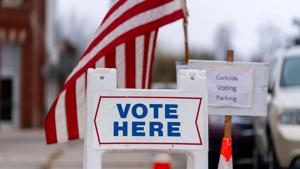
Alongside a battle for control of Congress, voters in states across the country will take up ballot initiatives to decide key issues. Citizenship requirements for voting, abortion, marijuana and psychedelic drug measures are among the issues to be considered across multiple states.
Here are some of those ballot measures.
Noncitizen Voting
In Arkansas, voters will consider whether to adopt an amendment to the state constitution that specifically prohibits noncitizens from voting. Currently, Arkansas allows any person in the state who is a citizen and at least 18 years old to vote.
The amendment would restrict voter eligibility to U.S. citizens who meet the “qualifications of an elector.”
“A person who does not meet the qualifications of an elector under this section shall not be permitted to vote in any state or local election held in this state,” the ballot measure reads.
Similarly, Kansas and South Dakota will have measures on the ballot to formalize citizenship requirements in each state’s constitution.
No state constitution in the country explicitly allows noncitizens to vote. Eighteen other states explicitly prohibit noncitizen voting.
Marijuana and Psychedelic Drugs
In Idaho, voters will take up a measure that could give the state legislature authority to legalize marijuana, narcotics, and other psychoactive substances. Additionally, the measure would prevent citizens from initiating state statutes to legalize the substances.
Idaho is one of 11 states where medical and recreational marijuana use is illegal. If voters approve the measure, it would make Idaho the first state to strip voters of the ability for future legalization efforts outside of the legislature.
Twenty-four states and the District of Columbia have legalized possession and use of marijuana for recreational purposes. Thirteen states and the District of Columbia passed legalization measures through citizen-led ballot measures
“Too many legislatures across this nation have sat back and just waited as initiative after initiative would come after them, until they finally overwhelm it and overwhelm the legislature,” Idaho Sen. Scott Grow, R-Eagle, said. “We are acting because that’s our responsibility.”
Abortion
In November, Missouri voters will consider a ban on abortion in the state except in the case of medical emergencies, rape, incest and fetal anomaly. The provision would give and exception for abortions in cases of rape or incest after 12 weeks gestation.
If voters in Missouri pass the measure, it would undo a 2024 state initiative that upheld the right to an abortion in the state.
In Nevada, voters will return to the polls to affirm whether the right to an abortion should be included in the Constitution.
In 2024, voters approved a measure to enshrine abortion rights in the state constitution. However, state law requires a measure to be approved in two consecutive even-year elections before a constitutional amendment.
Abortions up to 24 weeks are legal in Nevada due to a law passed in 1990. However, the advocacy group Reproductive Freedom for All urged passage of the ballot measure due to efforts from the Trump administration to restrict abortion.
“We must have state laws in place – like those proposed in Question 6 – that ensure people can access the care they need no matter what the Trump administration does,” Reproductive Freedom for All’s website reads.
Transgender Minors
In the same Missouri ballot measure attempting to restrict abortion access, voters will consider whether to prohibit minors from accessing gender transition surgeries and prescription or administration of cross-sex hormones.
This measure follows similar efforts from states to restrict minors’ access to gender transition hormones, puberty blockers and sex change operations.
In 2025, the U.S. Supreme Court allowed Tennessee to prevent health care providers from administering puberty blockers or hormones to minors with the intent of “enabling the minor to identify with, or live as, a purported identity inconsistent with the minor’s biological sex.”
“This case carries with it the weight of fierce scientific and policy debates about the safety, efficacy and propriety of medical treatments in an evolving field,” Chief Justice John Roberts wrote for the majority. “The voices in these debates raise sincere concerns; the implications for all are profound.”
Missouri voters are set to decide the ban on transgender care for minors alongside proposed abortion restrictions.
Voters will decide all of these issues at the ballot box in November. The midterm election is set for Nov. 3, 2026.