Center Square
Breaking: U.S. Supreme Court allows IL rep to sue over late ballots
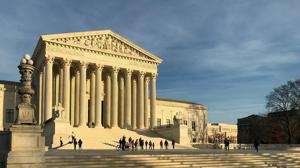
The U.S. Supreme Court, in a 7-2 decision, said an Illinois congressman has the right to sue the state over counting federal election ballots beyond Election Day.
U.S. Rep. Mike Bost, R-Murphysboro, filed a lawsuit against the state in 2022 for counting ballots postmarked on Election Day up to two weeks later. The court affirmed Bost had legal standing to sue without addressing whether states could allow mail-in ballots received after Election Day to be counted.
Chief Justice John Roberts, in a majority opinion for the court, said individuals who sue must display a personal stake in a case to have standing. As a candidate for office, Roberts said, Bost had that standing.
“A candidate has a personal stake in the rules that govern the counting of votes in his election,” Roberts wrote.
A candidate who expends additional resources or undergoes reputational harm will be affected by unlawful election rules, Roberts said. He argued candidates also have an interest in fair election laws.
“Candidates are not common competitors in the economic marketplace. They seek to represent the people,” Roberts wrote. “And their interest in that prize cannot be severed from their interest in the electoral process.”
In their dissent, Justices Sonia Sotomayor and Ketanji Brown Jackson took issue with Roberts’ claim that candidates have a special interest in the fair elections process which gives special standing to sue.
“In a democratic society like ours, the interest in a fair electoral process is common to all members of the voting public,” Jackson wrote. “The Court thus ignores a core constitutional requirement while unnecessarily thrusting the Judiciary into the political arena.”
The Supreme Court did not rule on the merits of Bost’s challenge to mail-in ballot counting laws. However, the high court will hear Watson v. Republican National Committee, a challenge to state laws allowing mail-in ballots to be counted after Election Day.
The case comes from Mississippi, one of 16 states and the District of Columbia that accept mail-in ballots after Election Day. Jason Snead, executive director of the Honest Elections Project, celebrated the court’s decision to hear the case.
“The Supreme Court now has the chance to set the record straight: Federal law clearly says that ballots must be received by Election Day,” Snead toldTCS. “Despite this, some states continue to allow absentee ballots to pour in days or even weeks late.”
“This case gives the Supreme Court the chance to resolve that question once and for all,” Snead said.
Trump visits Michigan to promote economic ‘turnaround’

President Donald Trump returned to Michigan on Tuesday to tout the economy and the auto industry.
During his visit, Trump spoke to the Detroit Economic Club and visited a Ford plant in Dearborn. During his speech, he praised his first year in office as an economic success – pointing to dropping inflation and gas prices.
“Who knew it was going to turn out this well,” Trump said. “After less than 12 months in office, I’m back in Michigan to report to you on the strongest and fastest economic turnaround in our country’s history.”
In his speech, the president also defended his tariff policies.
“The Trump Tariffs have delivered us trillions of dollars of new investment,” he said. “They brought hundreds of billions of dollars pouring into the United States Treasury, helped curb inflation, and helped cut the federal budget deficit by a staggering 27%.”
A number of states and businesses have challenged his authority to put those in place and that is currently under consideration by the U.S. Supreme Court, with a decision expected by June.
Just before the president took the stage in Detroit, the U.S. Bureau of Labor Statistics released its much-anticipated Consumer Price Index for December.
It found that consumer prices climbed 2.7% over the last year, before seasonal adjusting. Trump applauded the report’s numbers.
“Biden gave us a colossal stagflation catastrophe, but my administration has rapidly and very decisively ended that,” he said. “We have quickly achieved the exact opposite of stagflation – almost no inflation and super high growth.”
While 2026 inflation dropped significantly from 2022’s high of about 6.5%, a recent poll found that Michiganders are still feeling the effects of higher prices.
A poll conducted by WDIV and Detroit News asked voters from across the state a number of different questions, including one on what impact they think Trump’s economic policies have had on the nation’s economy.
In response to that question, 38% said “stronger,” 48% said “weaker,” and 10% said “no impact.” That could be a bellwether for Republicans going into the midterm election, especially in a swing state like Michigan which helped push Trump over the finish line to an election win in 2024.
Possibly sensing that Americans’ continued concerns about the cost of living, the president also laid out future plans to try to address that. Those plans include banning large institutional investors from buying single-family homes, capping credit card interest rates, and announcing a “healthcare affordability framework.”
Investments into the car industry was another highlight of Trump’s trip.
Michigan saw companies like Stallantis and JR Automation announce millions of dollars in investments in the state last year. On this trip, Trump stopped by a Ford factory to focus on that company’s recent growth.
“We have a great relationship with the president and his whole staff,” said Ford Executive Chairman Bill Ford. “We couldn’t be more excited. We’re adding market share. We’re growing as a company. We’re adding jobs.”
Fed charges: Yemeni, Hatian nationals stole millions in SNAP benefits

It’s not just Somali nationals in Minnesota who’ve been charged in a widescale scheme to defraud taxpayer-funded federal welfare programs. Haitian and Yemeni immigrants have also been charged with stealing tens of millions of dollars from the Supplemental Nutrition Assistance Program during the Biden administration.
SNAP is administered by the U.S. Department of Agriculture and state agencies. Recipients use EBT (electronic benefit transfer) cards to purchase qualifying SNAP food items.
U.S. Sens. Ted Cruz and John Cornyn, Republicans from Texas, argue foreign nationals who defraud the federal government should face consequences, including revoking potential citizenship privileges and deportation, The Center Square reported.
If their bill becomes law, it could apply to two Haitians who owned Boston-area bodegas charged in a $7 million SNAP fraud scheme, among many others.
Haitians Antonio Bonheur, a naturalized citizen, and Saul Alisme, a legal permanent resident, were charged with food stamp fraud by the U.S. attorney for Massachusetts. Alisme’s Haitian passport was issued in March 2021, expiring in February 2031, according to the criminal complaint. He was issued a Social Security card in November 2024 – the same month Massachusetts Gov. Maura Healey’s administration reported the alleged fraud to the Biden administration.
Bonheur’s 150-square foot store began accepting SNAP in September 2021; Alisme’s 500-square foot store began accepting SNAP around May 2025, according to the charges. Despite the small square footage, they received up to $500,000 a month in SNAP money, “outpacing full-service supermarkets,” investigators allege.
Bonheur’s monthly SNAP redemptions “regularly exceeded $100,000 – with many months exceeding $300,000 and, at times, $500,000. By comparison, one full-service supermarket in the same area redeems approximately $82,000 per month in SNAP benefits,” according to the charges.
The majority of the transactions exceeded $95 worth of purchases, an amount “typically associated with large supermarkets, not small variety stores with limited food inventory,” investigators say.
Undercover operations revealed that “SNAP benefits were allegedly trafficked for cash” at the stores where “defendants themselves allegedly worked the cash registers and personally exchanged SNAP benefits for cash” and sold liquor in exchange for SNAP benefits, the charges allege.
They also allegedly sold MannaPacks produced by the nonprofit Feed My Starving Children, authorities allege. The vitamin-and-mineral fortified rice meal and potato packs are specifically formulated to help malnourished and impoverished children living overseas. They were selling them for $8 each, “profiting from food intended for humanitarian relief,” the DA’s office said.
“Because both stores carried little legitimate food inventory and generated minimal lawful revenue, the defendants allegedly relied almost entirely on USDA-funded SNAP redemptions as their source of income,” the charges allege. “To conceal the nature and source of these funds, the defendants allegedly maintained numerous secondary bank accounts through which SNAP proceeds were transferred, withdrawn as cash and redeposited to create the appearance of legitimate business activity while obscuring the true source of funds.
In another case, a bodega in Brooklyn, New York, was “Ground Zero” for an alleged Yemeni immigrant scheme that stole $20 million of SNAP benefits from thousands of low-income individuals and families living in at least 10 states.
Last February, the U.S. Attorney for the Eastern District of New York charged Dawood Kassim (Badr al din Kassim) and Dia Alqalisi (Diaaldeen Alqalisi) with SNAP fraud.
The charges allege they conducted fraudulent SNAP transactions out of Throop Farm Market in Bedford-Stuyvesant. This involved allowing SNAP recipients to exchange SNAP benefits for cash or non-SNAP eligible goods, including beer, in exchange for a kickback, the charges allege, . It also involved using counterfeit and stolen SNAP EBT cards, stealing more than $7 million from SNAP recipients living outside of New York, according to the charges.
The detention memo filed in Kassim’s case states he was born in Yemen but later became a U.S. citizen, the U.S. Attorney’s Office confirmed to The Center Square.
Kassim is listed as a licensed real estate agent with United 726-728 Realty LLC in New York. The license is active since 2022, according to state records.
Alqalisi appears to claim to be born in the U.S. to Yemeni immigrant parents, is a CUNY graduate, former Virtusa Information Technology intern and Uber driver whose stated hobby is “reading on ethical hacking,” according to his WayUp profile.
Oklahoma residents were particularly hard hit by the scheme, a local NBC News affiliate reported. State authorities said they had no way of reimbursing the residents whose EBT funds were stolen in New York.
Secretary of Agriculture Brooke Rollins has required state agencies to share state SNAP data to ensure that “illegal immigrants aren’t getting benefits meant for American families.” As of December, 29 states had complied. Twenty-one Democratic states refused to comply and sued. Rollins said the USDA has “already uncovered massive fraud.”
The USDA is encouraging fraud to be reported online or by calling 1-800-424-9121.
Los Angeles County considers creating ICE-free zones

Editor’s note: This story has been updated since its initial publication to include a comment from the U.S. Department of Homeland Security.
Los Angeles County is considering designating ICE-free zones as a response to the Trump administration’s crackdown on illegal immigration.
The proposal comes from Los Angeles County Supervisors Lindsey Horvath and Hilda Solis, who sit on a board that governs the county. The plan is for an ordinance to be drafted and brought before the board in 30 days.
Speaking during Tuesday’s Board of Supervisors meeting, Horvath said, “Our federal government is killing its own citizens” in broad daylight and in front of witnesses and cameras.
“People have been shot; people have been killed; families have been shattered,” said Horvath.
One of those people was Renee Good, a mother of three who was shot and killed last week by an ICE agent in Minnesota.
The Trump administration says Good hit the ICE agent with her vehicle and that the agent acted in self-defense. The same agent had been dragged by a car in a June 2025 incident. Still, Horvath claimed Good was “acting within her full rights as a legal observer,” adding that Good was one of several people to die in ICE operations around the country.
“This motion creates ICE-free zones by drawing a clear boundary,” said Horvath, who represents the 3rd District of Los Angeles County. “LA County will not allow its property to be used as a staging ground for violence caused by the Trump administration.”
According to Horvath, the county’s public spaces “should be places of care and safety,” not fear.
“We may not control federal enforcement everywhere, but we do control our own property, and we have a responsibility to act when lives are at stake,” said Horvath.
Solis, who represents the county’s 1st District, followed Horvath’s remarks by saying that news reports have been full of ICE-related raids, shootings and deaths. Solis called that an outrage.
“You do not have the right to come in and harass people without a warrant,” said Solis.
Supervisor Janice Hahn represents the county’s 4th District. Hahn said it is “disturbing that we’ve come to this point,” adding the county cannot allow its property to be a “tool” for the work that ICE is doing.
“I hope this sends a message,” said Hahn.
The Center Square sought comment from the U.S. Department of Homeland Security, which questioned how the new ordinance would benefit the people of Los Angeles.
“This is illegally illiterate. Enforcing federal immigration laws is a clear federal responsibility under Article I, Article II and the Supremacy Clause,” a department spokesperson told The Center Square late Tuesday afternoon in an email.
“While Los Angeles sanctuary politicians continue to release pedophiles, rapists, gang members, and murderers onto the city’s streets, our brave law enforcement will continue to risk their lives to arrest these heinous criminals and make Los Angeles safe again,” the spokesperson added.
States sue feds over gender ideology rules on health grants

New York, California and Oregon are leading 12 states suing the U.S. Department of Health and Human Services over allegedly threatening to withhold billions of dollars in grants unless states illegally discriminate against transgender people.
The lawsuit, filed Tuesday in the U.S. District Court for Rhode Island, is challenging the new conditions that the states’ Democratic attorney generals say are discriminatory.
Oregon Attorney General Dan Rayfield said the new Health and Human Services policy demands recipients of health, education and research funding “must certify compliance with a presidential executive order that seeks to deny the existence of transgender people and impose rigid, unscientific definitions of sex.”
“This policy uses federal money to interfere with deeply personal medical decisions that belong to patients, families, and their doctors,” Rayfield said in a statement. “Agencies shouldn’t be forced to take care away from people just to keep their funding.”
Besides California, New York and Oregon, states suing the Trump administration are Colorado, Delaware, Illinois, Michigan, Minnesota, Nevada, Rhode Island, Vermont and Washington.
Defendants include Secretary of Health Robert F. Kennedy Jr. and Dr. Mehmet Oz, director of the Centers for Medicare and Medicaid Services.
The Center Square reached out to the White House and the Department of Health and Human Services for comment, but did not get a response by press time.
The plaintiffs say the new policy forces states to discriminate against transgender individuals or lose Health and Human Services grants that fund medical training, research, and the treatment and prevention of diseases.
“These changes to HHS’s grant policy are yet another effort by President Trump to unlawfully and maliciously target transgender, nonbinary, intersex, and gender nonconforming individuals,” California Attorney General Rob Bonta said in a statement. “HHS has overstepped its Constitutional authority and ignored proper procedures in an attempt to codify its hateful agenda.”
The states’ lawsuit says Trump can’t change a law by his executive order on gender ideology. The suit accuses the Trump administration of trying to rewrite Title IX, the 1972 federal law that prohibits sex-based discrimination in education programs or activities that receive federal funding.
“The Gender Conditions reverse previous policies — in effect across multiple federal agencies and administrations, including the first Trump administration — recognizing that federal laws prohibiting sex discrimination, including Title IX, protect against discrimination on the basis of gender identity,” the suit says.
New York Attorney General Letitia James said the Trump administration is trying to force states to choose between their values and vital funding through a “cruel and unjust directive.”
“This policy threatens health care for families, life-saving research, and education programs that help young people thrive in favor of denying the dignity and existence of transgender people,” James said in a statement.
Johnson expects on-time passage of all govt funding bills as two more head to floor

Congress has less than a month to pass the remaining appropriations bills providing fiscal 2026 funding for federal agencies, but House Republicans are convinced it’s possible.
House Speaker Mike Johnson, R-La., told reporters Tuesday that he believes lawmakers can pass the remaining nine of 12 funding bills by the Jan. 30 deadline, negating the need for a Continuing Resolution to prevent a government shutdown.
“We cannot govern by CR or omnibus. And when we do that, it also loses Congress’s opportunity and credibility,” Johnson added. “It’s taken a while, but we are finally moving that boulder uphill.”
Following Johnson’s remarks, lawmakers on the House Budget Committee sent two more appropriations bills in the form of a minibus to the floor for a vote this week.
The minibus provides a total of $76 billion for the departments of State and Treasury, the IRS, the Executive and Judiciary branches, national security agencies, and others.
Both Republican and Democratic lawmakers made compromises in the bill, but it received broad bipartisan support among committee members.
“Is this appropriations package perfect? No. No appropriations bill ever is. But it does avoid another lapse in funding, and it rejects some very bad ideas,” Ranking Member Jim McGovern, D-Mass., said.
McGovern and other Democrats specifically praised the $30 billion increase in election security grants and $5.5 billion allocated for international humanitarian assistance programs.
Republicans, meanwhile, championed the taxpayer savings in the minibus, which cut $9.3 billion from last year’s funding levels, a 16% spending reduction.
“Is this my idea of a perfect bill? Of course not. But I’m happy for bills that pass and stay within lines, and these bills have stayed within the lines,” House Appropriations Committee Chairman Tom Cole, R-Okla., said.
“My goal is to get them all done before January 30, and get them done in a way that people on both sides of the aisle are comfortable voting for them, knowing that they didn’t get everything they want but knowing that their worst fears and nightmares did not come true,” he added, echoing Johnson’s optimism.
Only three fiscal year 2026 appropriations bills — together funding Veterans Affairs, military construction, the Department of Agriculture and rural development, and the Legislative branch — have become law.
Three more funding bills passed the House last week in the form of a three-bill minibus, granting appropriations for the departments of Commerce; Justice; Energy; Interior; and the Environmental Protection Agency, among others.
Senate Majority Leader John Thune, R-S.D., told reporters he plans to keep lawmakers in town until the upper chamber passes that minibus and sends it to President Donald Trump’s desk. If senators pass any amendments, however, the package will have to go back to the House for final approval.
WATCH: Advocates urge action on trans sports ban
While justices in the U.S. Supreme Court heard arguments Tuesday over whether state laws banning transgender people from participating in women’s sports were unconstitutional, advocates on both sides urged lawmakers to act.
The justices heard arguments in Hecox v. Little and B.P.J. v. West Virginia, two cases that challenge state laws preventing transgender people from participating in girls and women’s sports.
Carrie Peters and her daughter, Taylor, came to the U.S. Supreme Court from Wyoming to advocate for Idaho and West Virginia’s laws. Carrie Peters said she has worked to implement similar laws in Wyoming.
“I want her spaces to be protected,” Carrie Peters said about her daughter. “The issue is so much bigger than sports it’s just something we’re both incredibly passionate about.”
Taylor Peters, a high school tennis player, said she has seen her teammates compete against transgender athletes.
“It’s hard to watch; their opportunities are being taken away,” Taylor Peters said. “There needs to be some protections put in place for women’s sports and spaces.”
One of the cases before the court, B.P.J. v. West Virginia, focuses on 15-year-old Becky Pepper-Jackson, who has identified as transgender for the majority of the teenager’s life.
Pelecanos, a fellow at Lambda Legal, said Pepper-Jackson never went through endogenous puberty and has limited competitive advantages over other athletes.
“Becky went through the same female hormonal puberty as all of her peers,” Pelecanos said. “She doesn’t have advantages that our opposition is claiming she has.”
Stacey Scheffelein, chair of the America First Policy Institute’s America First Women’s Initiative, said there are differences beyond hormones between transgender and cisgender people.
“Men on average have greater muscle mass, stronger bones, larger hearts and lungs, and higher red blood cell counts,” Schieffelin said. “Those differences create undeniable advantages in speed, strength, and endurance. This is not ideology, it’s biology”
A portion of the legal arguments justices of the court heard focused on how Title IX, a federal policy prohibiting sex-based discrimination, should be applied. Schieffelin said using Title IX protections to include transgender people in sports misunderstands the law.
“Protecting women’s sports is exactly what title nine requires,” Schieffelin said. “For the first time, we see our courts standing up for what is right.”
Advocates for Pepper-Jackson said Title IX is designed to give all students, including those who are transgender, equal access to educational opportunities.
“For her to play in sports like all of her peers is for her to be able to get the same education as her peers,” Pelecanos said about Pepper-Jackson.
Evelyn Ullman came to the U.S. Supreme Court’s steps to represent the group, Democrats for an Informed Approach to Gender. While a supporter of Democrat causes, Ullman said transgender inclusion in sports is not aligned with the women’s rights movement.
“If you just create this nebulous term where gender identity is what should determine what category you play in, there is no more definition of women,” Ullman said. “How can you protect women’s rights when you cannot actually define what a woman is?”
Ullman said political coalitions in the Democrat party have stirred up intense party infighting over transgender issues. She said a minority of Democrats support allowing transgender people to participate in women’s sports.
“It’s a minority of Democrats who actually believe that but they’re a very vocal and outspoken minority,” Ullman said. “They’ll do everything they can to make your life a living hell if you have a different opinion from them.”
“I see some of our opposition really trying to push this idea that women are weak and need protection, and I’m sad to see that because that just doesn’t feel representative of the girls and young women I know,” Pelecanos said. “So I’m hoping since we share that value of fairness that we can all come together and lift women up.”
Advocacy groups praise Trump admin’s healthcare price transparency commitment

The Trump administration’s commitment to healthcare price transparency has been met by praise from advocacy groups, with the organizations stating such a move is “imperative” and what Americans deserve.
Executive director of Save Our States Trent England told The Center Square: “Price transparency is a core part of President [Donald] Trump’s pro-worker, pro-family, and pro-growth healthcare strategy to lower costs, expand access, and let Americans keep more of the money they earn.”
Save our States is an advocacy group focused on defending the constitutional power of states, according to its website.
England told The Center Square: “For too long, families, workers, and small businesses have been trapped by hidden prices and surprise medical bills that line the pockets of powerful hospital systems and insurers.”
“The Administration is putting patients back in charge by forcing the healthcare industry to show real prices upfront, just like any other service,” England said.
“When Americans can compare costs, plan ahead, and avoid getting ripped off, competition works and prices come down,” England said.
Founder and chairman of PatientRightsAdvocate.org Cynthia Fisher told The Center Square that “by requiring upfront prices for patients and full transparency for employers, these reforms expose hidden fees and ensure every healthcare dollar is accounted for.”
PatientRightsAdvocate.org is a nonprofit dedicated to realizing healthcare price transparency in the nation.
Fisher told The Center Square that “under President Trump and Secretary [Robert] Kennedy’s leadership, the Department of Health and Human Services has a clear opportunity to deliver healthcare price transparency quickly, driving lower prices, stronger competition, more jobs, and real savings for American families.”
“We applaud this effort and urge the Administration to move as fast as possible so Americans can see and feel the tangible results of true transparency without delay,” Fisher said.
Executive director of parental rights advocacy group American Parents Coalition Alleigh Marré likewise told The Center Square that her organization “applauds Secretary Kennedy for his tireless efforts to implement healthcare transparency.”
“Transparency in healthcare is imperative for parents because financial uncertainty should never be a barrier to care for our families,” Marré said.
As parents have a responsibility to care for their children’s health, having to make such health decisions without knowing the cost “makes financial planning nearly impossible,” Marré said.
Marré told The Center Square that “as evidenced by [yesterday’s] announcement, healthcare price transparency is thankfully a top priority of the Make America Healthy Again agenda.”
On Monday, Kennedy posted on X about healthcare price transparency, stating: “President Trump and I are doing everything we can to pull back the curtain on prices for hospital stays, physician visits, and prescription drugs.”
“We’re delivering on those promises, working to make your health care more transparent, more accessible, and more convenient, with no surprises,” Kennedy wrote.
The HHS has not yet responded to The Center Square’s request for comment.
Former ‘Vegas’ coroner seeks county administrator job after journalist’s murder

Retired Clark County Coroner P. Michael Murphy, who was brought in to fix the county’s public administrator’s office right before the then-administrator murdered a newspaper reporter, is running for the administrator’s job.
Murphy, a Republican, was the Clark County coroner for 13 years before retiring in 2015. In 2022, he was brought in to address alleged misconduct by then-Clark County Administrator Robert Telles that was exposed by Las Vegas Review-Journal investigative reporter Jeff German. Staff in the office told German that Telles was abusive to subordinates and was carrying on an affair with an employee.
German was murdered on Sept. 2, 2022 in front of his Las Vegas home. Telles was convicted of his slaying in 2024 and sentenced to at least 28 years in prison. Murphy tipped off police about Telles being a suspect after office staff recognized the suspect’s vehicle was one that Telles’ wife owned.
“I was called into the position when it was in chaos and as the summer progressed and the homicide happened, it turned into total chaos,” Murphy told The Center Square in a phone interview, adding he worked hard to fix the problems. “I want to finish what I started.”
Though the filing period isn’t until March so others could jump into the race, M.J. Ivy, who worked as an estate investigator in the office when it was in conflict, has announced he will run for the Democratic nomination.
Ivy said his main focus is to help people in their time of need.
“I want to help poor people who don’t have any voice,” he told The Center Square in phone interview. “People who don’t have family members, we want to do this the right way.”
Murphy, who served as police chief in Mesquite, Nevada, and as a police officer in other departments, has never run for elected office. He is currently a program manager for The National Center for Missing and Exploited Children. The county hired his company to address problems in the administrator’s office and with his successor in the coroner’s job. Using a company allowed him to continue to collect his pension when doing the contract work. Nevada law prevents most government employees from collecting a paycheck and pension unless they are elected officials or run the work through a corporation or LLC.
Ivy, an U.S. Air Force veteran, worked as communications director for a library district in Colorado, formed his own communications company, ran for a seat as regent and is a pastor. He knew Telles through the Democratic Party when they both were running for office and worked in the public administrator’s office for about four months before he said he was let go by current Public Administrator Rita Reid. He said she told him she couldn’t trust him because of his political connections to Telles.
Reid could not be reached for comment.
The public administrator handles estates of people who die without wills or trusts and do not have family able or willing to deal with the estate.
Republican in blue county
Murphy said he understands that running as a Republican in a Democratic county is an uphill battle because no Republican has held the office.
Murphy said he wants to streamline the office to speed up the cases as well as conduct community outreach to inform people of the importance of estate planning to avoid having their property go into probate or be handled by the public administrator’s office after they die.
“No offense to government, but it is not most efficient way to handle this,” he said.
Telles handling of the office was mired in rumors and investigations of corruption, and Murphy said he wants to increase the auditing process to make sure the office is transparent and above reproach.
Ivy said he respects Murphy and agrees that transparency and accountability are key to gaining the public’s trust after the conflicts in the office.
“There was a lack of communication and true strong leadership,” he said.
One-term pledge
Murphy said he only wants one term, and he will fight to make the office an appointed position instead of an elected one.
“I’m sure we don’t need this to be an elected position,” he said. “Ultimately I would go to the Legislature so the county could have a choice on whether or not it is an elected or appointed position.”
Ivy said he would like to see the PA remain an elected position because there is already a public guardian, but he isn’t sure it needs to be a partisan one.
In 2022, Reid reluctantly ran for the office because of her and other staff’s clashes with Telles. The staff members went to German to expose the problems and affair, providing him a video of Telles in the back seat of a vehicle with a subordinate. Murphy said Reid is retiring after one term.
Murphy has name recognition as the county’s long-time coroner, as the person selected to address problems with the Telles’ administration and for his appearances on various television shows that highlighted the work of coroner in Las Vegas.
He hopes to reform the public administrator’s office and make it more like the coroner, which is appointed by the county manager.
“I plan to work myself out of a job,” he said.
WATCH: U.S. Supreme Court weighs trans sports ban
The U.S. Supreme Court heard arguments Tuesday in two cases over whether biological males can participate in women’s and girls’ sports.
Little v. Hecox and B.P.J. v. West Virginia challenged state laws in Idaho and West Virginia, respectively, that prevent transgender women and girls from participating in female sports.
The justices weighed whether the sports bans violate the Constitution or Title IX, a federal law that prohibits sex discrimination.
Kathleen Hartnett, a lawyer representing transgender athlete Lindsay Hecox in Idaho’s case, said there is not a competitive advantage between cisgender and transgender people in sports when hormones are controlled.
“The testosterone is the advantage on this record,” Hartnett said. “This person had mitigated testosterone.”
Justices Neil Gorsuch and Brett Kavanaugh pointed to scientific uncertainty over whether blocking hormones eliminates a competitive advantage in sports. Both justices expressed uncertainty about creating a protected status for transgender individuals without more scientific consensus.
“Given that half the states are allowing it, half are not, why would we try to constitutionalize a rule for the whole country,” Kavanaugh asked.
Justice Amy Coney Barrett pointed to the state laws specifically prohibiting transgender girls and women from participating in sports on the basis of transgender status.
“Since trans boys can play on boys teams, how would we say this discriminates on the basis of transgender status,” Barrett asked.
In arguments over West Virginia’s case, lawyers clashed with the justices in multiple instances over legal tactics used to argue for or against transgender individuals participating in female sports.
“Biological sex matters in athletics in ways both obvious and undeniable,” said Michael Williams, West Virginia solicitor general. “The law is indifferent to gender identity because sports is indifferent to gender identity.”
Justice Ketanji Brown Jackson pointed to inherent discrimination between cisgender women and transgender women. She appeared to signal the case must consider the differences in treatment under the law for both categories.
“The law operates differently for cisgender women and transgender women,” Jackson said.
Justice Sonia Sotomayor joined Jackson in apparent criticism of West Virginia’s legal arguments. She pointed to the lower court’s inability to find a violation of the equal protection clause, but did find a violation of Title IX.
“I’m not sure how it could do that, if the evidence is not sufficient to justify finding an equal protection violation its not a violation,” Sotomayor said.
Lawyers argued that West Virginia’s law treats Pepper-Jackson differently from other girls on sports teams throughout the state on the basis of sex. The lawyers said Title IX protections should extend to transgender individuals.
“If boys and girls as groups are being given equal sets of overall opportunity, every individual gets equal opportunity,” said Joshua Block, a lawyer for the American Civil Liberties Union who represented Pepper-Jackson.
Kavanaugh questioned whether the participation of transgender athletes would discriminate against cisgender girls and women who participate.
“Someone who tries out and makes it will bump someone else from the starting line up,” Kavanaugh said.
Justice Clarence Thomas also appeared to question the argument that a transgender individual could be included in Title IX protections when that status was likely not considered in the law’s passage.
“You’re challenging a category that does not exist in the statute but is dependent on the existence of the category in the statute,” Thomas said.
In a closing rebuttal, Williams asserted a strong link between biological sex and biological athletic performance. He also pointed back to questions of competing medical science.
“In areas of evolving science and medicine, legislatures have the primary responsibility for weighing competing evidence,” Williams said.