Center Square
Treasury, IRS ramp up investigation into Minnesota fraud
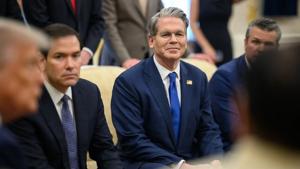
The administration continues to ramp up its response to the massive social services fraud in Minnesota, with Treasury Secretary Scott Bessent enumerating steps his department is taking to prevent similar abuses going forward.
“I am optimistic that we are going to put an end to this waste, fraud and abuse, that we are going to have recoveries for the American people, and that we are going to hold people accountable, set an example and make sure that federal aid gets to the people it was intended for and not to the fraudsters,” Bessent said in a statement.
He explained several initiatives begun by the Treasury Department, as well as one to come.
The department’s Financial Crimes Enforcement Network and the IRS are investigating some money service businesses – organizations that perform financial services outside of a formal bank – that were used to send funds to Somalia and other places overseas. Some have alleged that stolen social services funds directly or indirectly funded the terrorist group al-Shabaab, an al-Qaeda affiliate based in Somalia.
“We have traced where the money went and are examining it,” Bessent said.
FinCEN has also issued a “geographic targeting order” for banks and money transmitters in the Twin Cities’ counties, requiring enhanced financial reporting that makes it easier for analysts to spot fraudulent activity.
“This will put a microscope on these businesses, advance prosecutions and assist in the recovery of funds laundered internationally,” Bessent said.
The IRS is auditing “financial institutions that facilitated the laundering of Minnesota funds,” and it is forming a new task force that will focus on investigating the abuse of “pandemic-era tax incentives” and the misuse of nonprofit tax exempt status by entities that participated in Minnesota based social services fraud schemes.
The Treasury Department is also providing training to Minnesota law enforcement on how to better spot and prevent fraud.
The Justice Department is carrying out its own investigations into the now-estimated $9 billion of Minnesota social services fraud, and the administration has frozen federal social services funding to Minnesota, California, Colorado, Illinois and New York.
Bessent indicated investigations into other states are likely around the corner.
“The Minnesota protocols will serve as a genesis and a launching pad for investigations into other states,” Bessent said. “Treasury will deploy all tools, all tools, to bring an end to this egregious unchecked fraud and hold perpetrators to account.”
Tariff authority decision still awaited from Supreme Court

Tariff authority by second-term Republican President Donald Trump was not decided by the U.S. Supreme Court on Friday, meaning the federal government can continue to collect the revenue for now.
Businesses around the world had braced for a possible decision, but the high court released an unrelated opinion. The opinion could come nearly any time before the end of June.
Trump has made tariffs a central part of both his domestic and foreign agendas during his second term. Last April, Trump imposed import taxes of at least 10% on every U.S. trading partner. Since then, the president has suspended, changed, increased, decreased and reimposed tariffs under the 1977 International Emergency Economic Powers Act.
A group of states and small businesses challenged Trump’s tariffs under the 1977 law, winning in two lower courts before the administration appealed to the Supreme Court.
The high court agreed to hear the case on an expedited basis, given the economic stakes at issue. The Trump administration could be forced to refund more than $133.5 billion in tariffs to importers if the Supreme Court sides with the states and small businesses in the case.
Trump has called the case one of the most important of all time and said that an unfavorable ruling could result in economic ruin for America.
Businesses have reported that tariffs have pushed up prices for consumers.
Minneapolis schools offer remote learning while ICE operations continue

Minneapolis Public Schools can choose remote learning for at least a month in the wake of the shooting of Renee Good by an ICE officer on Wednesday.
The school system sent emails to teachers Friday, say published reports, outlining the remote learning option while federal immigration enforcement efforts continue in the city.
The school district also stated that it is aware of an incident on Wednesday at Roosevelt High School involving federal law enforcement agents and is currently investigating.
That incident, according to media reports, happened around 3:30 p.m. when several agents descended on school grounds from unmarked cars as students and teachers were leaving school.
CBS News reported that the Department of Homeland Security said in a statement that a U.S. citizen was trying to impede immigration operations and hit a government vehicle with his vehicle before leading agents on a 5-mile chase.
CBS also reported that Homeland Security said a teacher assaulted a border patrol agent and a crowd threw objects and paint at officers and their vehicles.
That incident happened less than 3 miles from the killing of Good, a 37-year-old mother of three.
“We are working with our partners including the city of Minneapolis and others to support the individuals directly impacted,” the district said in a statement.
Education Minnesota, an organization comprised of 477 local unions, called for U.S. Immigration and Customs Enforcement to stay away from Minnesota schools.
“Yesterday’s actions by ICE in Minnesota – including the shooting of a community member, the unjust detention of a Minnesota educator, and the use of pepper spray on students – are unconscionable in a civil society,” the group said in a statement. “ICE’s continued operations make every Minnesotan less safe. Their presence near our schools puts students and educators at serious risk. We demand that ICE operations be kept away from schools so students, educators and staff can learn and work in safety and peace.”
CBS reported that Homeland Security said at no time was pepper spray used at Roosevelt.
Trump administration sued for freezing child care funds

New York is leading four other states in suing the Trump administration over a freeze of more than $10 billion in federal funding for child care and anti-poverty programs.
The lawsuit, filed Friday in U.S. District Court in Manhattan by Attorney General Letitia James, seeks to block the U.S. Department of Health and Human Services from withholding money from New York, California, Colorado, Illinois, and Minnesota amid ongoing federal scrutiny into the child care programs. Trump administration officials have said the pause was necessary to investigate “potential” fraud.
James and the other AGs argue the freeze is “arbitrary and capricious” and violates federal law and the U.S. Constitution by usurping Congress’ power over spending and bypassing long-established procedures for probing allegations of fraud.
The AGs claim in the 41-page complaint that the Trump administration has “publicly stoked allegations of fraud” to claim that the five states are providing unlawful benefits to undocumented immigrants, “regardless of whether they have been substantiated.”
They said the allegations are being used “as a pretextual justification to punish perceived political enemies of the Trump Administration by unlawfully withholding critical funding pending purported fraud detection measures unauthorized by any statute.”
“Defendants have said that the ACF Funding Freeze is necessary to root out ‘potential’ fraud, but this is pretext,” the AGs wrote in the complaint. “Their transparent motivation is to punish “Democrat-led” states who are disfavored by the administration.”
Earlier this week, HHS announced that it was withholding money from three federally funded programs: the Child Care and Development Fund, Temporary Assistance for Needy Families and the Social Services Block Grant in the five Democratic-led states. The agency said the funding pause is necessary to ensure benefits are not improperly given to undocumented immigrants and others who are ineligible under federal law.
“Families who rely on child care and family assistance programs deserve confidence that these resources are used lawfully and for their intended purpose,” Deputy HHS Secretary Jim O’Neill said in a statement. “This action reflects our commitment to program integrity, fiscal responsibility, and compliance with federal requirements.”
In New York, the funding includes $2.4 billion in cash assistance to more than 200,000 families to help cover housing, food and other necessities, according to the James’ office. The federal government also provided the state with $638 million in child care subsidies last year to help low-income parents work or attend school and $93 million through the Social Services Block Grant for services aimed at preventing abuse and neglect, James said.
In the lawsuit, the attorney general said the freeze on funding could lead to disruptions for families that depend on the funding for childcare services and force some child care providers out of business.
“Once again, the most vulnerable families in our communities are bearing the brunt of this administration’s campaign of chaos and retribution,” she said. “After jeopardizing food assistance and health care, this administration is now threatening to cut off childcare and other critical programs that parents depend on to provide for their children.”
The legal fight over the funding comes as New York moves to dramatically expand childcare programs, with Gov. Kathy Hochul and New York City Mayor Zohran Mamdani on Thursday unveiling a $1.7 billion initiative that will provide universal childcare for two-year-olds in the city. Hochul said the spending is part of broader efforts to expand universal child care statewide.
Minnesota authorities cut out of ICE shooting investigation

Hennepin County Attorney Mary Moriaty said the community could be left in the dark after the FBI refused to cooperate with local authorities to investigate Wednesday’s fatal shooting of a Minneapolis woman by ICE officers.
The FBI reversed course after initially saying the Minnesota Bureau of Criminal Apprehension and the FBI would conduct a joint investigation into the killing of 37-year-old Renee Nicole Good. Instead, Minnesota authorities will have no access to evidence, materials and interviews.
“After the FBI rescinded its cooperation agreement with the Minnesota Bureau of Criminal Apprehension, our office immediately began exploring all options to ensure a state level investigation can continue,” Moriaty said in a statement. “If the FBI is the sole investigative agency, the state will not receive the investigative findings, and our community may never learn about its contents. We are speaking to our local partners on paths forward that will allow us to review the investigation and be transparent in our decision making.”
TCS was unsuccessful prior to publication of getting comment on the change in an email request to the U.S. Department of Justice.
Bureau of Criminal Apprehension Superintendent Drew Evans said in a statement the investigation could be questioned without local, state and federal cooperation.
“Without complete access to the evidence, witnesses and information collected, we cannot meet the investigative standards that Minnesota law and the public demands,” Evans said. “As a result, the BCA has reluctantly withdrawn from the investigation. The BCA Force Investigations Unit was designed to ensure consistency, accountability and public confidence, none of which can be achieved without full cooperation and jurisdictional clarity.”
Evans also said he expects a thorough and complete investigation by the FBI, and the full file will be shared with state and federal prosecutors.
The city plans to remove a barrier around a memorial for Good, a mother of three, at some point today.
An agent for U.S. Immigration and Customs Enforcement shot and killed Good. She had driven into a roadway where agents were conducting enhanced immigration enforcement.
Tricia McLaughlin, assistant secretary of Homeland Security, said Good’s vehicle was “attempting to run over our law enforcement officers.” She also said the officer feared for his life and fired defensive shots.
Homeland Security Secretary Kristie Noem called Good’s actions an “act of domestic terrorism.”
City and state leaders called the Trump administration’s version of events wrong and have said ICE’s presence in the community is creating chaos and harm.
Federal officials said an agent struck by Good’s vehicle was treated and released from a hospital.
On Thursday, Vice President J.D. Vance said Good might have been part of a rise in leftwing protests and violence.
Op-Ed: The Supreme Court must stop Louisiana’s retroactive lawsuits
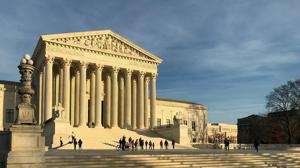
On Monday, the U.S. Supreme Court will hear oral arguments in Chevron v. Plaquemines Parish on a threshold jurisdictional question. The Court’s answer could have sweeping consequences for the energy industry and all federal contractors, determining whether such cases belong in federal court when defendants acted under federal direction.
Central to the case is the federal officer removal statute. Congress updated this statute over the decades, as recently as 2011 under President Barack Obama, no longer requiring a direct line of control and thereby recognizing the importance that such disputes be heard in federal, not state, courts. Accordingly, the Court should rule that the case properly belongs in federal court.
The case’s historical background is that during World War II, President Franklin D. Roosevelt effectively nationalized America’s energy industry (as he did others). At the time, the Petroleum Administration for War dictated almost every aspect of production, from the rig to the refinery to the railroads. Federal officials decided, among other things, how much crude oil to extract from Louisiana (more, more, more), the refineries to process it, how to distribute it, and what resources and products were needed for Allied victory, especially Avgas, a specialized type of high-octane aviation gasoline that was critical to Allied air power and victory and depended on Louisiana crude oil. Moreover, the federal government had the power to seize products and raw materials, repeatedly enlarge capacity, and increase production quotas at will. Thus, the government made America’s energy producers into its instruments of wartime policy and production in direct service of national defense, under extraordinary federal direction and supervision.
Accordingly, it is wrong and unfair for Louisiana and its municipalities, 80 years later, to sue American energy producers in Louisiana state courts for alleged environmental damage, especially when the local governments are deeply entwined and in cahoots with the plaintiffs’ attorneys, so much so that, in a perturbing surrender of Louisiana’s sovereignty to the plaintiffs’ attorneys, their contract prohibits Louisiana from endorsing any substantive defenses, even if legally valid.
A traditional originalist approach shows that the statute’s plain text and Congress’s original intent of the statute and its 2011 amendment control, and that disputes involving private companies obeying federal government directives to produce critical wartime needs, are exactly what the statute intended to be heard in federal court. State or local governments cannot use their own state courts to second-guess or nullify federal policy and law, whether regarding defense, environmental, or something else. Additionally, the risk of conflict or bias in state court is too high because the state and local governments are parties to the litigation. For example, Louisiana Judge Michael Clement, Gov. Jeff Landry, and Attorney General Liz Murrill all received substantial campaign contributions from the plaintiffs’ attorneys and their associated PACs.
Thus, the Court’s decision will have ramifications not only for this case but also for environmental “lawfare” and other bogus lawsuits designed to bankrupt unpopular industries sprung from the unholy alliance of states, municipalities, and plaintiffs’ lawyers. This is especially true for any industry or company that touches upon national defense, which today is about half of all federal contracts. During World War II, the federal government conscripted many non-defense companies, in addition to the energy industry, to manufacture weapons and war equipment. Ford built almost half of all B-24 Liberator bombers, and Chrysler built tanks and B-26 Marauder and B-29 Superfortress bombers. General Motors, Underwood Typewriter, National Postal Meter, IBM, and Rock-Ola (jukeboxes and pinball machines) manufactured millions of M1 Carbines, and Singer Sewing Machine and Union Switch & Signal (railroad signaling equipment) manufactured 1911A1 pistols, among other things. Furthermore, this case will likely affect whether one state court’s rulings may effectively dictate other states’ and the nation’s policy choices, especially where Congress already spoke on the issue.
Paul Clement, the petitioners’ lawyer and former U.S. Solicitor General, correctly argued in his certiorari petition that the lawsuits against American energy producers are “an effort by local governments to obtain massive recoveries from companies that assisted the federal war effort long ago.” The Constitution created a federalist system precisely to prevent that kind of retroactive targeting. No one in 1942 thought that extracting, producing, refining, and transporting critical oil and petroleum products to win World War II would someday be alleged to be a violation of a state coastal statute for billions of dollars in damages.
The Supreme Court should reverse the Fifth Circuit and reaffirm what every generation of Congress and every prior Court has always understood: that when the federal government calls, those who answer deserve federal court protection from “state court proceedings that may reflect local prejudice.” The justices should ensure that logic and the law, not local politics, have the final word and that local courts may not rewrite America’s national interests generations after the fact.
Trump requests $6.2M in attorney fees from Fulton County
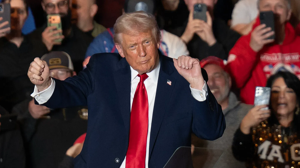
A 222-page document filed in Fulton County Superior Court outlines President Donald Trump’s $6.2 million in legal fees spent defending himself in an election interference case.
Fulton County taxpayers could be forced to pay those legal fees if they are approved by a judge. A bill passed by Georgia lawmakers allows defendants to bill the county if the prosecuting attorney is disqualified for misconduct and the case is dismissed.
A judge removed District Attorney Fani Willis from the case after defense attorneys uncovered a romantic relationship between her and lead prosecutor Nathan Wade. Trump’s legal team said in their motion for legal fees that the August 2023 grand jury indictment was political.
“Prior to the special purpose grand jury concluding its work, DA Willis was disqualified from investigating a putative target, current Lt. Governor Burt Jones, for misconduct stemming from DA Willis openly promoting and headlining a fundraiser for his political opponent,” the motion said.
Charges against Trump and the 18 other defendants were dropped after Peter Skandalakis, executive director of the Prosecuting Attorneys’ Council of Georgia, appointed himself to the case and filed a motion to dismiss the case in November. Skandalakis also cleared Jones, a gubernatorial candidate, of any wrongdoing.
The motion filed Wednesday shows how the legal fees are split between the attorneys and a company called 2M Document Management and Imaging, which sent $690,000 to the Make America Great Again PAC.
Steve Sadow billed $1,516,456. His retainer was a flat $1.5 million fee paid in three payments of $500,000. The retainer did not include expenses, according to the document.
Atlanta Attorney Jennifer Little’s fees in the document are $2.3 million, which included an initial $25,000 retainer and a rate of $450 an hour.
Findling Law Firm required a non-refundable retainer of $100,000 and a billable hourly rate ranging from $1,000 to $350, depending on the attorney. The total cost for Findling Law is $1,464,004.73, according to the document.
Other law firms listed are Dwight L. Thomas, P.C. ($118,217.80); Law Offices of Matthew K. Winchester ($43,215) and The Bullard Firm, LLC ($107,835).
The motion also includes $7,500 for Trump’s bail bond fee.
While the case is over, scrutiny of the prosecution continues. The Senate Special Committee on Investigations questioned Willis, a Democrat, about her prosecution last month. She told the committee that she took on the case because “because people came into my jurisdiction and they broke the law.”
Willis remains in office. She staved off a primary challenge in 2024 and defeated Republican Courtney Kramer with 68.1% of the vote.
U.S. economy added more than 500,000 jobs in 2025

The U.S. economy added 50,000 jobs in December, according to Bureau of Labor Statistics.
The rate of job growth has remained steady over the past several months. Healthcare, food services and social assistance drove the rate of job creation up in December.
In 2025, the economy added 584,000 jobs. Heather Long, chief economist at Navy Federal Credit Union, said it was a difficult year for job seekers.
“2025 was the worst year for hiring outside of a recession since 2003,” Long wrote in a post on social media.
The unemployment rate in December remained steady at 4.4%.
In December, health care employment trended upward with 21,000 added jobs. In the year as a whole, health care jobs increased by an average monthly rate of 34,000. This monthly gain is less than in 2024, where the average gain was 56,000.
Even still, health care and hospitality jobs drove hiring for the year. Employment in food services and drinking places increased by 27,000 in December.
Social assistance added 17,000, with most gains coming from individual and family services at 13,000.
“The U.S. is experiencing a jobless boom,” Long said. “Growth is strong, but there is a ‘hiring recession’ with almost no hiring outside of healthcare and hospitality.”
In the year overall, health care added 405,000 jobs and social assistance added 308,000 jobs.
Retail trade lost 25,000 jobs in December, driven by declines in warehouse clubs and general merchandise retailers.
Average hourly earnings rose by 12 cents in December to $37.02.
Jed Kolko, senior fellow at the Peterson Institute, said immigration policy has slowed workforce growth which has contributed to less job growth in reports.
“People are working,” Kolko wrote on social media. “But the workforce is shrinking because of immigration policy.”
Trump eyes striking Mexican cartels
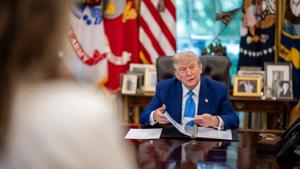
President Donald Trump says he will be expanding the war on drugs in Latin America, striking targets south of the border.
During an interview with Fox News’ Sean Hannity, Trump made the announcement, with plans to target Mexican drug cartels.
“We are going to start now hitting land, with regard to the cartels. The cartels are running Mexico,” the president told Hannity. “It’s very, very sad to watch and see what’s happened to that country, but the cartels are running and they’re killing 300,000 people in our country every single year.”
Trump touted his war on drugs, saying his administration has “knocked out 97% of the drugs coming in by water.”
The Trump administration has been busy carrying out over two dozen strikes on suspected narco-terrorists operating marine vessels in the Caribbean and eastern Pacific, leading up to last weekend’s massive air strikes on Venezuela and the capture of deposed Venezuelan President Nicolas Maduro.
Unlike Maduro, the president has been more lenient with Mexican President Claudia Sheinbaum, acknowledging that she is a good person, opting instead to criticize her leadership, claiming that Sheinbaum has been intimidated by the cartels.
Mexico has been accused of being a major passageway for the trafficking of the deadly drug fentanyl, among others.
Trump’s comments come on the heels of his threats to strike Colombia, only to appear to be backtracking after talking with Colombian President Gustavo Petro.
Following a call between the two leaders Wednesday evening, the pair appears to have had a productive conversation leading to a White House meeting in the “near future.”
“It was a Great Honor to speak with the President of Colombia, Gustavo Petro, who called to explain the situation of drugs and other disagreements that we have had,” the president posted to his Truth Social account. “I appreciated his call and tone.”
Prior to the call, tensions between the two leaders appeared high, with Trump threatening military action as of Sunday evening.
Onboard Air Force One during his return to Washington, the president was asked if the U.S. could target Colombia next on the heels of Saturday’s strike in Venezuela and the capture of Maduro.
Trump responded: “It sounds good to me.”
The president accused Petro of selling drugs to the U.S.
“Colombia is very sick, too, run by a sick man, who likes making cocaine and selling it to the United States, and he’s not going to be doing it very long,” Trump told reporters.
Petro appears to be trying to reassure the U.S. of his country’s commitment to fighting drug trafficking ahead of the proposed meeting.
“Dear U.S. Representative, Colombia has put 300,000 killed in the fight against drug trafficking, and in my government we have already seized 2,800 tons of cocaine and in the world’s seizure operations, Colombian intelligence has participated in 63% of them,” Petro posted to X on Thursday morning. “We have destroyed 13,000 cocaine laboratories in just three years. Remember it: my government is the one that has seized the most cocaine in the entire history of that substance in the world.”
Robots and AI dominate major trade show in Las Vegas
Make way for the robots.
Artificial intelligence is front and center at the famed Consumer Electronics Show, which took over Las Vegas this week at multiple venues. AI is part of the new technology that was unveiled across a variety of industries and put on display in front of tens of thousands of visitors from more than 150 countries.
The global event, which can act as a benchmark for the coming year’s tech, has indicated an even further lean into AI, with a focus on hardware and health products.
“This year the big trend that we’re seeing is AI moving from the cloud into hardware,” CES spokesperson Katie O’Grady told The Center Square on Thursday. “A big trend right now is robotics. We’re seeing a lot of humanoid robotics, a lot of manufacturing-focused robotics that are powered by AI.”
Robotics have been in the works for years. But proponents at CES 2026 are saying that the time is finally coming where AI and physical robots are beginning to work together. Several companies showed that off, from Boston Dynamics’ humanoid Atlas to LG’s laundry-folding CLOiD robot and one of O’Grady’s favorites – Roborock’s Saros Rover – a stair-climbing automated vacuum cleaner.
“It’s the time now to move from research and development toward the deployment and commercialization of these robots,” said Ignacio Contreras, vice president of marketing at semiconductor chip manufacturer company Qualcomm.
Contreras made those comments while humanoid models were operating on their chips on the stage at the trade show.
“Every single year we’re seeing it get a little bit more tangible,” said O’Grady. “Right now, AI sounds a little bit science fiction-y to folks who aren’t as enmeshed in the tech world, but it is starting to be in more and more of the products that we use every single day.”
“We used to say that every company is a tech company, and now it’s looking more and more like every company is an AI company in some capacity,” O’Grady noted. She added that AI is more present than ever at this year’s Consumer Electronics Show. “ There’s just no way around it.”
Of the many unique ideas emerging in the AI-related world is startup Mangoslab’s Nemonic Dot. The manufacturer says the speech-to-braille label printer allows blind people to easily label their own items, such as medicine or spices, by simply speaking and printing out a transcribed braille-dotted sheet.
The health industry, alongside robotics, was one of the main focuses of this year’s CES. Digital health, as CES called it, is a booming industry.
Wearable medical devices, such as Fitbits, are expected to grow from a roughly $100 billion industry today to $500 billion by 2034, according to Fortune Business Insights. But the changes to the health industry, O’Grady said, are not out of step.
“When you go to the doctor, half of what you interact with is a robot. You go in for an X-ray; there’s a robot in there,” said O’Grady. “Even checking in half the time there’s a robot involved. It’s digital everything.”
The health industry products at CES 2026 are a possible preview of this year’s consumer trends.
Withings’ Smart Scale, which tracks a variety of body measurements from weight to cardiovascular age, was one of the more focused-on products. Also on display was a number of updated wearable devices, including Oura’s latest generation of medical rings, which claimed to be able to more accurately track women’s periods and fertility.
“Having information about your health is incredibly important to being able to make decisions about your health, and seek treatment for your health” said O’Grady. “So I think with wearables and digital health in general, the trend is just more and more information about your body. And then the next step, I think, is using AI to create insights and figure out actions that you can take from that data.”
As has been expressed for products across much of the tech industry, concerns have been brought up over data usage and privacy for medical information gained from wearable tech. Oura was recently involved in its own privacy-related scandal with connections made by online users between the tech company and military contractor Palantir, which has been widely reported as an overblown and misconstrued concern.
Subjects such as AI drew many to this year’s CES. Organizers told The Center Square that they could not confirm attendance data until the end of the four-day event, but said they felt good about this year’s attendance following 2025’s 140,000 visitors.