Hochul to feds: Fork over $13.5B in tariff refunds

Gov. Kathy Hochul is demanding the Trump administration refund New York $13.5 billion in tariff payments following the U.S. Supreme Court’s ruling last week.
In a letter to Treasury Secretary Scott Bessent, called on the federal agency to “immediately formulate and implement a plan to refund all tariff proceeds” in response to the court’s ruling striking down most of President Donald Trump’s global tariffs as “unlawful” following a legal challenge from states and businesses.
“Having unlawfully seized billions of dollars from American people and businesses, the federal government should now do the right thing: give it back,” Hochul,a Democrat, said in a statement.
The average New York household was saddled with an average $1,751 in added costs — or $13.5 billion statewide — due to the president’s tariffs since they were enacted last year, Hochul wrote, citing estimates by Yale University’s Budget Lab.
New Yorkers have felt the consequences of the president’s tariffs “ripple through every sector of our economy,” Hochul wrote. Consumers “paid dramatically more for everyday goods” she said, while small businesses “faced increased supply and equipment costs.”
“Our state’s farming industry has taken a particular hit, with farmers reporting an added layer of uncertainty that makes planning and future investment challenging,” Hochul wrote.
Trump’s tariffs were challenged by a group of states, including New York and California, along with small business owners, who argued that the president exceeded his authority by imposing them.
In a 6-3 ruling the Supreme Court on Friday ruled that the International Emergency Economic Powers Act — a 1970s law that the Trump administration invoked — doesn’t authorize the president to impose sweeping, open-ended tariffs.
In the ruling, the court’s majority didn’t spell out a process for refunds but the decision that Trump’s approach was “illegal” has opened the door to claims from importers that lost more than $133 billion in duties collected from the tariffs.
On Tuesday, Federal Express sued the federal government, seeking a “full refund” of the money the shipping giant paid for tariffs, in the first of likey many such legal challenges to recoup lost revenue. Other large corporations and labor unions filed lawsuits against the Trump administration seeking refunds before the Supreme Court ruled that the tariffs are illegal.
New York has joined several other states, including California, in demanding a full refund for consumers and businesses who saw higher costs as a result of the tariffs.
“Millions of New Yorkers are owed a refund for the real and widespread consequences of President Trump’s reckless and illegal tariff policy,” Hochul wrote in her letter. “Compensation is owed to the people of New York, and New Yorkers look forward to receiving our payout in full.”
Paramount Skydance wins bidding war to buy Warner Bros.

Netflix, which offered an $83 billion bid for Warner Bros., announced Thursday it dropped out of the bidding war.
That clears the way for Paramount Skydance to buy Warner Bros., which would merge Paramount in Hollywood and Warner Bros. in Burbank for the first time. The iconic studios are about 8 miles from each other and have been around since the early 20th century. Warner Bros. is known for everything from Bugs Bunny and “Casablanca” to the Superman and Harry Potter movies, and Paramount has served as the home to the “Star Trek” and “Mission Impossible” franchises since the 1960s.
Warner Bros. Discovery’s board told Netflix earlier Thursday that Paramount Skydance’s $31-per-share offer was better than Netflix’s offer. At the time, Warner Bros. Discovery issued a statement saying it remained interested in its Warner Bros. assets being purchased by Netflix.
But Netflix, the world’s largest streaming service, responded it wouldn’t try to match Paramount’s bid.
“The transaction we negotiated would have created shareholder value with a clear path to regulatory approval,” Netflix Co-CEOs Ted Sarandos and Greg Peters said in a statement. “However, we’ve always been disciplined, and at the price required to match Paramount Skydance’s latest offer, the deal is no longer financially attractive, so we are declining to match the Paramount Skydance bid.”
Sarandos and Peters, whose company is headquartered in Los Gatos, Calif., said they believed Netflix would have been “strong stewards of Warner Bros.’ iconic brands, and that our deal would have strengthened the entertainment industry and preserved and created more production jobs in the U.S. But this transaction was always a ‘nice to have’ at the right price, not a ‘must have’ at any price.”
Netflix and Warner Bros. Discovery agreed to a sale in December. Netflix at the time said it would buy Warner Bros. for $72 billion, which was the equity value. Netflix put the total enterprise value at $82.7 billion. But the deal soon became uncertain when Paramount Skydance launched a hostile $108 billion bid.
At the time, Wayne Winegarden, an economist and senior business fellow with Pasadena-based Pacific Research Institute, noted a Netflix deal could be better for Warner Bros. and Paramount Skydance employees. He said redundancies at Paramount Skydance and Warner Bros. Discovery, which both operate major TV and movie studios, would be more likely. He told The Center Square that raises the risks of layoffs.
What’s certain is the historical magnitude of Thursday’s developments.
Warner Bros. was originally started by four brothers – Jack, Harry, Albert and Sam – who officially incorporated their business in 1923. Warner Bros. was the first studio to release a movie with sound with “The Jazz Singer” (1927).
Paramount’s history dates back to 1912 when Adolph Zukor, W.W. Hodkinson and Jesse L. Lasky started the company.
The studio’s milestones included its then parent company, Gulf+Western, buying neighboring Desilu Studios from Lucille Ball in 1967 for $17 million and getting the “Star Trek” and “Mission Impossible” franchises as a result. No one at the time knew those would ultimately become financial gold mines for Paramount.
Skydance Media merged with Paramount Global on Aug. 27, 2025, in an $8 billion transaction. The enterprise value of the merger was $28 billion.
13 state AGs win victory against ESG with Vanguard settlement

Marking a victory in the fight against Environmental, Social and Governance (ESG), over a dozen state attorneys general secured a settlement Thursday with asset manager Vanguard – the company agreeing it will end its ESG efforts and turn over ESG-related documents.
Chief executive officer of American Energy Institute Jason Isaac told The Center Square that the settlement “is a huge win in the fight to stop the ESG and net-zero schemes being pushed by Wall Street elites and the climate cartel.”
“These ESG and net-zero policies were never about protecting the environment; they’re about controlling markets and choking off affordable energy that Americans depend on,” Isaac said.
As a part of the settlement, Vanguard will “pay $30 million in fines, turn over all documents related to their coordinated ESG activism, and end all ESG activism for years to come,” Executive director of Consumers’ Research Will Hild said on X.
Hild told The Center Square that “the reckoning is here.”
The settlement “is a massive blow to the ESG asset manager cartel that sets the stage that more is to come,” Hild said.
“We have been sounding the alarm that asset managers BlackRock, State Street, and Vanguard have been colluding and deceiving investors by pushing scams like ESG investing onto consumers,” Hild said.
“Now, the Attorneys General are getting overdue accountability and a massive course correction from Vanguard,” Hild said.
Similarly, Jason Isaac told The Center Square: “For years, asset managers BlackRock, State Street, and Vanguard have used their influence to penalize fossil fuel producers, strangle investment in reliable energy, and reward companies that play along with their political agenda.”
“That’s collusion, not capitalism,” Isaac stated.
“The weaponization of finance to achieve ideological outcomes must end, and it’s encouraging to see states standing up for energy freedom and economic growth,” Isaac said. “The era of ESG coercion is ending, and free-market principles are winning again.”
The settlement with Vanguard has connections to a lawsuit 13 state attorneys general filed against asset managers BlackRock, State Street, and Vanguard in an effort to lower electricity prices, according to a press release from Iowa Attorney General Brenna Bird.
Attorneys general from Texas, Iowa, Alabama, Arkansas, Indiana, Kansas, Louisiana, Missouri, Montana, Nebraska, Oklahoma, West Virginia, and Wyoming intended to combat “a BlackRock-led cartel that drove up the price of electricity under the guise of ‘green energy’ investing,” with the lawsuit, the release said.
Iowa Attorney General Brenna Bird told The Center Square “Iowans should not have to pay higher prices for energy because of a woke Wall Street agenda.”
“I’m grateful that Vanguard has chosen to set higher standards for the industry and has agreed to resolve this case,” Bird said.
“We’ll set our sights on BlackRock and State Street now and continue to fight for truly competitive markets to help Iowans and all Americans,” Bird said.
Similarly, Hild told The Center Square that “BlackRock CEO Larry Fink should be extremely worried about what could be uncovered next.”
When reached, Vanguard told The Center Square: “We remain dedicated to our core mission of standing up for investors and giving them the best chance for investment success.”
“Our agreement to resolve this matter recognizes our innovative Investor Choice program as a tool for empowering investors and bringing new voices into the proxy voting ecosystem,” Vanguard said.
Chief executive officer of State Financial Officers Foundation OJ Oleka told The Center Square: “This news is about justice, and should serve as a warning to any firm that conspires to sacrifice the savings, livelihoods, and retirements of hardworking Americans at the altar of a selfish woke trend.”
“As staunch defenders of fiduciary duty against faddish ideological movements that corrupt investments and impoverish Americans, we’re thrilled to see ESG suffer this latest blow,” Oleka said.
“This is not an abstract issue,” Oleka said. “Vanguard not only put radical climate politics before its duty to maximize financial returns – it caused real families to face real hardship with higher energy bills and diminished financial security.”
Seattle begins installing anti-federal immigration enforcement signage

One of the first of an expected 656 signs stating that city property in Seattle cannot be used by federal authorities for civil immigration enforcement efforts has been posted at Jefferson Park in the Beacon Hill neighborhood.
The signs are part of Mayor Katie Wilson’s Jan. 29 executive order to prevent the Trump administration from using city property as part of its campaign to detain and deport illegal immigrants.
Wilson said in the executive order that “appropriate preparation is critical given the unpredictable, chaotic, and violent behavior of the federal government,” a reference to immigration enforcement actions in Minneapolis and other U.S. communities that have led to the death of protesters and clashes with federal immigration agents.
A U.S. Department of Justice spokesperson in a statement to The Center Square Thursday said the department “will not tolerate the obstruction of lawful efforts to enforce federal immigration law and has sued several jurisdictions over sanctuary policies that put the American people at risk.”
The statement went on to say, “The department will continue to bring litigation against willful offenders and work overtime to ensure those harmful policies are eradicated across the county.”
The sign at Jefferson Park reads, “This property is owned and controlled by the city of Seattle.
“It shall not be used for civil immigration enforcement staging, operations, or processing.”
Other signs will be more prominently displayed.
The city plans to install 25 signs outside Seattle City Hall and the Seattle Municipal Tower and other city municipal buildings and 20 signs on the Seattle Center campus, home to some of the city’s most iconic attractions, according to a Tuesday memo from city council staff analyst Greg Doss.
It’s unclear whether signs would be posted outside the Space Needle, because it is under a private lease, or the Climate Pledge Arena, but much of the 74-acre Seattle Center campus is directly controlled by the city.
Another 60 signs are planned for power substations operated by the city-owned power company, Seattle City Light, and for the Ballard Sculpture Garden, which is owned by the power company.
The biggest share of signs, 470, will be posted at parks, community centers, swimming pools and boating ramps, the Doss memo details.
Multiple city parking garages, according to the memo, will also get signs.
The memo said the city will spend $45,000 manufacturing the signs and that city departments will be expected to absorb the cost of producing the signs from their existing budgets.
It did not estimate the cost to install the signs, or how long it will take to install all of the signs.
Andrew Arthur, a fellow at the conservative-leaning Center for Immigration Studies, said he expects the Justice Department to sue Seattle over its anti-ICE policies.
The former immigration judge called Wilson’s order “political pandering” to left-leaning Seattle residents that would not stand up in court.
He maintained that the U.S. Constitution’s 10th Amendment establishes that federal laws and treaties take precedence over conflicting state or local laws.
Arthur said the city is also spending dollars on the signs that could be used for other city services.
“It’s a complete waste of city money,” he said.
Arthur said the city will also have to spend more money defending “their losing position,” assuming the Justice Department files a lawsuit.
Wilson’s office did not respond to requests for comment from The Center Square.
However, in her executive order, Wilson states that the 10th Amendment prohibits the federal government from commandeering the city’s property and resources.
In addition to the Wilson executive order, the Seattle City Council’s Public Safety Committee is expected to recommend to the full City Council in late March that it pass an ordinance codifying Wilson’s executive order into city law.
The committee’s chairman, Bob Kettle, said after a committee meeting on Monday that placing the signs on city property is the right thing to do to show immigrants that the city supports them.
“We have a whole lot of refugees coming here from places where it was not safe to turn to local government,” he said. “So, they have little faith.”
In a statement to The Center Square, City Attorney Erika Evans said that Seattle leaders will act with urgency and courage to protect residents.
“As such, my office will fight vigorously to enforce this legislation if it is enacted, including by seeking relief in the courts for any potential violations of the ordinance,” she said.
Both Wilson’s executive order and the proposed ordinance exclude preventing ICE action when immigration agents have the authority to obtain a judicial warrant.
Seattle is one of several cities that have placed signs on city property prohibiting ICE enforcement and staging action.
Chicago and Providence have passed similar executive orders on signage.
On Monday, the Justice Department filed a lawsuit against New Jersey and its Gov. Mikie Sherrill over a recent executive order banning ICE from state property without a judicial warrant.
Hillary Clinton slams ‘repetitive’ Epstein questions, denies Bill’s involvement
Former Secretary of State Hillary Clinton said she “never had any connection or communication” with convicted sex offender Jeffrey Epstein.
The U.S. House Oversight Committee deposed Clinton in New York on Thursday over her ties to Epstein. She said Ghislaine Maxwell, Epstein’s former associate who is serving a prison sentence for conspiring with Epstein to sexually abuse minors, was a casual acquaintance.
Before the deposition, Rep. James Comer, R-Ky., said he would question Clinton on why Maxwell came to her daughter’s wedding. Clinton said Maxwell came to the wedding as a guest of someone else who was invited. She did not specify with whom Maxwell attended the wedding.
Clinton lamented that the committee did not hold a public hearing in its Epstein investigation. Clinton also complained about a photo Rep. Lauren Boebert, R-Co., took of her during the hearing which was posted online by conservative social media influencer Benny Johnson. The hearing was paused briefly due to the photo being posted.
“We had to pause the hearing for a period of time until we could get assurances that no rules would be broken going forward,” Clinton said.
The hearing was recorded and a recording is expected to be released within the next 24 hours.
Clinton said she was asked the same questions about her ties to Epstein repetitively. She said lawmakers also asked her about unidentified flying objects and a conspiracy theory from the 2016 presidential election.
“I don’t know how many times I had to say ‘I don’t know Jeffrey Epstein, I never went to his island, I never went to his homes,'” Clinton said.
She also said her husband, former President Bill Clinton, ended his relationship with Epstein before Epstein’s sexual abuse charges emerged in 2008.
“I think it is fair to say that the vast majority of people who had contact with him before his criminal pleas in [2008] were like most people,” Clinton said. “They did not know what he was doing, and I think that that is exactly what my husband will testify to tomorrow.”
Comer called the deposition “productive,” and said he came to the conclusion that most answers to his questions would come from Bill Clinton. Comer said Hillary referenced her husband for answers on the ties between Epstein and the couple’s charitable foundations more than a dozen times.
Comer rebutted the idea that he would subpoena President Donald Trump in the oversight committee’s investigation. Rep. Anna Paulina Luna, R-Fla., said the oversight committee asked victims about Trump’s involvement with Epstein and they exonerated him.
“Why would we bring in the President of the United States who’s been exonerated, who cooperated with law enforcement and who released the [Epstein] files,” Paulina Luna said.
Clinton said she appreciated Comer’s line of questioning toward the end of the deposition where he asked her for suggestions in investigation.
“I want to see the truth come out,” Clinton said. “That was a reassuring way to end a very long, repetitive deposition.”
Bill Clinton is expected to testify before the oversight committee on Friday.
WATCH: California Assembly passes resolution seeking federal wildfire relief
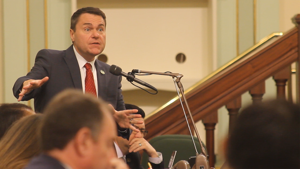
Following a sometimes fiery debate, the California Assembly passed a resolution Thursday that asks the federal government to fund more wildfire relief in Los Angeles County.
Assembly Joint Resolution 27 asks President Donald Trump to appeal to Congress to provide disaster aid. It also asks Congress to grant that monetary assistance to the county regardless of whether the president makes the request. The resolution now goes to the Senate for consideration, but will not require Gov. Gavin Newsom’s signature.
“This is something that every president in the history of this country has done – provide federal aid for disaster victims,” said Assemblymember John Harabedian, D-Pasadena, and co-author of the resolution.
“This is something that should have happened a long time ago, and every Californian congressional representative, Democratic and Republican, has called on this for months,” Harabedian said on the Assembly floor in Sacramento. “If the president isn’t willing to do it, Congress must step up and provide Los Angeles with its money right away.”
The Palisades and Eaton fires, which killed a total of 31 people in Los Angeles County, burned a total of 37,728 acres, according to the California Department of Forestry and Fire Prevention.
The Palisades fire alone burned 6,833 structures and is the ninth deadliest wildfire in California’s history, the department said. The Eaton fire was the fifth deadliest in the state’s history, according to CalFire.
Thursday’s resolution didn’t stipulate how much money California lawmakers want the federal government to allocate for Los Angeles County.
But Republican lawmakers who pushed back on the Assembly floor said the federal government has already transferred $6 billion to wildfire response and recovery, in addition to state efforts to aid Southern California communities affected by the fires.
“Gavin Newsom put in an invoice for $40 billion,” Assemblymember Carl DeMaio, R-San Diego, said during the Assembly floor debate on the resolution. “You know why? Because he’s spending money like a drunken sailor and so are you. You’re using their tragedy to ask for money because you can’t control your spending habits.”
DeMaio added that only 28 of 15,000 homes had been rebuilt in Los Angeles County and that the state’s lawmakers should act faster to approve rebuilding permits, among other actions to help constituents in their districts.
“I think we need a federal investigation and audit,” DeMaio said during his passionate talk.
The resolution follows a slew of bills introduced this year that aim to help Los Angeles County wildfire victims who lost their homes in the January 2025 fires. Those bills aim to keep predatory land speculators from making offers for lots where burned-down homes once stood for well under market value or compel insurance companies to pay the full monetary value of a lost home, according to previous reporting by The Center Square.
“The initial federal support provided by President Biden provided only a fraction of what was needed for our impacted communities,” Assemblymember Jacqui Irwin, D-Thousand Oaks and co-author of the resolution, said on the Assembly floor. “We need to restore the lives of 1982,000 displaced residents. It is time for our federal government to step up and provide relief for California without delay.”
Democrats introduce bill to restore IRS Direct File program

A group of U.S. lawmakers introduced legislation Thursday to codify the IRS Direct File program, which the Trump administration shut down in 2025.
The Direct File Act, supported by 150 Democrats across the House and Senate, would reinstate the shuttered service, which gave taxpayers the option to electronically file their federal tax returns directly with the IRS at no cost.
“Americans shouldn’t have to waste valuable time or hard-earned money just to file their taxes,” Rep. Brad Sherman, D-Calif., a supporter of the bill, said. “The Direct File Act expands on the successful 2024 pilot and offers a straightforward, no-cost filing option that will make the process simpler and more affordable for working families.”
According to the U.S. Treasury department, nonbusiness taxpayers spend an estimated average of about 8 hours and $160 on filing tax returns, while business taxpayers spend an average of 21 hours and $610.
A report authored by the Economic Security Project estimated that individual taxpayers could save up to $23 billion annually if the Direct File program were fully implemented.
But while it operated, the program cost taxpayers overall much more than the IRS’s original cost projections, one of the reasons the Treasury cited as a reason for the program’s suspension.
The IRS had estimated the federal government would spend about $9 to $16 dollars per return filed through Direct File. The actual cost amounted to roughly $138 per return in tax year 2024, even though less than 1% of taxpayers used the program.
“Direct File had low overall participation and relatively high costs and burdens on the federal government, compared to other free filing options,” the department reported. “For tax year 2024, returns submitted using Direct File constituted less than 0.5 percent of the approximately 146 million returns filed. Direct File had a cost to the federal budget of at least $41 million for tax year 2024 returns, or a cost of at least $138 per return accepted through Direct File.”
The report also noted that the topline number likely “understates the true costs of developing, administering, and supporting Direct File for tax year 2024,” and that the “complexity and technical demands also diverted IRS resources from other core priorities.”
Democrats’ Direct File Act would not only reinstate the Direct File Program but also implement other changes, including effectively prohibiting the IRS from restricting free online tax preparation services in the future.
The bill is unlikely to pass either chamber of Congress due to Republican opposition to the program.
Lawmakers postpone Cook County property tax debt sale to continue working on reforms
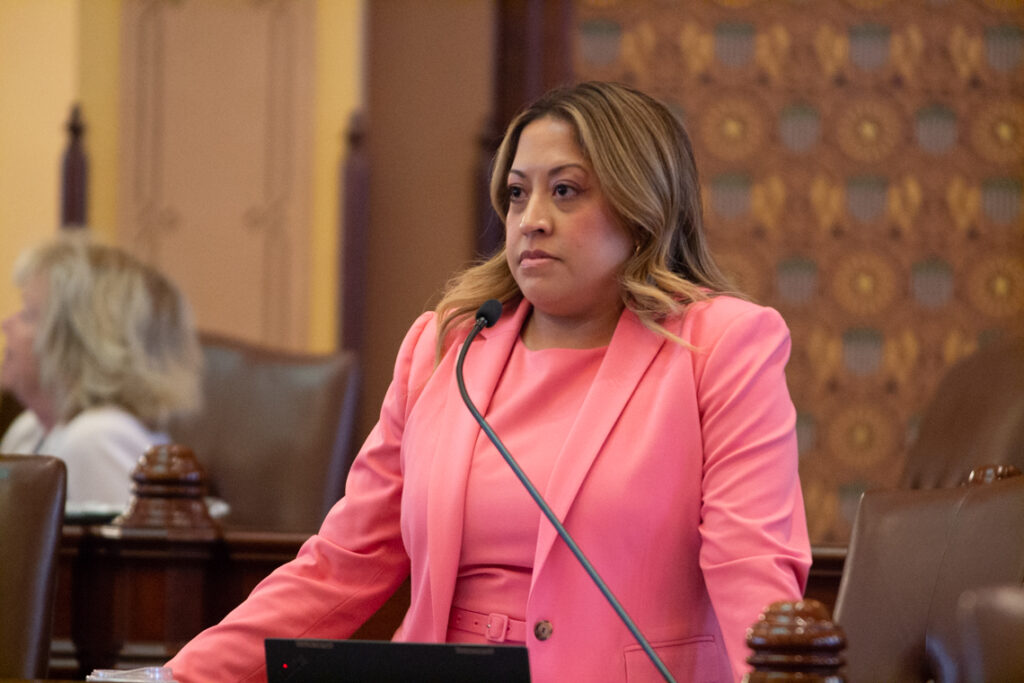
Lawmakers said they need more time to reform current state law, as litigation against county treasurers builds.
Read MoreExperts weigh in on regional efforts to limit federal immigration enforcement

King County and Seattle have recently taken steps to hamper any possible federal Immigration and Customs Enforcement activities in their jurisdictions, specifically to limit enforcement on local property and to prevent the expansion of detention facilities.
King County and Seattle were placed on a 2025 list of 500 “sanctuary jurisdictions” by the federal government for obstructing immigration enforcement.
Earlier this month, King County Executive Director Girmay Zahilay signed an executive order prohibiting federal immigration authorities from accessing non-public, county-owned or controlled spaces. The executive order also allocates $2 million to bolster protections for immigrant and refugee communities.
Late last month, Seattle Mayor Katie Wilson announced a series of initial steps to prepare the city for a potential surge in federal immigration enforcement, including directing the police department to verify the identification of federal agents and document reports of immigration enforcement activity, prohibiting federal immigration officials from using city-owned or controlled property for enforcement activities and allocating $4 million to local immigrant support organizations.
The Seattle City Council is currently considering a measure that would prohibit new detention centers within its city limits, a direct response to potential Department of Homeland Security efforts to increase ICE facilities in the region.
These actions come on the heels of the high-profile fatal shootings of civilians Renée Good and Alex Pretti by federal agents last month during immigration enforcement efforts in Minneapolis.
A July 2025 federal law – the One Big Beautiful Bill Act – that authorized more than $170 billion in new funding for immigration enforcement also prompted preparation for possible heightened ICE activity in Washington state.
The Center Square reached out to a pair of experts – immigration attorney Hector Quiroga and Jessica Vaughan with the Center for Immigration Studies – for their thoughts on regional preparations for a potential surge in federal immigration enforcement efforts.
“The actions taken by both the Seattle City Council and King County reflect a sanctuary policy approach,” explained Quiroga, CEO of the Spokane Valley-based Quiroga Law Office, which has multiple branch locations in Washington, including offices in Kennewick, Wenatchee, Vancouver and Tacoma. “They are designed to protect immigrant communities by limiting local collaboration with federal immigration agencies, except when there is a valid judicial order. Legally, these jurisdictions have certain backing under the Immigration and Nationality Act, which establishes that cooperation with ICE is voluntary, except in specific cases. Additionally, these measures are consistent with legal precedents that recognize local authority to decide how to use their own resources and handle personal data.”
Vaughan, director of policy studies at the Washington, D.C.-based CIS, was less sanguine about the actions taken by King County and Seattle.
“These new policies are puzzling and reckless,” she said. “There is no rational justification for obstructing immigration enforcement against illegal aliens who have committed other crimes, and there is no rational justification for preventing law enforcement agencies from sharing information that is related to a legitimate and important enforcement purpose.”
Federal law authorizes ICE to remove individuals, including those who have committed violent crimes, so sanctuary jurisdictions cannot legally prevent that from happening. Sanctuary policies can significantly hinder the removal process by limiting cooperation between local law enforcement and federal authorities.
“From a legal and rights-protection perspective, yes, these policies are appropriate,” Quiroga said. “Limiting cooperation in civil cases and allocating resources to organizations that support immigrants helps strengthen community trust. What I do not agree with is the perception that these measures automatically put public safety at risk; the law allows exceptions for individuals accused or convicted of serious crimes, and these jurisdictions are aware of and apply those exceptions.”
Vaughan questioned that notion.
“It is safer for everyone for ICE to arrest deportable criminal aliens in the secure environment of the jails, but these rules prohibit ICE from entering the jails,” she said. “They will prohibit local police from informing ICE when a wanted deportable criminal alien is being released from a jail. Why would the local political leaders want to shield criminal aliens from enforcement and give them the opportunity to continue preying on people in the community?”
The perception that local jurisdictions are letting violent illegal immigrants escape justice is not accurate, according to Quiroga.
“Washington jurisdictions are not refusing to comply with detainer orders issued by federal judges or in cases of serious crimes,” he said. “Local policies focus on voluntary cooperation in civil, not criminal, cases. Therefore, not automatically turning over every detainee does not necessarily create a public safety risk, as long as protocols for individuals with serious or violent criminal records are followed.
“In practice, these measures prioritize protecting the general immigrant community from arbitrary detentions, those who do not pose a risk and could only be detained because of their immigration status, while maintaining exceptions for cases that do present a risk.”
Vaughan criticized Wilson’s directing the SPD to verify the identity of federal agents and document their activities when operating within the city.
“It is amusing, but absurd, that the politicians want to force local police to verify the identity of ICE officers, but apparently not criminal aliens,” she said. “This is beyond virtue-signaling; it is deliberate obstruction of an important activity that protects the public and preserves the integrity of our legal immigration system. There will be consequences for these jurisdictions, but sadly, not for the politicians who are toying with people’s safety.”
Lawmakers take step to incentivize Bears to stay in Illinois
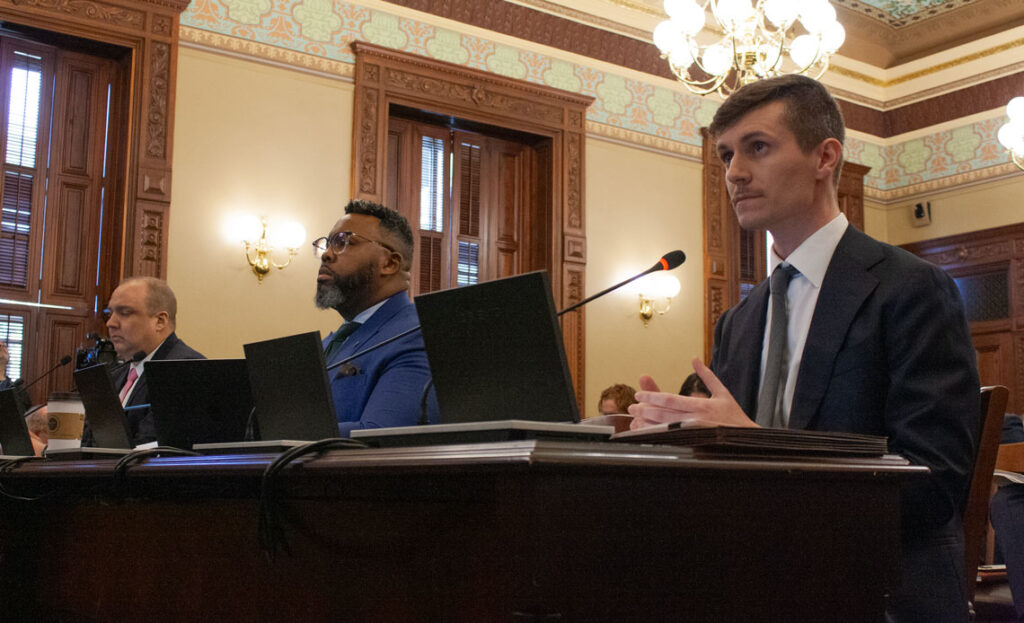
The House adjourned for the next two weeks without taking a vote on a bill that could keep the Bears in Illinois.
Read More