Colorado Legislature advances ‘no tax on overtime’ bill

The Colorado Senate State, Veterans and Military Affairs Committee narrowly approved a bill that would remove overtime “add-back” taxes in response to federal overtime tax changes.
The overtime tax change would reduce state revenue by roughly $235 million, but dip into state tax credits to cover the funding gap. The committee approval vote moves the bill onto the Senate Appropriations Committee.
“ ‘No tax on overtime’ might be a catchy slogan that creates an appeal, but the actual benefits are much less than might seem on first glance,” Joshua Mantell, director of government relations for Colorado’s Bell Policy Center for progressive economic policy, told the committee Thursday.
The Colorado bill, Senate Bill 26-056, comes shortly after the Trump administration’s 2025 One Big Beautiful Bill Act included a measure to limit taxes on qualified overtime work. The federal deduction is effective between the 2025 through 2028 tax years, and the proposed Colorado state-level deduction would start in the 2026 fiscal year and run until the federal 2028 deadline.
Chris Stiffler, senior economist at the Colorado Fiscal Institute, argued the tax deduction would not benefit the state’s lowest earners who already pay little to no state income tax. He added that the tax deduction would benefit 9% of taxpayers, cutting an average of $63 per person – but with nearly half of eligible recipients in the top one-fifth of earners.
“Most Coloradans living paycheck to paycheck will see no benefit at all,” said Stiffler. “Many low wage workers do not receive overtime because they piece together two part-time jobs, work in gig arrangements, or have caregiving responsibilities that limit their hours.”
But many others supported the tax deduction. Colorado Legislative Director Carl Smith of the Smart Transportation Division, a major railroad labor union, said the change would provide relief to his overworked union members.
“A large part of railroad workers’ income comes from overtime,” said Smith. “Many of the people I represent work 12-hour shifts, five days a week – making overtime a significant part of their income. As essential workers, overtime on the railroad is mandatory. Railroad workers don’t get an option to decline overtime.”
Opinions among the five-person committee were mixed and largely fell along party lines. The vote in favor of the bill was 3-2 with Republican Sens. Rod Pelton and Sen. Lynda Zamora Wilson joined by Democratic Sen. William Lindstedt, who said he cautiously supported the measure, but wanted the Appropriations Committee to give it a look. Democrats hold a majority in both houses of the Colorado Legislature.
“We have a workforce problem in this state, and more and more people are having to do overtime just because there’s not enough people, enough employees to fill some of these spots,” Pelton said in support of the bill. “I don’t think we should over-penalize the people that are staying in there, doing the job and keeping the businesses open.”
Committee Chair Sen. Katie Wallace, a Democrat, said she wanted to provide relief to working Coloradans, but thought there were better methods. She cited budgetary risks that would come from dipping into state tax credits amidst economic uncertainty, arguing the tax deduction would become a liability to the state’s most financially vulnerable.
“If we’re below the cap, this legislation will be a further hit to the general fund in an already terrible budget year, pulling even further funds away from Medicaid, SNAP and other programs that directly assist those families who need it most,” said Wallace. She added later, “I think that now is the time for a targeted approach to our tax systems that benefit those who need it the most first.”
Republicans double down on changing filibuster after Thune rules it out

Senate Majority Leader John Thune, R-S.D., has thrown cold water on the possibility of tweaking filibuster rules to ensure passage of a key Republican election reform bill.
Nevertheless, some Republicans are still calling on Thune to reinstate the “talking filibuster,” where senators who oppose a piece of legislation must hold the floor and speak.
The House-passed SAVE Act – which among other things would mandate that all states require photo ID and verify the citizenship status of potential voters – has virtually no chance of garnering the 60 votes needed for it to pass the upper chamber.
Senate Democrats appear universally opposed to the bill, claiming that requiring people to present proof of citizenship, in person, when registering to vote for federal elections will discourage or prevent certain groups of Americans from voting.
Many Republicans, therefore, want to return to the historical method of filibustering, which would allow them to pass the SAVE Act via majority vote once filibustering senators have ceded the floor.
Following Thune’s comments on the issue Wednesday, Sen. Mike Lee, R-Utah, argued that Republicans “can’t afford the consequences of inaction” while Sen. Rick Scott, R-Fla., urged lawmakers to “keep up the pressure.” Sen. Tommy Tuberville, R-Ala., followed up on Thursday as well, asking Thune to do “[w]hatever it takes” to get the bill across the finish line.
The majority leader, however, appears unmoved. Thune had explained to reporters that a talking filibuster could turn into a weeks-long process, and with a partial government shutdown still ongoing, lawmakers do not have the time.
“Once we get on, if we were going to go down that path, it’s very hard to pivot and get back to open up the government,” Thune said. [Reopening the government] is harder to do when you’re in the throes of a talking filibuster.”
Even if Republicans are able to reach a deal with Democrats to reopen DHS and end the shutdown, Thune added, “the talking filibuster issue is one which there is not, certainly, a unified Republican conference, and there would have to be.”
“If you go down that path, you’re talking about the need to table what are going to be numerous amendments, and an ability to keep 50 Republicans unified pretty much on every single vote,” he said. “And there isn’t support for doing that at this point.”
Thune promised a vote on the SAVE Act but said the process by which lawmakers take it up is “an open question,” and that the bill being subject to the 60-vote threshold is “a very real possibility.”
LA school board to discuss superintendent after FBI search

The Los Angeles Unified School District Board of Education will meet late Thursday afternoon to discuss Superintendent Alberto Carvalho, whose home was searched by FBI agents carrying boxes from it.
Listed on the closed session’s agenda are the words “public employment” and “general superintendent of schools.”
After the closed session, the Board of Education says it will begin an open session where it will “report on any actions taken.” The meeting is scheduled to start at 4 p.m. PST.
The reason for Wednesday’s search at Carvalho’s office and his home in San Pedro, a Los Angeles coastal neighborhood, has not officially been revealed by the federal government. Carvalho has not commented on it.
News reports say it may be connected to possible kickbacks when Carvalho was superintendent of Miami-Dade County schools. Other news reports claim the search is tied to an artificial intelligence company known as AllHere. LAUSD hired AllHere in 2024, but the project never happened. According to media reports, the project was the development of a $6 million AI chatbot.
AllHere filed for bankruptcy in 2024.
The U.S. Attorney’s Office, as well as the FBI’s Los Angeles Office, are tight-lipped on Wednesday’s search. Both offices told The Center Square on Wednesday that the search warrant affidavit is under seal and they could not comment. That remained the case Thursday when The Center Square reached out to confirm information in news reports.
“Since the search warrant affidavit is under seal, we can neither confirm nor deny that information,” the U.S. Attorney’s Office told The Center Square.
The LAUSD did not respond Thursday to The Center Square’s request for comment. However, an LAUSD spokesperson told The Center Square on Wednesday that the district is cooperating with the investigation.
“We do not have further information at this time,” added the LAUSD spokesperson.
With more than 500,000 students covering 710 square miles, LAUSD is the nation’s second-largest school district.
Carvalho has served as LAUSD’s superintendent since February 2022. The superintendent led Miami-Dade Public Schools for 14 years.
One of Carvalho’s most recent appearances before the Los Angeles Unified Board of Education was on Feb. 17, when he discussed layoffs.
Hillary Clinton ‘did not recall’ meeting Epstein, calls for Trump subpoena

Former Secretary of State Hillary Clinton said she “did not recall ever meeting” convicted sex offender Jeffrey Epstein in the U.S. House Oversight Committee’s deposition on Thursday.
The committee called former Secretary of State Hillary Clinton and former President Bill Clinton to testify separately in New York over their connection to Epstein and his associate, Ghislaine Maxwell.
“I had no idea about their criminal activities. I do not recall ever encountering Mr. Epstein” Hillary Clinton wrote in her opening statement, which she shared on social media. “I never flew on his plane or visited his island, homes or offices.”
In a news conference before Hillary Clinton’s deposition began, Republicans on the committee appeared skeptical of her claims denying knowledge of criminal activities. Rep. James Comer, R-Ky., said Ghislaine Maxwell was invited to the wedding of Bill and Hillary Clinton’s daughter Chelsea.
“We’re not accusing Hillary Clinton of any wrongdoing,” Comer said.
Comer also mentioned emails from Jeffrey Epstein released by the U.S. Department of Justice where the convicted sex offender touted donations to charities operated by the Clintons.
Also in the files, Commerce Secretary Howard Lutnick invited Epstein to a 2015 fundraising event for Hillary Clinton’s presidential campaign, years after Epstein was convicted on charges of prostitution with a minor.
It is unclear if Epstein ever attended the event. Other documents in the DOJ’s release suggest Lutnick had a long spanning relationship with Epstein. Rep. Nancy Mace, R-S.C. said she would question Hillary over Lutnick’s involvement with Epstein.
Lutnick was Epstein’s neighbor in New York City. Comer said it was “very possible” Lutnick would be called to testify on his association with Epstein before the committee.
Before the deposition, House Democrats said they had “no evidence” Hillary Clinton had any interactions with Epstein.
Rep. Robert Garcia, D-Calif., urged colleagues on the oversight committee to subpoena President Trump over his ties to Epstein as well
“Let’s get President Trump in front of our committee to answer the questions that are being asked across this country from survivors and from those who have been brutally attacked and raped sometimes as children,” Garcia said.
During the deposition, Senate Minority Leader Chuck Schumer, D-N.Y., held a news conference and pointed to reports of a woman who alleged Trump sexually assaulted her when she was a minor. The reports said those documents were not included in the Justice Department’s release.
Schumer said several Senate Democrats will review unredacted Epstein files “in the coming days.”
“Pam Bondi and Kash Patel have mismanaged these records during their tenure in office,” Sen. Dick Durbin, D-Ill., said.
In her opening statement, Clinton criticized the Trump administration and the House Oversight Committee for its investigation into Jeffrey Epstein’s criminal conduct. She pointed to the new reports of sexual assault allegations against President and called on him to be subpoenaed.
“A committee run by elected officials with a commitment to transparency would ensure the full release of all the files,” Clinton wrote. “Instead, you have compelled me to testify, fully aware that I have no knowledge that would assist your investigation, in order to distract attention from President Trump’s actions and cover them up despite legitimate calls for action.”
“If this committee is serious about learning the truth about Epstein’s trafficking crimes, it would not rely on press gaggles to get answers from our current president on his involvement; it would ask him directly under oath about tens of thousands of times he showed up in the Epstein files.”
Former President Bill Clinton is expected to testify on Friday.
Arizona House to consider bill on arrests of illegal immigrants

Editor’s note: This story has been updated since its original publication.
A new Arizona bill would require state and local police to notify federal law enforcement once an illegal immigrant is arrested.
Senate Bill 1055 is heading to the state House for consideration after the Senate passed it Tuesday by a vote of 16 to 11. The Republican majority backed the bill. No Democrats voted for it.
SB 1055 would also prevent state and local officials from limiting federal immigration law enforcement to “less than the full extent allowed by federal law.”
The bill allows an Arizona resident to bring legal action against a state or local jurisdiction that is hindering federal immigration law enforcement.
If a judge finds that a jurisdiction violates SB 1055, the court can impose a penalty of $500 to $5,000 per day until the violation ceases.
Also, the fine can be for the number of days the policy remains effective after a person files a lawsuit.
Sen. Wendy Rogers, R-Flagstaff, the sponsor of SB 1055, said the legislation “strengthens cooperation with federal authorities, gives law enforcement the tools they need, and ensures Arizona is not a sanctuary for cartel activity, fentanyl trafficking or human smuggling.”
“Border security is not a partisan issue,” she said, answering The Center Square’s questions by email. “It’s a public safety responsibility, and this bill reflects that.”
In Arizona, nine law enforcement agencies participate in the federal 287(g) program, which allows local law enforcement to carry out specific immigration enforcement duties.
According to Rogers, SB 1055 will strengthen “existing partnerships.”
“This is about coordination, transparency and clarity – not extra work,” Rogers said.
Under President Donald Trump, the number of illegal immigrants coming into Arizona have fallen dramatically from the number during former President Joe Biden’s tenure.
In fiscal year 2024, Arizona experienced 564,495 illegal immigrant encounters. Compared to fiscal year 2025, the state saw 66,452 illegal immigrant encounters. This represents an 88% decrease in encounters.
But Rogers expects Hobbs will likely oppose SB 1055 if it reaches her desk. Republicans hold majorities in both Arizona houses, but lack enough seats to override the Democratic governor’s vetoes. In that case, the Republicans would need some Democratic votes to reach the two-thirds threshold. But as mentioned previously, no Democrats voted for SB 1055 in the Senate.
“The real question shouldn’t be whether the Arizona legislature can override a veto or pursue a ballot referendum,” Rogers said, answering The Center Square’s question Thursday about procedures by email. “The question deserving an answer is this: WHY would the governor consider vetoing a bill that directly protects Arizona families from fentanyl, sex trafficking, drug trafficking, and dangerous criminals residing illegally in our state? THAT is the conversation Arizonans deserve; not a debate over procedural mechanics, but why commonsense public safety protections would be opposed at all.”
“Border security should never be held hostage to political ideology,” Rogers told The Center Square earlier this week. “The people of Arizona expect leadership, not obstruction. If the governor won’t partner with federal authorities to protect our communities, the legislature will.”
In addition to SB 1055, the state Senate passed two Rogers-sponsored bills aimed at increasing immigration enforcement.
SB 1520 mandates Arizona state agencies share immigration-related information when requested by the federal government.
SB 1421 prevents certain Arizona financial institutions from accepting specific forms of identification issued to illegal immigrants. Also, the bill says a person must confirm their lawful status before making certain foreign money transfers.
The Center Square reached out this week to the U.S. Department of Homeland Security for comment, but did not get a response as of press time.
Trump administration could set expectations for tariff refunds Friday
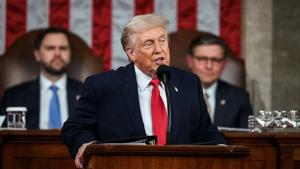
A federal appeals court ordered the Trump administration to respond by Friday to a request for tariff refunds, initiating what could be a long fight over billions collected from tariffs.
Judges from the United States Court of Appeals for the Federal Circuit ordered the administration to formally respond to a request from small businesses that challenged Trump’s tariffs under the 1977 International Emergency Economic Powers Act.
The order comes after the Supreme Court ruled that the International Emergency Economic Powers Act didn’t give Trump expansive tariff powers. The high court said Congress alone has the power to impose tariffs.
Attorneys for the Liberty Justice Center, the Texas-based nonprofit law firm that brought the tariff case, said small businesses have suffered under the weight of the highest tariffs in nearly a century.
“Plaintiffs are small businesses that have been paying the exceedingly burdensome tariffs for almost a full year, and who have suffered the dire financial consequences of those tariff payments,” the attorneys wrote in a separate motion before the Court of International Trade.
The attorneys asked for a permanent injunction to block tariff collection under IEEPA and sought refunds with interest.
Last Friday, Trump criticized the high court for its silence on the issue of refunds and said, “I guess it has to get litigated for the next two years.”
Businesses want to avoid prolonged litigation.
“Swift refunds of the impermissible tariffs will be meaningful for the more than 200,000 small business importers in this country and will help support stronger economic growth this year,” said Neil Bradley, executive vice president and chief policy officer at the U.S. Chamber of Commerce.
Recent research shows Americans paid the cost of Trump’s tariffs.
“U.S. firms and consumers continue to bear the bulk of the economic burden of the high tariffs imposed in 2025,” according to a report from the Federal Reserve Bank of New York.
Other studies have reported similar findings. The Kiel Institute for the World Economy found that Americans are paying almost the entire cost of tariffs. A December 2025 study from Duke’s Department of Economics found that during the 2019–21 trade dispute, consumers ultimately paid more than the tariff cost on European wines.
Walz proposes new gun restrictions in wake of Annunciation school attack

Nearly six months since the Annunciation Catholic School shooting, Minnesota Gov. Tim Walz has proposed a sweeping “ban” on different firearms and firearm accessories.
The package includes more than a dozen new restrictions.
“Too many times, we have seen gun violence inflict immense heartbreak and loss in Minnesota, Walz said recently. “It’s time for us to come together to take real, actionable steps toward common sense gun laws.”
Two students died during the attack, which happened during the school’s mass on the morning of Aug. 27. Another 30 in attendance were injured. The 23-year-old shooter formerly attended the church and school.
Lydia Kaiser, an eighth-grader who was shot in the head during the attack, spoke along with Walz in favor of the proposed restrictions.
“Two students were shot and killed, two students survived gunshot injuries to the head. I am one of them,” Kaiser said . “All children have the right to live free from gun violence in schools, churches and in our communities. Elected officials have a duty to protect us from guns. No one should have to go through what we went through at Annunciation.”
In response to that, Walz called for accountability.
“It’s time for our legislators to take a lesson in courage from eighth-graders like Lydia and stand up to the gun lobby,” he said.
This package has been anticipated from Minnesota Democrats since the shooting. While there is still some lack of clarity around what specifics will be included in the bills, Walz’s office did release some information on the Gun Violence Prevention Package.
Specifically, that it will:
• Ban “military assault rifles” and high-capacity magazines
• Re-pass the binary trigger ban
• Ban firearms without serial numbers
• Require firearm insurance for all gun owners
• Implement “gun industry accountability”
This is just a few of the measures included in the package.
Republican leaders in the state House, Reps. Lisa Demuth and Harry Niska, responded with concern to Walz’s announcement.
“Now that the governor has finally released the plans he’s been talking about for five months, we’re hoping he’ll also release language so Minnesotans can see exactly what he is proposing,” their statement said. “We heard multiple House Democrats say they could not support an unconstitutional bill, so it appears his bans are off the table even for Democrats.”
They said the priority should be on mental health and early intervention.
“We look forward to working together on bills that keep people safe and protect our constitutional rights.”
The future of this package is uncertain as Republicans and Democrats both hold 67 seats in the House, and Democrats hold the majority in the Senate by just one seat.
Trump heads to Corpus Christi on affordable economy tour

President Donald Trump will give remarks at the port of Corpus Christi on Friday, days before the Texas primary.
With Trump conducting a series of trips around the country focused on a more affordable economy before the midterm elections, many Corpus Christi residents shared mostly positive comments regarding affordability in the city.
The majority told The Center Square that gas prices and groceries decreased while housing prices increased. John Longoria, a construction contractor, told The Center Square the housing affordability issues were not a failure of Trump’s policies.
“That part of the economy has nothing to do with the president. He’s trying to make houses affordable,” Longoria said. “It’s just hard to afford homes no matter what, but he is doing a good job with the economy, I would say, like, best he can for what he was left with.”
Despite housing prices costing more, multiple real estate workers said that lower interest rates have allowed buyers to return to the housing market.
“For us, it means that people can actually purchase right now. So I’ve noticed that it’s helped out,” Gomez, owner of Gomez Properties, said. “You actually compare metrics to two years ago, and now all the metrics are better.”
One thing that Corpus Christi locals hope their city leaders will highlight during Trump’s visit is the water crisis, which has been an ongoing issue for years.
“In less than one year we all run out of water unless drastic measures are taken now,” Adam Stern, a local musician and real estate agent with Cravey Real Estate Services, Inc., posted on social media. “We are looking at the decimation of our town. This council is out of control, and many have lost confidence in them for good reason.”
With aging infrastructure causing repeated water contamination and low reservoirs forcing the city into stage 3 drought restrictions, some Corpus Christi residents are panicking.
“The reservoir’s combined capacity is 9.3%. Without a reliable water source, it’s going to cost everyone more money to live and do business here,” Warren Taylor, a concerned retired citizen, said.
On Tuesday, negotiations of a design build contract for the Inner Harbor Seawater Desalination Treatment Plant project was passed by the city council after repeated denial.
“There was five that voted for it, three voted against it, and one abstained. And whereas before we had previously had five voted against it,” Melinda De Los Santos, a concerned citizen involved with the water committee, said. “There was a lot of pressure on our city council. They were getting calls from the Governor, the governor’s office, about pushing through with this detail plan.”
Authorization for negotiation is just the first step, leaving many Corpus Christi residents hopeful that Trump’s visit will assist in resolving the crisis.
“I hope that whatever plan that gets put in place under his advisement and his leadership, working with our local government here,” Liza De Los Santos, a real estate agent and small business owner, said, “I just hope that it’s good stewardship of our water resource.”
Regarding the upcoming primaries, most Corpus Christi locals who spoke to The Center Square said they did not have a personal loyalty to one political party or another and voted based on the values a party addresses. With current political values, 7 of 10 Corpus Christi locals told The Center Square they intend to vote Republican in the upcoming election.
“The things that I’m more worried about is are we going to elect the same people that, you know, that preach a really good message but don’t really have no initiative to change?” Andrew Perez, a Corpus Christi refinery worker, said. “It’s all who, you know, we vote in.”
Pro-life org disappointed in SOTU’s failure to address mail-order abortion drugs

Pro-life organization Susan B. Anthony Pro-Life America is disappointed that mention of what it considers a dangerous mail-order abortion pill was absent from Tuesday evening’s State of the Union, after earlier in the day releasing its own “State of the Unborn” address.
Susan B. Anthony Pro-Life America President Marjorie Dannenfelser told The Center Square that “President Trump’s State of the Union was historic in length, yet he failed to address one of the most urgent and growing crises facing our nation: the pressing issue of dangerous mail-order abortion drugs.”
“The silence was deafening, especially as the Biden-era reckless mail-order abortion policy continues to erode pro-life gains and harm women and babies nationwide,” Dannenfelser said.
Earlier on Tuesday, Marjorie Dannenfelser released a “State of the Unborn” address, in which she detailed what abortion looks like in the nation today.
Dannenfelser called on the Trump administration and GOP leaders to “stand firm on the Hyde Amendment and tackle the crisis of mail-order abortion drugs that is fueling hundreds of thousands of American deaths a year,” according to a press release on the State of the Unborn address..
Dannenfelser told The Center Square that.”tragically, abortions are up, not down, since Dobbs at 1.1 million annually, largely because more than 60% are abortions fueled by mail-order drugs that bypass state protections.”
Dobbs refers to the landmark Supreme Court case in which Roe v. Wade and Planned Parenthood v. Casey were overturned, and it was decided that abortion is not constitutionally protected, as stated by the National Constitution Center.
Dannenfelser told The Center Square that “horror stories are emerging across the country” about the mail-order abortion pill.
“Women are being poisoned and forced into abortions by abusers, traffickers, pimps, boyfriends, and exes ordering the drugs online,” Dannenfelser said.
“Just yesterday, a federal district court in Louisiana held a hearing in Louisiana v. FDA, where Attorney General Liz Murrill and abortion drug coercion survivor Rosalie Markezich highlighted the devastating harms that mail-order abortion drugs are causing,” Dannenfelser said.
Dannenfelser noted that the mail-order abortion issue “is all thanks to Biden’s COVID-era policy of abortion drugs by mail.”
“The Trump-Vance administration could reverse [the policy] today if they chose to act,” Dannenfelser said. “The GOP base is waking up to this harsh reality.”
“Recent polling revealed that 32% would be less enthusiastic about voting in the November midterm election if GOP leaders abandon pro-life policies and 34% would be less willing to volunteer – numbers that rise even higher among the most engaged GOP voters,” Dannenfelser said.
“This problem will only grow as the reality sets in,” Dannenfelser said.
International Monetary Fund says U.S. federal debt ‘too big’

A report from the International Monetary Fund warns that U.S. debt is likely to remain elevated in the coming years, a risk for the U.S. and the global economy.
“The conclusion is that the current account deficit is too big,” IMF Managing Director Kristalina Georgieva said.
The warning comes as Congress mulls a non-binding resolution to limit deficits to 3% of gross domestic product, or GDP, a measure of total economic activity.
The IMF said that the U.S. government deficit is expected to remain in the 7% to 8% of GDP range annually. That would cause government debt to hit 140% of GDP by 2031, IMF officials wrote in their first Article IV review of the Trump administration’s policies.
“While the risk of sovereign stress in the U.S. is low, the upward path for the public debt-GDP ratio and increasing levels of short-term debt-GDP represent a growing stability risk to the U.S. and global economy,” the Article IV report noted.
U.S. debt stands at about $38 trillion, according to the U.S. Treasury Department, highlighting the scale of the financial challenges discussed in the IMF report.
The IMF report also said some of President Donald Trump’s tariffs are working against his pro-growth policies.
“The reduced taxation of tips and overtime pay, combined with increases in the child tax credit, should boost household incomes,” according to the report. “However, staff models suggest that reductions in Medicaid and food assistance, combined with higher tariffs, will act in the opposite direction, resulting in materially lower real disposable incomes for the bottom third of the income distribution and an increase in the poverty rate.”
IMF officials said the U.S. needs a plan to address its financial challenges.
“A clear, frontloaded fiscal consolidation plan is needed to put debt-GDP on a downward trajectory,” the report said.
“Achieving this needed realignment of the fiscal position will require going beyond the ongoing efforts to identify efficiencies in discretionary, non-defense federal spending (which makes up only 15% of total federal outlays),” according to the report. “Rather, the bulk of this adjustment will need to be borne by increases in federal revenues and a rebalancing of entitlement programs (notably social security and Medicare).”
Bipartisan support continues for House Resolution 981, which would limit yearly deficits to 3% of GDP by 2030 or sooner. Last year’s budget deficit was about double that at 6% of GDP.
The resolution sets a target of reducing the deficit to 3% of GDP or less. After reaching that goal, Congress will then aim for a balanced budget. Congress has not achieved this in more than two decades.
House Resolution 981 directs the House Budget Committee to recommend enforcement options within 180 days. These options include procedures for when the target is unmet. The Rules Committee must suggest rule changes to help meet the target. These changes could make it harder to waive budget rules and require the Congressional Budget Office to analyze major bills. The resolution also urges Congress to avoid budget gimmicks.
The last budget surplus was in 2001. Since then, spending has outpaced revenues, and annual deficits grew sharply during the COVID-19 pandemic. The fiscal year 2025 deficit was $1.7 trillion, or about 6% of GDP.
Congress last passed a budget below the 3% target in 2015.
The growing national debt, which is nearing $39 trillion, is largely the result of Congress spending more money than it collects, along with rising costs for Medicare and Social Security as the U.S. population ages and healthcare costs continue to increase.