Trump’s tariffs set to rise to 15% for some countries, Greer says
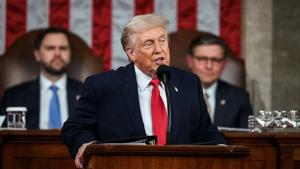
The Trump administration signaled a possible climb in some U.S. tariffs above 10%, but provided few specifics.
Jamieson Greer, the U.S. trade representative, said Wednesday that the 10% tariff on imported goods was likely to increase.
“Right now, we have the 10% tariff. It’ll go up to 15% for some and then it may go higher for others, and I think it will be in line with the types of tariffs we’ve been seeing,” Greer said on Fox Business’ “Mornings with Maria.”
Trump first announced a 10% global tariff hours after the Supreme Court struck down his tariffs under a 1977 law last week. The next day, he said he would raise that global rate to 15%.
The 10% global tariff Trump signed on Friday went into effect at 12:01 a.m. Tuesday. A bulletin from U.S. Customs and Border Protection said that Trump’s executive order imposed an additional 10% ad valorem duty. The duty applies to imported articles of every country for 150 days under Section 122 of the Trade Act of 1974, with exceptions.
Before the Supreme Court’s ruling on Friday, the United Kingdom paid the lowest import duties at 10%. Most other nations faced higher rates, including the European Union, Japan, Indonesia and others.
Greer told Bloomberg TV that the White House was preparing to raise the temporary tariffs to 15% “where appropriate.”
Kevin Hassett, director of the National Economic Council of the United States, told reporters that tariffs would remain a key part of Trump’s economic agenda, even after the ruling.
“The tariffs are not going back to zero,” he said. “That’s not going to happen.”
The Yale Budget Lab found that consumers faced an overall average effective tariff rate of 16% before the Supreme Court ruling. After the ruling, it fell to 9.1%, then climbed back to 13.7% when Trump imposed Section 122 tariffs. The Yale Budget Lab also estimated that the Section 122 tariffs would mean a loss of between $600 and $800 for the average U.S. household.
The Supreme Court, split 6-3, ruled that the International Emergency Economic Powers Act didn’t give Trump expansive tariff powers. Justices Clarence Thomas, Brett Kavanaugh and Samuel Alito dissented.
“The Framers gave ‘Congress alone’ the power to impose tariffs during peacetime,” Chief Justice John Roberts wrote for the majority.
Clintons to face questions from lawmakers this week over Epstein ties
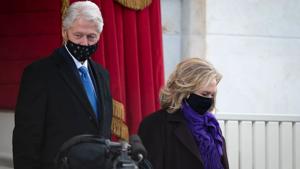
After six months of stalling, former Secretary of State Hillary Clinton and her husband, former President Bill Clinton, will appear before lawmakers for their depositions.
The former first lady will appear before the House Oversight Committee on Thursday, while the former president will do so Friday.
The committee had subpoenaed the couple last August to testify about their connections with convicted sex-trafficker Jeffrey Epstein and his close associate Ghislaine Maxwell.
Bill Clinton had flown on Epstein’s private plane four separate times in 2002 and 2003, on one flight pictured receiving a massage from one of Epstein’s victims.
He also attended a dinner with Maxwell – whom he allegedly was close with – in 2014, three years after reports surfaced of her involvement in Epstein’s child abuse activities, according to the subpoenas.
The committee subpoenaed Hillary Clinton in part due to her hiring Maxwell’s nephew to work for her 2008 presidential campaign and later hiring him to work in her department when she served as secretary of State.
Though originally scheduled to appear in October, their depositions were postponed to December, and then January, after urging by the Clintons’ lawyer. Both Clintons failed to show up to their depositions and only agreed to the February depositions after the committee voted to hold them in contempt of Congress.
The couple has not been formally accused or charged with wrongdoing and are some of the many high-profile figures who had associated with the now-deceased Epstein. President Donald Trump, billionaire Bill Gates, ex-Prince Andrew Mountbatten-Windsor, former CEO of Victoria’s Secret Lex Wexner, and dozens of others
Epstein was found dead in his jail cell while awaiting trial in 2019, while Maxwell is serving a 20-year prison sentence.
The Clinton’s depositions are part of an ongoing investigation by the committee into Epstein’s connections. Maxwell appeared before lawmakers in a virtual deposition Feb. 9, but refused to answer any questions, indicating that she would continue to plead the Fifth unless granted clemency by Trump.
Wexner faced the committee Feb. 18, where lawmakers learned little except receiving Wexner’s confirmation that he authored the letter signed in his name within Epstein’s “birthday book”.
Wexner denied having any knowledge of Epstein’s crimes throughout their entire relationship that spanned nearly two decades, saying his financial advisor – whom he had given full power of attorney to and had called previously “a loyal friend” – had duped him.
Epstein’s accountant Richard Kahn, and then Epstein’s legal advisor Darren Indyke, will also be deposed sometime in March. The committee has not announced yet whether it will subpoena anyone else, though Democrats have called for Trump to answer questions as well.
Supreme Court blocks ICE contractor immunity appeal

The U.S. Supreme Court, in a unanimous decision, ruled that prison contractors cannot immediately appeal a trial court’s decision, despite several claims to federal immunity.
The case, Geo Group Inc. v. Menocal, focused on a prison in Colorado that contracted with U.S. Immigration and Customs Enforcement. An individual detained at the prison sued over policies that required him to complete labor while detained without little or no pay.
The prison contractor sought to dismiss the claims, under the presumption that ICE allowed it to implement its forced labor policies. However, a lower court judge denied that presumption. The prison group cited a 1940 decision that extended liability protections to federal contractors the government authorized.
The prison sought to immediately appeal the lower court’s decision but was rejected. Justices on the high court upheld that rejection and tailored immunity for federal contractor lawsuits to be more specific.
“But the right to a finding of non-liability stands on a different footing: It can be effectively vindicated after a trial has occurred, through the reversal of an adverse final judgment,” Justice Elena Kagan wrote. “And so the denial of a merits defense is generally appealable only once trial-court proceedings have ended.”
Justices on the court emphasized that the government itself maintains sovereign immunity but that does not necessarily extend to federal contractors.
Justices Clarence Thomas and Samuel Alito filed concurring opinions of Kagan’s judgement. However the justices differed in their explanations.
Alito argued that federal contractors should have the right to immediately appeal a defense the bring up certain constitutional or public policy concerns.
“This rule holds true even if the defense at issue turns on the legality of the defendant’s conduct,” Alito wrote.
The case will now go forward to be litigated further in lower courts. Further litigation of the case could end will a large liability for the prison group.
Report: Patchwork state food laws could raise grocery prices 12% nationwide

Differing state laws banning certain food ingredients or requiring new warning labels could raise grocery prices by about 12% in affected states and, potentially, nationwide if similar proposals spread, a new economic analysis warns.
Americans for Ingredient Transparency commissioned the report, and Policy Navigation Group conducted the analysis. The study examined laws passed in Louisiana, Texas and West Virginia. It concluded that such measures would increase grocery costs in those states by a combined $12.2 billion annually compared to a uniform federal framework. The analysis also warns that regional distribution networks could increase costs in neighboring states.
“If these laws are enacted, consumers across the country could face at least a 12 percent increase in annual grocery costs in the coming years,” the study states.
Lawmakers in dozens of states have advanced bills to ban specific food ingredients or require new labeling for products the federal government already regulates. The debate has raised questions about federal preemption and whether Congress should establish a national standard instead of allowing states to impose separate rules.
Differing state ingredient laws force manufacturers and distributors to adjust packaging, sourcing and compliance systems, and companies pass those costs on to consumers, the report argues. Laws in Louisiana, Texas, and West Virginia “will create an effective tax increase of 12% on groceries for their states with significant spillover effects in some neighboring states,” the analysis concludes.
In Louisiana, for example, a new law will require manufacturers to place a QR code on products containing any of 44 specific artificial ingredients, dyes or additives beginning Jan. 1, 2028. Texas passed a law last year that will require warning labels on packaging of products containing similar artificial ingredients by Jan. 1, 2027. West Virginia’s law seeks to ban seven artificial food dyes and two preservatives.
Nearly 1 million consumers in neighboring states, including New Mexico, Oklahoma and Arkansas, could face higher grocery prices due to regional supply chains, the report found.
If other states adopt similar legislation, a “50-state regulatory patchwork” would drive comparable price increases nationwide, the study warns.
Americans for Ingredient Transparency is urging Congress to create a single national standard governing ingredient safety and disclosure requirements.
“At a time when President Trump is delivering on his promise to make life more affordable for American families, the proposed patchwork of conflicting state ingredient laws threatens to undo that progress with an effective tax increase of 12% on groceries nationwide,” Andy Koenig, senior advisor to AFIT, said in a press release. “The only way to prevent this massive cost hike is for Congress to take the lead on the issue instead of the states and pass a uniform national standard for ingredient safety and transparency that keeps food affordable.”
The study marks the first attempt to estimate consumer cost increases tied to the recent surge in state ingredient regulation bills introduced in 2025 and 2026.
A survey of registered voters in 28 competitive House districts found that 87% believe ingredient regulation and labeling should operate under a national standard rather than a state-by-state system, AFIT said.
Policy Navigation Group, a Virginia-based consulting firm whose analysts previously worked at the Office of Management and Budget, said it followed federal analytic standards when conducting the economic evaluation.
Congress has not advanced legislation establishing a national framework, though AFIT said federal officials have put a national food standard “on the table for discussion.”
Trump calls out Minnesota in State of the Union, prompting Democrat protests

Minnesota Democrats faced off against President Donald Trump during his State of the Union address Tuesday night.
Throughout the nearly two-hour speech, Democrats like U.S. Rep. Ilhan Omar, D-Minnesota, repeatedly heckled the president.
An immigrant from Somalia herself, Omar specifically reacted to Trump’s comments about Somali immigration and accusations of widespread fraud.
“When it comes to the corruption that is plundering America, there has been no more stunning example than Minnesota – where members of the Somali community have pillaged an estimated $19 billion from the American taxpayer,” Trump said.
“The Somali pirates who ransack Minnesota remind us that there are large parts of the world where bribery, corruption and lawlessness are the norm, not the exception,” he added. “Importing these cultures through unrestricted immigration and open borders brings those problems right here to the USA.”
Omar could be heard yelling “liar” at Trump during those comments. At other times, she shouted “you have killed Americans” and “you should be ashamed.” She joined a few other Democrats in eventually walking out of the speech before it was finished.
During the speech, Trump announced he was charging Vice President J.D. Vance with leading a “war on fraud.” He referred specifically to fraud in Minnesota, which he said was “the kind of corruption that shreds the fabric of a nation.”
In another notable showdown, Trump directly called out Democrats on immigration.
He asked, “If you agree with this statement, then stand up and show your support: The first duty of the American government is to protect American citizens, not illegal aliens.”
In response to that, every Minnesota Democrat in attendance at the State of the Union refused to stand during the minute-long ovation. That included U.S. Sen. Amy Klobuchar, who is running for governor of Minnesota, as well as Omar and her fellow U.S. Reps. from Minnesota Angie Craig, Kelly Morrison and Betty McCollum.
U.S. Sen. Tina Smith, D-Minnesota, joined the dozens of Democrat lawmakers who boycotted the president’s address.
State of the Union highlighted political fracture between Democrats, Trump
The State of the Union proved to be anything but unifying between President Donald Trump and Democrats, with many Democrats making their disdain for the president clear.
Over 70 congressional Democrats boycotted the address, while many in the chamber defiantly protested the president.
Trump at times called out Democrats for failing to applaud or stand for parts of his speech. The most notable moment of the evening was when the president called on members of Congress to stand in support of American citizens.
“I’m inviting every legislator to join with my administration and reaffirm a fundamental principle. If you agree with this statement and stand up and show your support. The first duty of the American government is to protect American citizens, not illegal aliens,” said the president.
As the camera spanned over the gallery, the Democratic side sat stoically, while Republicans stood and applauded for an extended period.
The president used the moment to chastise Democrats, telling them that they should be “ashamed of themselves.”
The moment spurred a strong reaction from U.S. Rep. Ilhan Omar, D-Minn., shouting in response that the president should be “ashamed.” She then accused the president of “murdering” American citizens.
Sitting next to Omar, joining in shouting was fellow squad member Rep. Rashida Tlaib, D-Mich., who chose to wear a “F— ICE” pin.
Despite Omar and Tlaib’s shouting, it was Rep. Al Green, D-Texas, who was removed from the chamber after holding up a sign, marking the second year in a row he was ejected from the House floor during Trump’s State of the Union.
Meanwhile, a group of Democrats who skipped the address instead attended the “People’s State of the Union” hosted by the progressive group MoveOn.
The White House was quick to pounce on Democrats’ protest to the president’s address, releasing a list of portions of the president’s speech when a majority of Democrats failed to applaud.
Following the president’s speech, Democrats gave two formal rebuttals delivered by Virginia Democratic Gov. Abigail Spanberger and Sen. Alex Padilla, D-Calif. Spanberger focused on affordability, while Padilla, who delivered his speech in Spanish, focused on Trump’s immigration laws, warning that the president was using immigration officials to “manipulate” the midterm elections.
The president is scheduled to travel to Corpus Cristi, Texas, Friday, his first speech since his State of the Union address.
Trump moves ahead with tariff plans after Supreme Court ruling
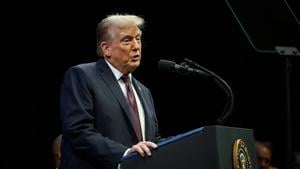
After the U.S. Supreme Court ruled his tariffs illegal, President Donald Trump vowed to rebuild the protectionist measures and restore some of the highest import duties in nearly a century, using different laws.
The president said he would use alternative laws to reinstate the import duties and maintain previously negotiated trade deals.
“Almost all countries and corporations want to keep the deal that they already made … knowing that the legal power that I, as president, have to make a new deal could be far worse for them, and, therefore, they will continue to work along the same successful path that we had negotiated before the Supreme Court’s unfortunate involvement,” Trump said during his address to Congress on Tuesday.
The largest of those trade deals was with the 27-nation European Union, which said earlier this week it was freezing plans to finalize the pact after the Supreme Court ruling.
Trump said the alternative laws for tariffs are more complex but may be better.
He further stressed that he didn’t need congressional approval for his new tariff regime.
“Congressional action will not be necessary,” he said.
Trump repeated his claim that foreign nations would pay the tariffs, despite economic research indicating Americans bear the cost.
“As time goes by, I believe the tariffs, paid for by foreign countries, will, like in the past, substantially replace the modern-day system of income tax, taking a great financial burden off the people that I love,” he said.
Trump previously promised that tariff revenue would cover $2,000 rebate checks, increased military spending, debt reduction, and other economic goals. But experts say tariff revenue won’t generate enough funds for any of those plans. The new 150-day tariff plan could also face challenges, especially if Congress gets involved.
After the Supreme Court ruled that the president’s tariffs under a 1977 law were illegal, Trump announced a 10% global tariff just hours later on Friday. The following day, Saturday, he posted on social media that he would raise the global rate to 15%.
Despite announcing a future increase, the 10% global tariff signed by Trump on Friday took effect at 12:01 a.m. Tuesday. The Center Square reached out to the White House to clarify when the announced 15% global tariff would be implemented, but did not receive an immediate response.
A bulletin from U.S. Customs and Border Protection said Tuesday that Trump’s latest executive order imposed an additional 10% ad valorem duty. The duty applies to imported articles of every country for 150 days under Section 122 of the Trade Act of 1974.
The Supreme Court, divided 6-3, ruled that the International Emergency Economic Powers Act didn’t give Trump expansive tariff powers. Justices Clarence Thomas, Brett Kavanaugh and Samuel Alito dissented.
“The Framers gave ‘Congress alone’ the power to impose tariffs during peacetime,” Chief Justice John Roberts wrote for the majority.
The Yale Budget Lab estimated Section 122 tariffs could cost the average U.S. household $600 to $800.
Trump to award Medal of Freedom to Michigan native, Olympic goalie Connor Hellebuyck
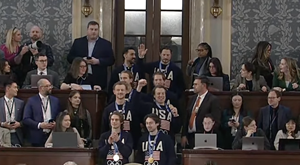
President Donald Trump announced during the State of the Union on Tuesday night that he will award the nation’s highest civilian honor to Michigan native Connor Hellebuyck, the Team USA men’s hockey goaltender who helped lead the United States to Olympic gold.
Hellebuyck recorded 41 saves in Sunday’s gold medal game against Canada, prompting the president to praise his athleticism. He will join decorated athletes such as Tiger Woods, Michael Jordan and Muhammad Ali as recipients of the Presidential Medal of Freedom.
Team USA attended the State of the Union and received a standing ovation. During his remarks, the president recounted a conversation he said he had with Hellebuyck after the victory.
“I asked him, ‘The one shot – the one where you put your stick in the back and it hit the neck of your stick and bounced off – do you practice that or was that a little lucky?’ He refused to answer that question,” Trump joked.
The team – which included several Michigan natives – captured the nation’s first Olympic hockey gold medal since the 1980 “Miracle on Ice” victory over the Soviet Union. It marks just the third time the U.S. men’s hockey team has won gold.
Trump said he looks forward to honoring Hellebuyck with the Presidential Medal of Freedom, with the support of his teammates.
“The members of this great hockey squad will be very happy to hear that I will soon be presenting Connor with our highest civilian honor, which has been given to many athletes over the years,” the president said. “Great athletes have gotten that, and I thought he deserved it. What a special job you did and what special champions you are.”
Republican candidates for governor — minus Bailey — try to distance themselves
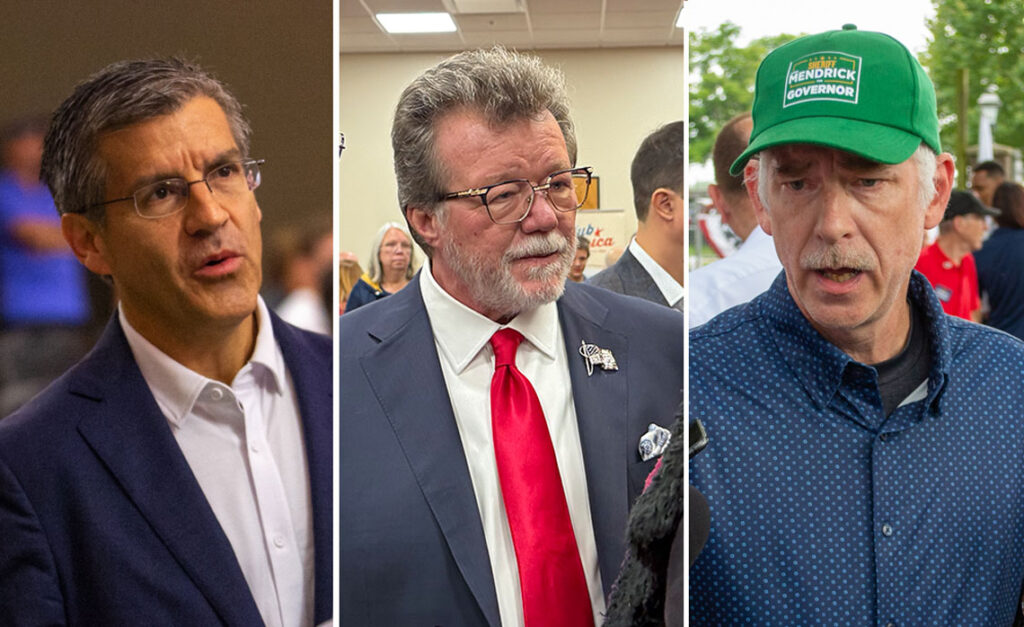
Candidates answered questions about their campaign donors and what lawmakers should do to keep the Bears in Illinois
Read MoreSupreme Court appears skeptical of Michigan family’s foreclosure case

The U.S. Supreme Court appeared skeptical on Wednesday of a Michigan family’s challenge to the foreclosure of their home due to unpaid taxes.
Justices on the court heard arguments in Pung v. Isabella County, a case challenging the constitutional basis of tax foreclosures. The case centers on a judge’s determination that the Pung family owed a $2,200 tax bill to Isabella County, Michigan.
The Pung’s never paid the taxes on the home and the local government sold it in a foreclosure auction for $76,000. Lawyers for the family argued the sale price of the home indicated the government imposed an unconstitutional excessive fine on the family over the unpaid tax.
The Pung family’s lawyers said the government should have sold the house for its fair market value, which was later sold for $195,000.
Several justices on the court argued that the family should have paid the taxes to avoid the home’s foreclosure. Justice Ketanji Brown Jackson said it would be unfair to American taxpayers if the government had to pay the difference between sale of the home and its fair market value.
“It seems like real unfairness to the American people that we are paying you because you didn’t pay your taxes,” Jackson said.
The justices also argued that a house would not be sold for its fair market value in the circumstances of a tax foreclosure.
Justice Sonia Sotomayor flatly disagreed with the claim that just compensation under the Fifth Amendment requires property to be sold for fair market value. She argued that there is no prior judicial evidence that points to fair market value as a determining factor.
Justice Samuel Alito pointed out that the government was required to notify the family of their procedural steps to resolve the tax issue. Therefore, he said, it did not make sense as to why they didn’t pay. He also cautioned against the court imposing in tax law proceedings.
“If we set out all these sorts of rules for these tax sales, how many years or cases will it take to flesh out all of these details?” Alito asked.
While several justices appeared skeptical of the Pung’s claims, they also did not appear to fully support the government’s aggressive tax bill pursuit.
Justice Amy Coney Barrett questioned whether a property owner would be liable for foreclosure if they owed $100 debt in taxes. Lawyers for Isabella County, Michigan, argued that the equity of the house had gone down after it was bought.
“States have used the foreclosure process to recover unpaid and delinquent property taxes,” said Matthew Nelson, a lawyer for Isabella County.
The justices pointed out the apparent fair market value of the home based on its $194,000 sale to a private owner after the government foreclosed on the property.
Justice Neil Gorsuch contested the government’s claim that foreclosure of the house was an appropriate solution to recover property taxes.
“I’m just curious how an erroneously applied tax bill led to taking someone’s home for a third of what it’s worth,” Gorsuch said.
The case builds from Tyler v. Hennepin County, where the U.S. Supreme Court ruled unanimously against a Minnesota county for seizing a 94-year-old woman’s home due to her $15,000 tax debt. The county kept the $25,000 profit from the sale, in violation of the takings clause, according to the high court.
Philip Ellison, a lawyer for the Pung family, said they are disappointed to lose the house but hope to find justice in recovery of their assets.
“The Pung family is devastated by the loss of this family home and what they want is the justice that hopefully the takings clause [of the Fifth Amendment] guarantees,” Ellison said.
Justices on the court are expected to issue a decision in the case by July.