A city blanketed in fear: Accountability Commission hears shocking testimony about ICE
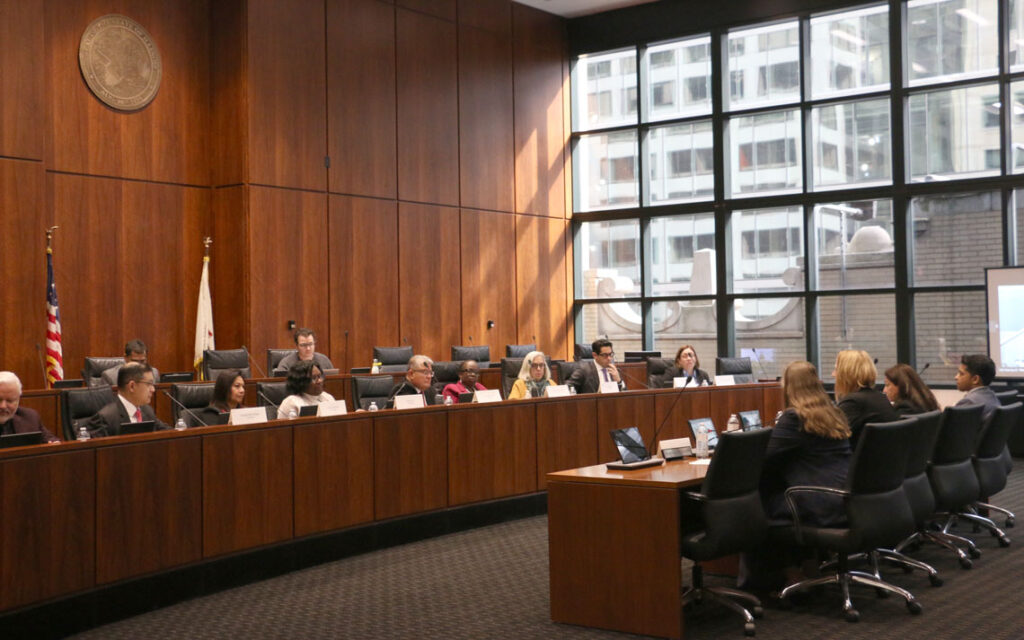
Commission hears of sweeping disruptions to daily life in the Chicago area caused by immigration raids.
Read MoreWATCH: Bill would suspend California gas tax for one year
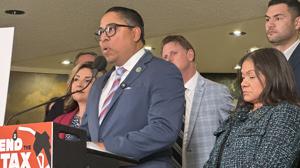
Editor’s note: This story has been updated to add a video.
California drivers and their wallets would get some relief at the pump if a new bill passes the state Legislature this year.
Assembly Bill 1745, introduced by Assemblymember Jeff Gonzalez, R-Indio, would suspend the state’s gas tax for one year. The tax currently sits at 61 cents a gallon, according to lawmakers with knowledge of the bill.
“Californians pay among the highest gas prices in the nation,” Gonzalez said Tuesday at a press conference announcing the bill.
“While families are tightening their belts, Sacramento continues to ask them for more,” he told reporters at the Capitol in Sacramento. “Parents should not have to choose between paying for gas or buying groceries.”
According to AAA, California had the highest gas prices in the country on Tuesday. The average price of a gallon of gas in California was $4.63 a gallon, followed closely by Hawaii at $4.40 a gallon, Washington state at $4.35, Oregon at $3.91, Nevada at $3.70, Arizona at $3.25, Pennsylvania at $3.13 and Vermont at $3.
The lowest gas prices in the country on Tuesday were in Oklahoma, where the average price of gas was $2.37 a gallon, according to AAA’s fuel prices tracker. The national average price was $2.95.
“High gas taxes, rising fees and decisions from the politicians who control the capital are making it harder for working families to make ends meet,” said Assemblymember Leticia Castillo, R-Corona, during the press conference. “This bill is a simple common-sense solution. It would temporarily suspend the gas tax and put real money back into your pockets when you need it the most.”
The effort to temporarily lift the gas tax in California follows a bill introduced by Assemblymember Lori Wilson, D-Suisun City and chair of the Assembly Transportation Committee, that would study the impact and feasibility of imposing a per-mile road user charge on California’s drivers. Assembly Bill 1421 was introduced in response to fears of declining gas tax revenue as more California drivers buy electric cars – eliminating the need to fill up a vehicle’s tank.
The gas tax pays for the state’s roads and highway system, according to previous reporting by The Center Square. An elimination of that tax, even temporarily, would create a funding gap for the state’s roads that Republican lawmakers on Tuesday said they want to backfill with general fund money.
“By pausing this gas tax, we need to make sure that we replace it from the general,” Gonzalez said in response to a Center Square question after the press conference on Tuesday. “It has to be replaced. We’re doing this on the backs of Californians. We need to find a place to get it from and we can get it from the general [fund].”
Data from the Tax Foundation shows that California has the highest gas taxes in the country, at 70.92 cents a gallon. Illinois has the second-highest gas taxes in the country, at 66.4 cents per gallon, followed by 59.04 cents per gallon in Washington state and 58.7 per gallon in Pennsylvania.
Alaska has the lowest gas taxes in the country – 8.95 cents per gallon.
Suspending the tax has support from associations that represent gas marketers in California, who said on Tuesday that the gas tax adds to the strain for many of the state’s families.
“For families commuting to work, getting kids to school or traveling long distances in rural communities, every cent matters,” said Elizabeth Graham, CEO of California Fuels & Convenience Alliance at the press conference. “Suspending the gas tax would provide immediate, visible relief at the pump. When consumers keep more of their own money, that supports other local businesses and strengthens our communities.”
Democrats again tank bill to reopen DHS
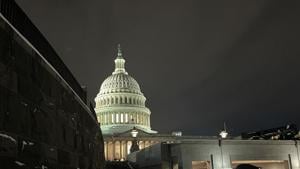
The U.S. Senate failed Tuesday night to advance the Homeland Security 2026 appropriations bill that would have ended the partial government shutdown.
“Republicans want to get to an agreement on Homeland Security funding. So does the White House. And we’ve acted in good faith throughout these negotiations,” Senate Majority Leader John Thune, R-S.D., said prior to the vote. “Are Democrats actually interested in a solution here, or are they just interested in a political issue?”
But 11 days since the Department of Homeland Security ran out of funds, Democrats are still refusing to provide the money unless Republicans agree to overhaul Immigrations and Customs Enforcement.
Calls for greater accountability in DHS erupted after an ICE agent fatally shot 37-year-old Alex Pretti in January, the second killing during that month of a U.S. citizen protesting in Minneapolis.
Democrats’ policy demands include prohibiting DHS agents from wearing masks, racially profiling, indiscriminately arresting people, tracking protestors, or entering private property without a judicial warrant in addition to an immigration court warrant.
Other changes Democrats want to see include requiring agents to display ID, wear body cameras, and obtain the consent of states and localities to conduct large-scale operations, among other things.
The Trump administration has already agreed to some of the demands, such as requiring body-worn cameras and ending roving patrols.
But it has thrown cold water on most of the other measures, arguing that personal ID requirements would endanger agents and that requiring judicial warrants or making “sensitive” locations off-limits would handicap the agency’s ability to do its job.
This is the second time in less than six months that Democrats have forced a shutdown over policy demands, with the most recent lasting a record-long 43 days.
With no federal funding, DHS employees deemed “essential” – including TSA agents and most members of FEMA, the Coast Guard, and the Secret Service – must work without pay during a shutdown, while the rest are furloughed.
While those agencies haven’t closed, they have ceased nonessential operations. ICE, however, has felt no impact by the lapse in DHS funding.
The agency is already funded for the rest of the Trump administration regardless of annual appropriations, due to a $75 billion boost from Republicans’ budget reconciliation bill.
WATCH: Democrats sue feds over childhood vaccine overhaul

Editor’s note: This story was updated Tuesday night to add a comment from the U.S. Department of Health and Human Services.
The attorneys general of California and Arizona on Tuesday announced Democrats’ multi-state lawsuit to block the Trump administration’s overhaul of the childhood vaccine schedule.
Democratic officials are calling the federal action unlawful.
Arizona Attorney General Kris Mayes said the suit names the U.S. Department of Health and Human Services and the Centers for Disease Control and Prevention as defendants.
The suit goes after “HHS Secretary Robert F. Kennedy Jr. and the CDC over their needless, confusing, scientifically unfound and unlawful revision of America’s immunization schedule,” said Mayes during a virtual press conference with California Attorney General Rob Bonta.
“Let me be clear about what happened here,” Mayes told reporters. “In January, an acting CDC director with no medical or scientific background signed off on a so-called decision memo that stripped seven critical vaccines of their recommended routine vaccination status in favor of an unwarranted shared clinical decision-making recommendation that is confusing for parents and providers alike and difficult for providers to implement.”
Jim O’Neill was made acting CDC director after the August firing of Susan Monarez.
O’Neill’s “Decision Memo” was announced Jan. 5. This followed a Dec. 5 memo from President Donald Trump that directed the leaders of HHS and CDC to review how other developed nations structure their childhood vaccination schedules and consider “the scientific evidence underlying those practices.” According to HHS, the leaders of the National Institutes of Health, the Food and Drug Administration, and Centers for Medicare and Medicaid Services consulted with health ministries of peer nations, considered findings and later directed the CDC to move forward with implementation.
“The data support a more focused schedule that protects children from the most serious infectious diseases while improving clarity, adherence and public confidence,” said O’Neill in a January press release.
O’Neill has since been replaced by NIH Director Jay Bhattacharya.
In January, the CDC said it would continue to organize the childhood immunization schedule in three categories: recommended immunizations for all children, recommended immunizations for certain high-risk groups or populations, and immunizations based on shared clinical decision making.
The first category included shots for chickenpox, diphtheria, Haemophilus influenzae type B, human papillomavirus, measles, mumps, rubella, polio, pertussis, pneumococcal disease and tetanus.
Gone are recommendations for vaccines for the flu, hepatitis A and B, rotavirus, and RSV (respiratory syncytial virus).
Bonta said he was proud to be part of this lawsuit, adding that it’s California’s 59th suit against the Trump administration.
“HHS Secretary RFK Jr. and his CDC are flouting decades of scientific research, ignoring credible medical experts and threatening to strain state resources and make America’s children sicker,” said Bonta. “Their actions have been unconscionable, illogical and illegal.”
Examples offered by Bonta include Kennedy “blowing past appointment requirements” for the Advisory Committee on Immunization Practices, including that it be fairly balanced, and instead appointing “several anti-vaccine advocates and people without clear credentials” in immunization science.
The lawsuit is filed in the U.S. District Court for the Northern District of California.
The Center Square Tuesday contacted HHS, where spokesperson Richard Danker called the lawsuit a “publicity stunt.”
“By law, the health secretary has clear authority to make determinations on the CDC immunization schedule and the composition of the Advisory Committee on Immunization Practices,” said Danker, the assistant secretary for public affairs.
“The CDC immunization schedule reforms reflect common-sense public health policy shared by peer, developed countries,” Danker said, answering The Center Square’s question in an email Tuesday evening.
Earlier, HHS referred The Center Square to a previous statement that said the updated CDC childhood schedule “continues to protect children against serious diseases while aligning U.S. guidance with international norms.” HHS also claimed that many peer nations achieve high vaccination rates without mandates by relying on trust, education and strong doctor-patient relationships.
“HHS will work with states and clinicians to ensure families have clear, accurate information to make their own informed decisions,” said HHS.
With parties on both sides of the lawsuit pointing the finger at one another, The Center Square asked the Arizona Attorney General’s Office what people are supposed to think.
Richie Taylor, Mayes’ spokesperson, said the recommendations being defended in this lawsuit are the product of decades of rigorous scientific research and peer review by thousands of independent experts.
“The public should trust the same evidence-based processes that eliminated polio, controlled measles until recently, and has protected public health for generations,” Taylor told The Center Square Tuesday. “The measles outbreaks now occurring across the country are an example of what happens when science is dismissed.”
In addition to those from California and Arizona, attorney generals involved in this lawsuit are Democrats from Colorado, Connecticut, Delaware, Maine, Maryland, Michigan, Minnesota, New Jersey, New Mexico, Oregon, Rhode Island and Wisconsin. Democratic Gov. Josh Shapiro of Pennsylvania is also participating.
Nearly two dozen of largest federal agencies shed over 278,000 workers in 2025

As a result of a concerted effort by the second Trump administration to reduce the size of the civilian federal workforce, the total staff of 23 of the largest executive-branch agencies shrunk by roughly 3% in the first half of 2025, with 144,000 additional jobs cut by year’s end.
The numbers come from a newly released report from the Government Accountability Office, which was tasked with tracking staffing changes across 24 federal agencies in the first half of last year. One agency did not provide the requested data, so data from 23 agencies is included in the report.
The president issued several executive orders in the first few months of 2025 directing much of the executive branch to trim its workforce, as well as a memorandum that put a hiring freeze on federal civilian employees. (The memorandum did include exemptions for the military, immigration enforcement, national security and public safety positions.)
Despite several ongoing lawsuits challenging the reduction in force, altogether, the 23 agencies shrunk by a total of more than 134,000 employees, or about 6% of their total workforce from January through June of 2025. However, during that same time period, those agencies brought on nearly 66,000 new hires, or roughly 3%, for a total reduction of about 3%. As of June, according to the office, the federal government still employed more than 2.2 million people.
The office did not provide hiring data for the second half of 2025, but it noted that agencies reported that another 144,000 federal employees left by the end of the year through the deferred resignation program put in place by the Office of Personnel Management.
Of the more than 134,000 that left by June, the vast majority (77%) retired or resigned, according to the report. The program offered many federal employees the option of taking paid administrative leave if they agreed to resign by the end of September 2025 or retire by the end of the year. Another nearly 20% were terminated or removed, and “less than 1% were separated through a reduction in force during this period,” according to the report.
The Department of Education shed the greatest number of employees as a percentage of its workforce, not accounting for new hires, with 813 separations (terminations, resignations or retirements), or nearly 21%, occurring from January to June 2025. The U.S. Agency for International Development was next, losing 749 employees, or 16.6% of its staff, during that same time period. The Department of Commerce, the Office of Personnel Management, the National Science Foundation and the Department of Health and Human Services followed, with reductions from 11-16%.
The National Aeronautics and Space Administration and the Department of Defense lost the least staff as a percent of their total workforce – the only two agencies that saw separations of less than 5%. Both hired half or nearly half of that during that time, to finish with 2.5-2.7% less employees total.
The Department of the Interior was the only agency that grew during the first half of 2025. It lost about 5.6% of its workforce through separations, or 3,808 people, but it hired nearly 11% back, concluding June with more than 68,500 employees.
The Department of Homeland Security came closest to regaining the workforce it lost, shedding over 11,400 employees but hiring over 10,200 during that same time period.
The Small Business Administration did not provide the requested data to the GAO, so its workforce data was not included in the report.
The director of the Office of Personnel Management said in November that approximately 317,000 people left the federal workforce last year.
Reuters reported in January that the federal workforce is the smallest it has been in “at least a decade”.
INSIDERS ONLY: A Tuesday update on the Bears stadium bill
Pritzker spoke positively about momentum, though Springfield took no action on a Bears bill.
Read MoreInvestigation: Wisconsin’s DPI took uncommon approach with Dells conference
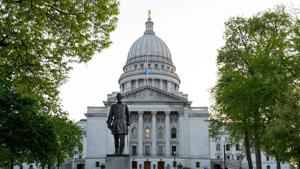
Wisconsin’s K-12 education leadership group said that its $368,000 standards-setting meeting in 2024 at a waterpark in the Wisconsin Dells was a “common approach” for state educational leaders across the country and in the two dozen other states that work with Data Recognition Corp. for testing.
But an investigation from The Center Square on standards-setting meetings and processes across the country showed that, while some other states that work with the company do hold in-person meetings, those meetings are all in capital cities with only participants who travel more than 50 miles to the conference utilizing overnight stays.
The Wisconsin Department of Public Instruction’s meeting in the Wisconsin Dells, however, meant that DPI staff also stayed at the water park, according to documents obtained by the Dairyland Sentinel through public records requests.
Some other states, such as Ohio and Minnesota, hold meetings remotely while neighboring Illinois does not work with Data Recognition Corp. but did its standards setting process in a mainly remote fashion as well.
Other states, such as Tennessee, hold smaller committee meetings such as the state’s standards review committees that will meet in Chattanooga this summer. Others hold regional small committee meetings.
But none matches up to meetings like DPI held at Chula Vista Resort.
DPI spokesperson Chris Bucher did not respond to questions from The Center Square asking for further details after he told other media outlets that the location was aimed at supporting Wisconsin tourism and stating the Wisconsin Dells meeting was a “common approach.”
Bucher said the company does testing in two dozen states.
A spokesperson for Data Recognition Corp. also did not respond to a request for comment from The Center Square on how it operates.
Data Recognition Corp., led by former Republican Wisconsin Senate Minority Leader Susan Engeleiter, reportedly signed a nearly $80 million 10-year contract with Wisconsin to operate its testing and create the Forward Exam after initially bidding $63 million on the contract.
The Wisconsin Democracy Campaign questioned Engeleiter’s donations to Wisconsin Gov. Scott Walker when the deal was signed. Gov. Tony Evers was the state school superintendent at the time.
Dairyland Sentinel and the Institute for Reforming Government are working together to fight for DPI to release a copy of a signed contract between DPI and Data Recognition Corp.
Questions regarding spending on the conference recently led Wisconsin’s Joint Committee on Finance to delay $1 million in a funding request to DPI.
“We just want to have the opportunity to at least review what’s going on there with this questionable use of funds,” Joint Finance Committee co-chair Mark Born said. “We just want to hit pause on that.”
IRG’s General Counsel and Director of its Center for Investigative Oversight Jake Curtis told The Center Square that, while the conference spending raised eyebrows and drew headlines, he believes the 88-member standards-setting group filled with school employees and leaders fits the exact definition of an Ad Hoc Committee and that meetings of that committee should be public and not subject to the non-disclosure agreements signed by conference attendees.
“In Wisconsin, we have very robust open meetings laws, public records laws and we have a strong sunshine set of laws in Wisconsin,” Curtis told The Center Square. “What the Department of Public Instruction did here was pretty obvious, just did not want the scrutiny from the public. And that’s frankly why it’s such a problem for DPI.”
Arguments heard in Louisiana v FDA over mail-in abortion drugs
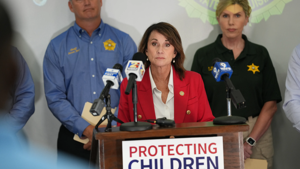
A federal judge in Louisiana heard arguments on Tuesday challenging a mail-order abortion drug rule, finalized in 2023 by President Joe Biden’s Food and Drug Administration.
Louisiana Attorney General Liz Murrill and plaintiff Rosalie Markezich, filed a lawsuit against the FDA for removing the rule that ensured women receive an in-person office visit before taking abortion drugs, including mifepristone.
“If the Biden FDA had not removed in-person dispensing, my then-boyfriend would not have been able to obtain abortion drugs and pressure me to take them against my will,” Markezich told Alliance Defending Freedom.
According to Murrill, Markezich was one of many women whose boyfriends or family members ordered abortion drugs from out of state and coerced or tricked them into taking them.
“Out-of-state abortion drug peddlers are violating the criminal laws of Louisiana and other states across the country that choose life,” Murrill told the Alliance Defending Freedom. “They aren’t providing healthcare; they’re drug dealers.”
In January, the U.S. Department of Justice asked the district court to halt the lawsuit, saying that Louisiana’s case lacked standing since Markenzich was not actively suffering immediate harm. With 60 members of Congress and 21 attorneys general in support of Louisiana’s lawsuit, the court hearing proceeded in Lafayette, Louisiana, on Tuesday.
Those in support of the FDA rule cited the Supreme Court decision that overturned the right to abortion provided by Roe v. Wade. Danco Laboratories, which is a New York distributor of mifepristone, was in support of the FDA rule.
“Making it a federal crime to mail drugs for lawful medical purposes contravenes nearly a century of precedent and all indicia of Congressional intent,” Danco Laboratories wrote. “It would also significantly interfere with states’ traditional power to enact their own ‘health and welfare laws.’”
Murrill argued that the FDA rule caused a contradiction with Louisiana’s strict abortion restrictions, allowing abortion drugs to be trafficked into the state from California and New York, endangering women.
“This is not about the mifepristone pill itself; it’s about the removal of in-person dispensing requirements that the Biden administration effectuated by rule during [the COVID-19 public health emergency],” Murrill said at a news conference Tuesday. “The in-person dispensing requirement protects women, and it protects babies, and there’s absolutely no reason why the FDA should have ever removed that requirement.”
Louisiana is not the only state challenging either the approval of mifepristone or subsequent actions easing the restrictions for mailing abortion pills. Missouri, Idaho, Kansas, Florida and Texas have challenged the ease of restrictions.
“They were seeking the same relief. And so it wasn’t until that litigation started to run into obstacles in its ability to proceed that we decided we needed to go ahead and proceed,” Murrill said.
Trump’s FDA has been hesitant to further restrictions on abortion drugs and other abortion-related measures, despite Murrill’s belief that they would reinstate the in-person dispensing requirement.
“Unfortunately they have not done it quickly, and I think that that should change,” Murrill said.
“We will continue to pursue enforcement of our laws, both civilly and criminally, against anybody who has facilitated the distribution of these drugs for the purposes of causing an abortion,” Murrill said. “It is a violation of our criminal laws, and we will pursue them and hold everyone accountable.”
Motion to disqualify prosecutors in Robinson’s trial is denied

A judge Tuesday rejected defense lawyers’ motion to disqualify the Utah County Attorney’s Office as the prosecution team in the case of Tyler James Robinson, charged with the murder of conservative leader Charlie Kirk.
The attorneys did not show that a significant risk to Robinson’s constitutional right to due process was posed by prosecutor Chad Grunander’s adult daughter being at the Utah Valley University rally where Kirk was shot and killed on Sept. 10, Judge Tony Graf Jr. ruled at the Fourth Judicial District Court in Provo, Utah. Kirk was a Scottsdale, Ariz. resident who cofounded Phoenix-based Turning Point USA and was speaking at the rally where he was killed.
“Defendant has not shown prosecution by the Utah County Attorney’s Office is tainted,” Graf said during the virtual hearing.
“The court is unpersuaded that Mr. Grunander’s relationship creates bias,” Graf said, ruling from his courtroom.
Attorneys representing prosecution, defense and media participated in the hearing from their offices. Robinson participated by audio only from the Utah County Jail and spoke only one time, to confirm to Graf that he could hear everyone.
Graf said Grunander’s daughter’s presence did not influence Utah County Attorney Jeff Gray’s decision to seek the death penalty if Robinson is convicted of aggravated murder. The judge also noted the ultimate decision to file charges against Robinson was made by Gray, not Grunander, who is the chief deputy in Gray’s office.
Graf added the Utah County Attorney’s Office has not called the daughter as a witness for the prosecution.
The judge also cited various unrelated cases to show where there was prosecutorial bias and said those conditions did not exist in the Robinson case.
After announcing his ruling, Graf spent the rest of the hearing consulting with attorneys about court dates for the next hearings. The judge ultimately set a three-hour hearing for March 13 and an all-day hearing for April 17. Both hearings are scheduled to start at 10 a.m. Mountain Standard Time.
Robinson, 22, is charged with seven counts, six of which are felonies. They include aggravated murder and multiple counts of witness tampering and obstruction of justice.
FedEx joins companies seeking tariff refunds as litigation looms

FedEx joined the growing list of companies seeking tariff refunds as confusion over President Donald Trump’s latest tariffs continues and the refund process begins.
The Tennessee-based shipping giant asked the U.S. Court of International Trade in New York for a full refund, but didn’t disclose how much it paid in tariffs.
The Liberty Justice Center is a nonprofit law firm that challenged Trump’s reciprocal tariffs in April 2025. On Tuesday, the firm filed motions in the U.S. Court of Appeals for the Federal Circuit and the U.S. Court of International Trade to enforce the ruling and start the refund process.
In a motion before the U.S. Court of International Trade, the Liberty Justice Center asked for a refund of all unlawfully collected tariffs, with interest.
“All American businesses that have had to pay illegal, unjust and unconstitutional tariffs, but the fight isn’t over,” said Sara Albrecht, chairman of the Texas-based Liberty Justice Center. “Now we are asking the courts to ensure the government honors its commitments and refunds American businesses.”
Trump promised tariff certainty for U.S. businesses after the Supreme Court ruled the president’s tariffs under a 1977 law were illegal. He first announced a 10% global tariff hours after the decision. Trump is seeking to rebuild his tariff wall under alternative laws. The next day, on Saturday, he said in a social media post that he would raise that global rate to 15%.
Nonetheless, the 10% global tariff Trump signed on Friday went into effect at 12:01 a.m. Tuesday. The Center Square reached out to the White House for details on the timing of the announced 15% global tariff rate, but did not receive an immediate response.
A bulletin from U.S. Customs and Border Protection said Tuesday that Trump’s latest executive order imposed an additional 10% ad valorem duty. The duty applies to imported articles of every country for 150 days under Section 122 of the Trade Act of 1974.
FedEx filed suit seeking refunds of all tariffs paid under the International Emergency Economic Powers Act.
“While the Supreme Court did not address the issue of refunds, FedEx has taken necessary action to protect the company’s rights as an importer of record to seek duty refunds from U.S. Customs and Border Protection,” according to a note on the company’s website. “At this time, however, no refund process has been established by regulators or the courts.”
FedEx is the first major company to seek refunds after last week’s Supreme Court ruling. Thousands of companies filed suit before the ruling, including Costco, Revlon, Kawasaki, Bumble Bee and Yokohama Tire.
The Supreme Court, divided 6-3, ruled that the International Emergency Economic Powers Act didn’t give Trump expansive tariff powers. Justices Clarence Thomas, Brett Kavanaugh and Samuel Alito dissented.
“The Framers gave ‘Congress alone’ the power to impose tariffs during peacetime,” Chief Justice John Roberts wrote for the majority.
The Yale Budget Lab estimated that the Section 122 tariffs would mean a loss of between $600 and $800 for the average U.S. household.